
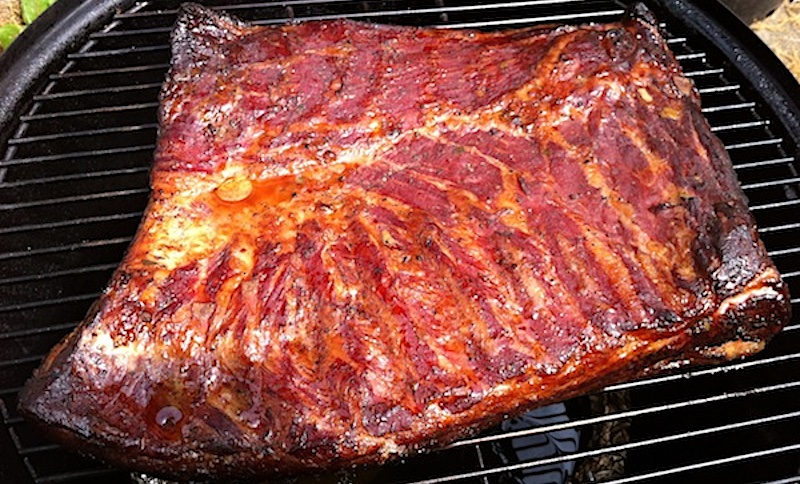
The Best Bacon in the World? Make It Yourself!
People who deny the facts of evolution completely puzzle me. Even putting aside the fossil record, DNA evidence and untold hours of programming on public television, do these people ever look around them? Stuff is changing all the time, for heaven's sake.
And I'm not even talking about the legendary example of the beaks of Darwin's finches on the Galapagos Islands, where "an immigrant first settled on one of the islands [and] it would undoubtedly be exposed to different conditions in the different islands (where) it would have to compete with a different set of organisms. ... Then, natural selection would probably favor different varieties in the different islands."
You don't have to look any further than this blog, which in geologic time has only existed for a millionth of a nanosecond, but it has evolved from a simple food blog with restaurant reviews, farmers’ market reports and recipes to a forum for discussion of issues about our food system, from the fields to our plates. And the recipes have changed, too, as I've learned more and tweaked them to fit the way we're eating now.
Take Dave's bacon recipe. On the recommendation of a friend, I bought him Michael Ruhlman's "Charcuterie: The Craft of Salting, Smoking, and Curing," considered the primer for those interested in learning about cured meat. In the five years since he cured and smoked his first pork belly, he's adjusted it to his own tastes, to the point where we find it next to impossible to stomach store-bought because even the most highly-touted examples simply don't measure up.
So if you're at all interested, it's incredibly easy. The only special equipment required is pink curing salt (different from Himalayan pink salt), two-gallon zip-lock plastic bags, a charcoal grill or smoker and a thermometer, then a week for the curing. Seriously, that's it.
And, of course, Dave's notes, which are here in his own words:
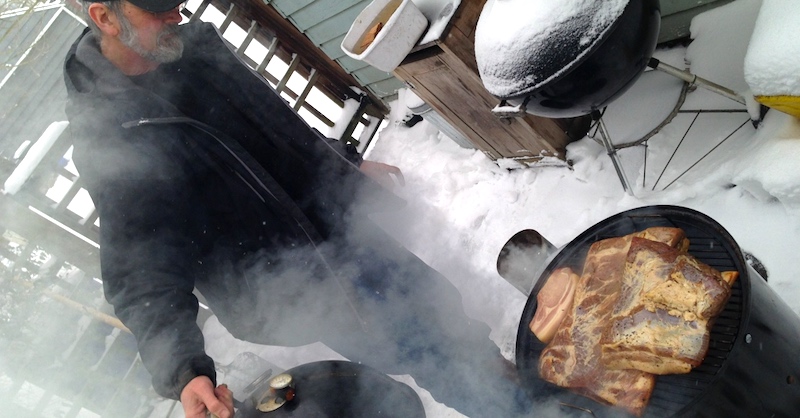
"The bacon recipe is based on the Michael Ruhlman recipe, with a couple of changes. I use half as much kosher salt as the recipe calls for—a quarter cup makes it way too salty. I use coarse sea salt rather than kosher. I use a little more garlic than called for—eight to 10 cloves, maybe. I don’t think I’ve ever made it with the optional thyme. I have made it with the optional juniper berries once or twice, but most of the time not. I usually make 12 or 13 pounds at a time, so I double the recipe as I’ve altered it. I usually have two pieces of belly, each rubbed and placed into the big plastic bags in the fridge on a Saturday or Sunday for smoking the next weekend. I turn them once a day. I put it in my Weber Smokey Mountain smoker, on the grates over a water pan, at a low temperature—I try to keep it about 200-225 degrees—over Kingsford with four or five chunks of soaked maple or cherry wood (not too much or the bacon’ll be too smoky and bitter). I smoke it until it’s about 145 degrees internally, usually about three or four hours."
But this will inevitably change and evolve— and I'll keep you posted!
Dave's Homecured Bacon
5 lbs. pork belly
1 oz. (1/8 c.) coarse sea salt
2 tsp. pink curing salt #1
4 Tbsp. coarsely ground black pepper
4 bay leaves, crumbled
1 tsp. freshly grated nutmeg
1/4 c. light brown sugar
8-10 cloves garlic, smashed in a garlic press
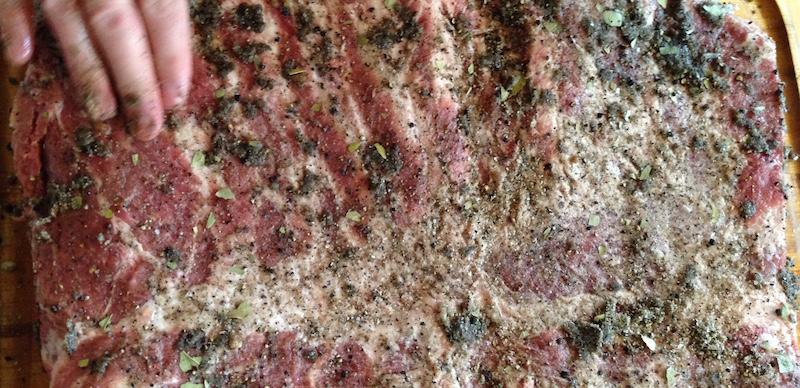
Place the pork belly on a sheet pan. Rub the salt and spice mixture all over the belly. Place it in a 2-gallon zip-lock bag and put in the refrigerator for seven days, turning it over once a day. After seven days, take it out of the fridge, rinse off all the seasonings under cold water and pat dry.
Place in smoker preheated to between 200-225 degrees over a water pan and smoke until an instant-read thermometer reads 145 degrees internal temperature. Cool and slice into one-pound slabs. Store in refrigerator or freezer.