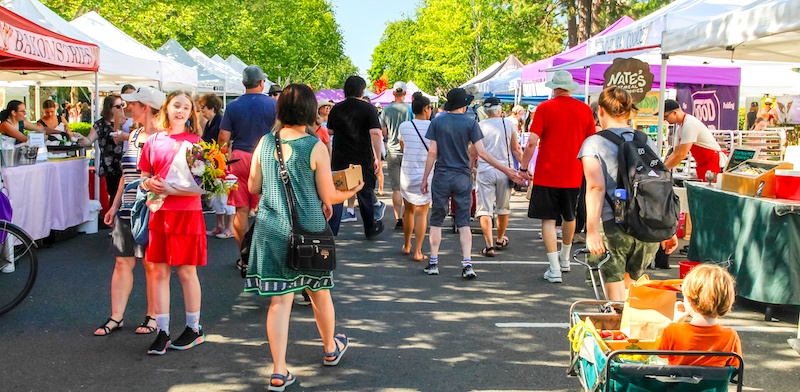
Think Strategically, Get More Value from Your Farmers' Market Trip

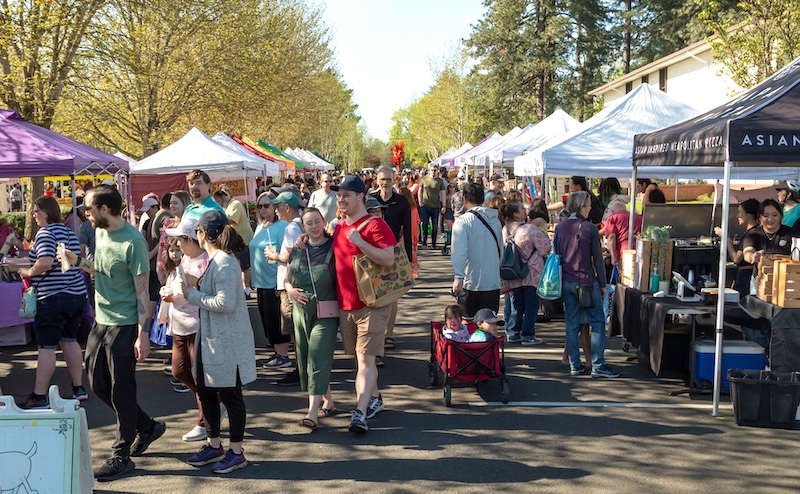
Do you feel overwhelmed when you go to the farmers' market? Does the abundance of produce on market tables and the brightly colored flowers, not to mention the noise of shoppers crowing about their finds, make your head spin? In the latest Beaverton Farmers' Market newsletter, Market Master Ginger Rapport has some sage advice for planning your next trip. 

As we are approaching the final stretch of March here in Oregon, the market feels like it’s on the verge of stepping into a new chapter right on the cliffhanger of the seasons. The winter crops are still holding strong, but here and there we are starting to spot the hints of spring, from bright and sunny daffodils to tender, flavorful greens and herbs, the first guests of season 2026. For our marketgoers, juggling busy schedules and work-life balance, this is actually the best time to think about their routine Saturday outing in terms of meal planning. The ingredients are flavorful, simple, and easy to mix and match across the meals.
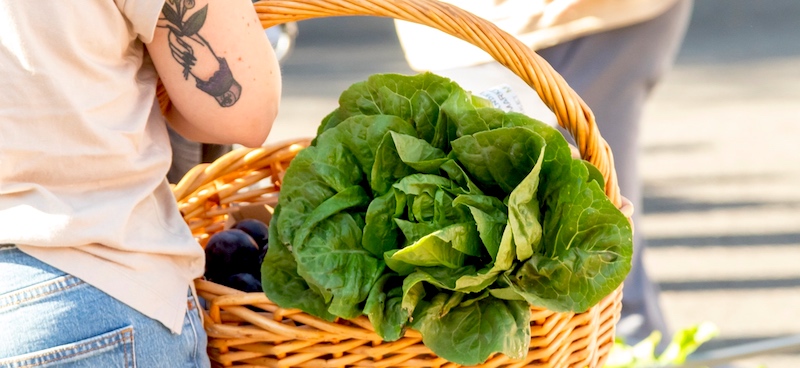
Make a weekly plan based on what's in season.

The concept of a “base basket” makes it easier to plan what to shop for and how to stretch your budget a little further. Instead of a single recipe, think strategically. Start with hardy veggies like potatoes, carrots, squash, and onions.

Add fresh seasonal produce like asparagus, kale, or spring greens. Build simple, flexible meals around what’s freshest and most flavorful at the market. Enjoy vibrant, nourishing dishes that make the most of the season.

Next stop—eggs, bread, and cheese to round things out. With these humble and simple staples, you can create a variety of dishes for the week without ever getting bored. Creamy soups, quiches, bowls, and sandwiches—the possibilities are endless!
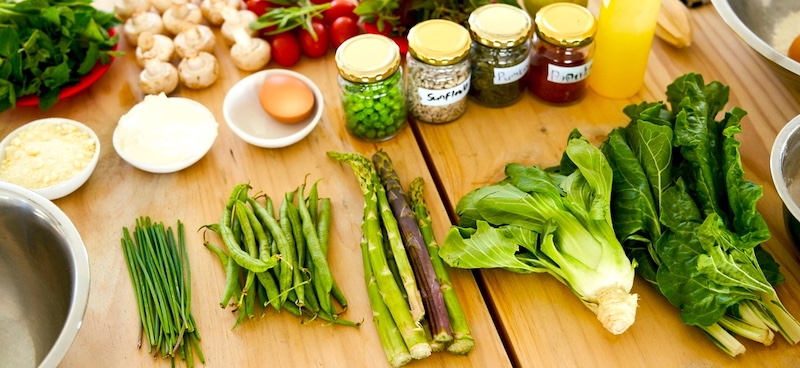
Prep ingredients rather than whole meals.

Strategize to prep ingredients rather than whole meals. A little bit of time after the market spent with your haul is going to yield a great payoff. Sauté your mushrooms, roast a pan of veggies, wash and chop the greens, and cook some grains like quinoa or brown rice - these are your building blocks for the week. Instead of cooking from scratch, you can assemble your meals in minutes from the ingredients that just need to be warmed up.

Approaching mid-week is when the farmers market produce really gets to shine! One-pan or one-pot meals make it easy to throw together a pasta dish or a stir-fry. A quick hummus, roasted veggie, and pickled radish wrap may be the best lunch you’ve ever made! Top with seasonal microgreens from Le Petit Jardin or herbs like scallions or parsley to brighten up the dish. All the ingredients are fresh and nutritious! Here is a delightful, customizable wrap recipe from The Garden Grazer that is perfect for lunch and will make all of your coworkers jealous.
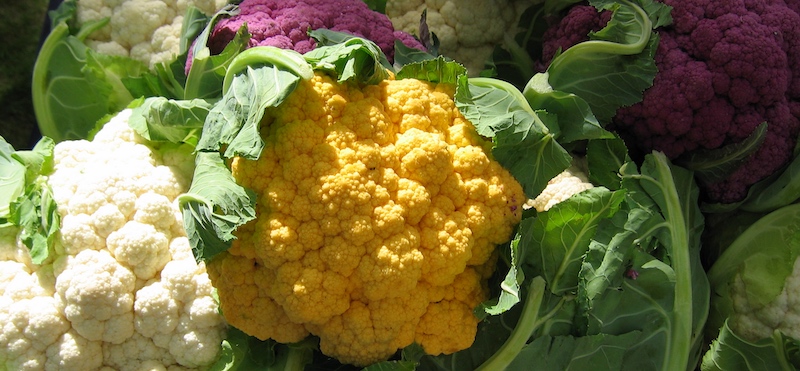
Roasted cauliflower is simple and versatile…just toss florets with olive oil and salt!

Toward the end of the week, “low energy” recipes will carry you over. Roasted veggies tossed on top of spring greens and topped with a fried egg from Santos Family Farm fancies up what may seem like a humble dinner. Try the delightful, exotic-flavored bread from our new vendor, The Spiced Oven, paired with goat cheese from Fraga Farmstead Creamery, and topped with vanilla-infused honey from Salmon Creek Farm, for a simple, no-effort platter with a relaxing glass of wine.

When life gets too busy, and there’s not even a minute to throw it all together for a family meal, Foglia Pasta has you covered! Pick up their trays of baked ziti, classic mac 'n' cheese, lasagna, meatballs, or fresh pasta for an easy dinner!

Finally, let the market guide you rather than the other way around. Late March in Oregon is all about transition, and your meals can reflect that—cozy but lighter, simple but vibrant. By shopping with flexibility and by prepping just enough to stay ahead, you can turn one farmers market visit into a full week of nourishing, stress-free meals that fit seamlessly into a busy life.
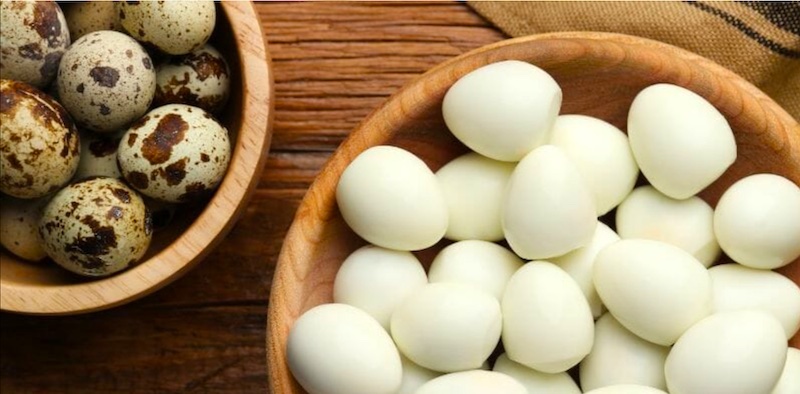
Pickled Quail Eggs? Count Me In!

In this week's Beaverton Farmers Market newsletter, manager Ginger Rapport interviewed a vendor about his favorite new snack, pickled quail eggs! Since I'm up for trying anything pickled, I thought I'd share his recipe here.

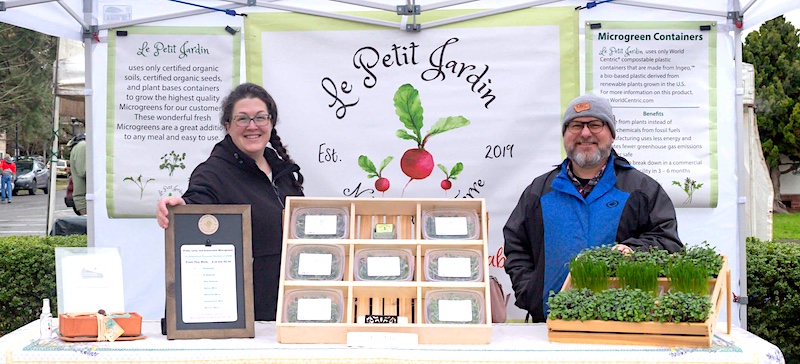
Le Petit Jardin, our microgreens grower, makes unique blends of these nutritious greens to use in your salads, brighten your sandwiches, or even use in your smoothies for an additional vitamin and nutrition boost, Michael Hager, the owner, shared with us that he discovered his new favorite thing—pickled quail eggs!

Tammy and Michael Hager of Le Petit Jardin.

Here is what he wrote:

“As you may know, I started to keep Jumbo Coturnix quails this past summer on my small homestead. Over the past months, I was able to take five Coturnix quails and grow my flock to over 20 quails that are all laying eggs now.

Monday, I was looking at the abundance of quail eggs in the fridge and said to myself, "How can I do something different with them?"  I have been making fresh eggs with them every morning. It hit me, why not make some pickled quail eggs? For best results, start this process one week ahead of time to allow the eggs to absorb the flavors of the pickling brine.

Pickled Quail Eggs

For the brine:
1 c. white vinegar or red wine vinegar
1 tsp. Kosher Salt
2-4 whole cloves
8 peppercorns, whole
1 tsp. red pepper flakes or cayenne (optional)

For the eggs:
1 dozen quail eggs at room temperature (not cold)
1 sprig of fresh dill
1 pinch Parsley fresh, chopped
1 jalapeño pepper, sliced crosswise in 1/8" rings (optional) 

Bring a medium-sized pan of water to a rolling boil over high heat. Add quail eggs to the water, making sure the water covers the eggs, and set a timer for 3 1/2 minutes. Keep the water at a low boil. While the eggs cook, prepare a bowl of ice water. When the time is up, take eggs directly from the boiling water into the bowl of ice water with a slotted spoon. Cool for three minutes, then gently crack and peel the eggs.

In a small saucepan, bring vinegar to a boil. Add in the kosher salt, garlic cloves, whole cloves and peppercorns. Add additional ingredients, such as cayenne powder or red pepper flakes, if you desire. Stir to combine until the salt is fully dissolved. Remove from heat but do not allow to cool completely.

Place your sprig of fresh dill and a pinch of chopped parsley in the bottom of a one-quart Mason jar. Add jalapeños at this stage if you’ve chosen to use them. Place the peeled quail eggs in the jar on top of the dill and parsley. Pour the hot pickling brine over the eggs. Use a knife, fork, spoon, or chopstick to carefully move the eggs around to ensure there are no air bubbles in your pickling mixture. Place a lid on the jar. Store in your refrigerator for 1 week before enjoying so the eggs have time to absorb the flavors of the brine. 

To serve, slice them up for salads or just eat them right out of the mason jar as a nice afternoon snack.

NOTE: Pickled quail eggs will last for up to 3 months in the refrigerator.


Check out my series on fermentation!

Root Vegetable Primer: Sweet Potatoes and Yams

The e-mails I get from local farmers' markets are often packed with information, not only about the vendors you'll find there each week, but often containing helpful information and recipes for the seasonal products stacked on their vendors' tables. The essay below, for instance, is from a recent Beaverton Farmers Market newsletter:

Most people think that they know the difference between sweet potatoes and yams, but they have been deceived. Sweet potatoes are not a type of yam, and yams are not a type of sweet potato. They are both tuberous root vegetables that come from a flowering plant, but they are not related and actually don’t have a lot in common. Yams are native to Africa and Asia and are related to lilies. Compared to sweet potatoes, yams are starchier and drier. In our country, yams are likely to be found in international and specialty markets, if at all. Sweet potatoes are the vegetables that you find in our grocery stores and farmers' markets.

Sweet potatoes grown by Anthony and Carol Boutard at Ayers Creek Farm.

Sweet potatoes come from the morning glory family (Ipomoea). Of the numerous varieties grown in the U.S., there are two major types: firm sweet potatoes, which have golden skin and paler flesh, and soft sweet potatoes, which have copper skin and orange flesh. The firm varieties cook up firm and a little waxy, the soft varieties are creamy, fluffy, and moist. Firm varieties were the first to be grown in the U.S. When we started growing the soft varieties, it was felt that there was a need to call them something different so they decided to call them “yams." This was a marketing decision, not a botanical one.

Sweet potato blossom (photo by Anthony Boutard).

Yams have rough brown skin and a dry, starchy texture and grow mainly in Europe, Asia and Africa. The word “yam” comes from the West African word “nyami," which means “to eat.” Sweet potatoes, on the other hand, are native to North America, have a conical shape, are usually red or orange in color, and have a sweet and creamy texture, which makes them very versatile and easy to cook with.

Roasted Yams or Sweet Potatoes Your Way

Recipe from the Good Stuff NW files.

This is a basic recipe that you can adapt any way you want. Roast the sweet potatoes in the oven, then serve them as is, or slather with butter; sweeten with a drizzle of maple syrup or a sprinkling of brown sugar and a splash of lemon; or simply improvise!

2-3 large yams or sweet potatoes, peeled and cut crosswise in 1/2" slices
2-3 cloves garlic, minced
2 Tbsp. olive oil
1/2 tsp. salt
Herbs, optional

Preheat oven to 350°.

Place slices in a large bowl with garlic, olive oil, salt and herbs, if using. Stir to combine and coat the slices. Line a baking sheet with parchment paper and lay the slices on it in a single layer. Place in oven and roast for 30-45 minutes until they can be easily pierced with a fork. Serve as is or zhoosh to your heart's content.

Top photo: Nat, Riverland Family Farm, courtesy Beaverton Farmers Market.

Celebrate National Hispanic Heritage Month with Locally Grown Chiles!

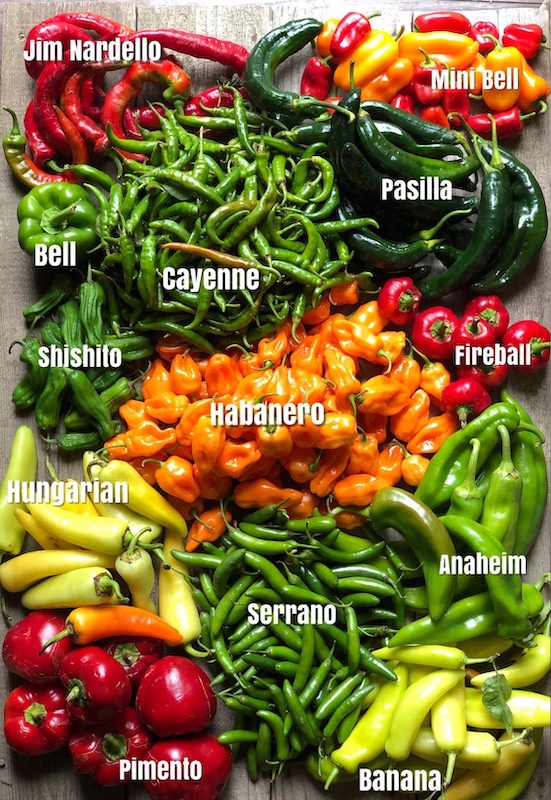
Right now our farmers' markets are flooded with a plethora of colorful chile pepper pods, and since September 15th through October 15th is National Hispanic Heritage Month, it's the perfect time to explore these beautiful and flavorful members of the capsicum family. Fortunately, Ginger Rapport of the Beaverton Farmers Market just sent out a primer in their current newsletter!

One of the ingredients that almost all Hispanic cuisines have in common is chile peppers.

Chile vs. Chili: According to Chef Mark Miller, author of the The Great Chile Book, the generally accepted convention is that "chile" refers to the plant or pod while "chili" refers to the dish made from meat and chiles. The name pepper is a misnomer that has existed since Christopher Columbus encountered capsicum plants and erroneously thought that he had found the plant that produces black pepper, which has no relation to capsicum. However, the name pepper is still used interchangeably with chile.

The chemical in chile peppers that gives them heat is capsaicin which is technically a neurotoxin. It stimulates the adrenal glands to release hormones, which theoretically creates an energy rush. The fiery sensation you feel also triggers the brain to produce endorphins, natural painkillers that promote a sense of well-being and stimulation. They can also make you sweat, which is your body’s natural air conditioner. This may explain why chiles figure prominently in cuisines in and around the tropics.
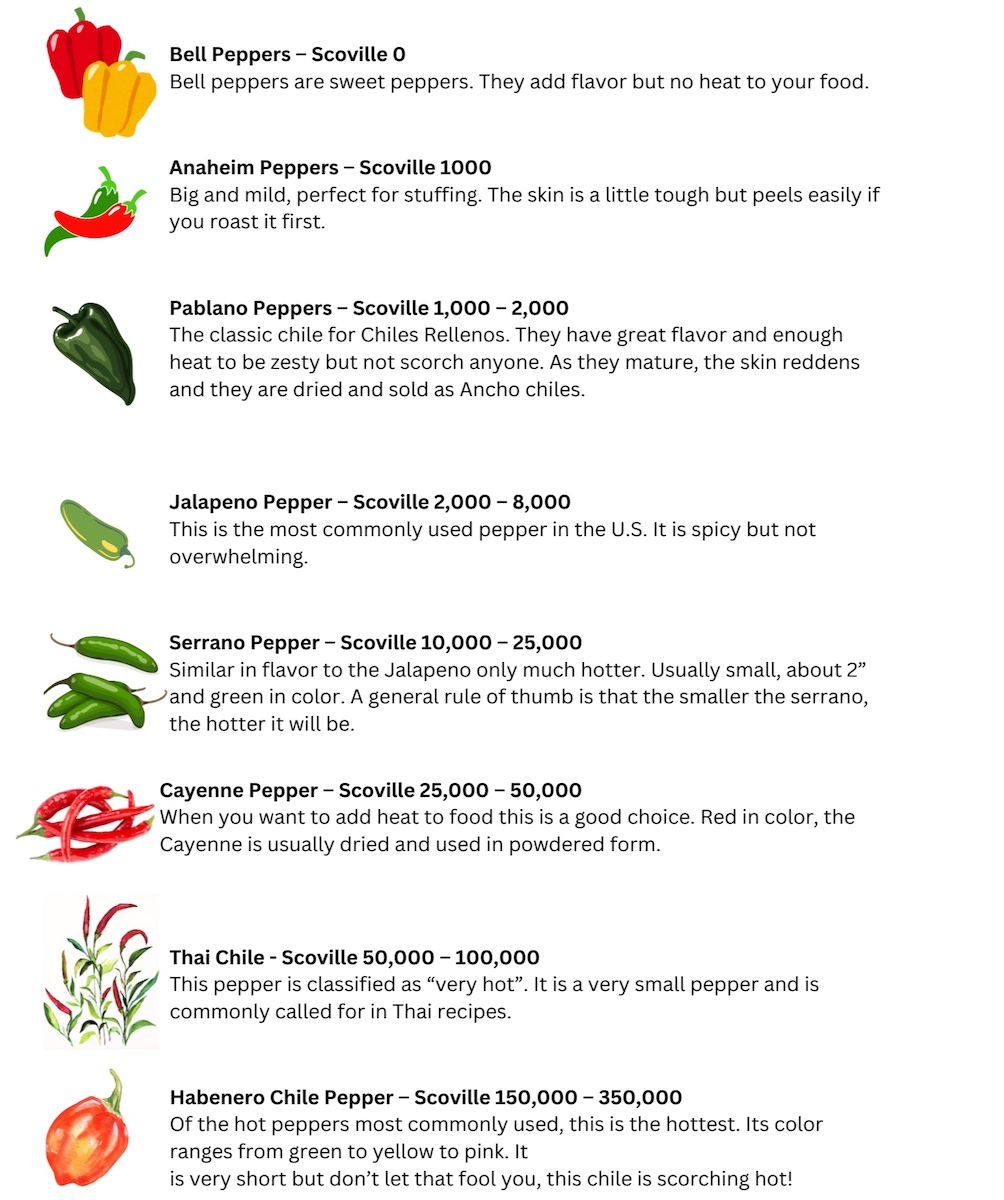
Depending upon whether you like them hot, mild, or somewhere in between, you will want to make informed decisions when purchasing chiles. The first thing that you should know is that the heat level in a chile is rated on a scale known as the "Scoville Heat Index." Invented by Wilbur Scoville, it ranks chiles in order from mildest to hottest in Scoville Heat Units (SHU), with zero being the mildest and the hottest being over a million. In general, the smaller the chile, the hotter it is. Below is a guide to the most common chiles found at farmers' markets. Scoville rankings* are included for each. Most of the heat is located in the seeds and white ribs inside. Removing the seeds and ribs, using only the flesh of the chile ,will give you all of the flavor and less of the heat.

Keep in mind that you should use gloves when handling the hottest peppers to avoid irritating your skin. It is important that you do not touch anything, especially your face—we know this from experience—before disposing of the gloves and washing your hands thoroughly.

Other peppers you will find in the market:
Padron Peppers: Scoville 500-2,500. Originally from Spain, they are harvested young and small, they typically have no seeds. This makes them mild, perfect for eating whole. Farmers tell us that about one in every 12 will be surprisingly hot and there is no way to know which one packs the extra punch, but take a nibble of the very tip to get an idea of how hot it is. Prepare by sautéing in olive oil until it is blistered and serve sprinkled with salt.

Shishito Peppers: Scoville 50-200. Popular in Japan, these are very similar to Padron peppers. Serve them sautéed with a drizzle of soy sauce and sesame oil. Very tasty in tempura.

Habanada: Scoville 0 (yes, zero). Bred by well-known organic plant breeder Michael Mazourek of Cornell University, these exceptional snacking peppers have all of the fruity and floral notes of the habanero without any spice (even the seeds are sweet and add to the flavor).

* Scoville rankings are often given in a range because varieties and growing conditions vary.

Photo of peppers from BFM newsletter, courtesy Shannon Feltus, Urban Farm Foods.

A Perfect Pear: Farmer Lynn Thompson's Favorite Dessert for Pear Season

This week's newsletter from the Beaverton Farmers Market is all about the colorful, luscious pears you'll see lovingly displayed in vendors' market booths, and I thought this one was so simple and uncomplicated that it deserved sharing here.

Decadent Pear

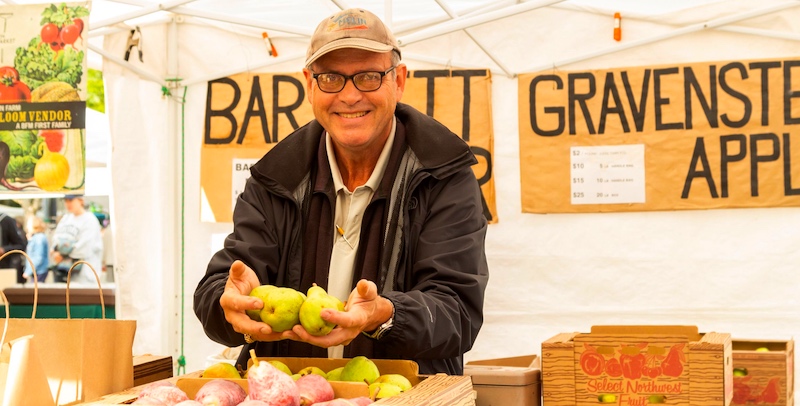
"Marketgoers love his apples, but they also love him for his amazing pears," wrote Market Master Ginger Rapport of Thompson Farms' Lynn Thompson. "Lynn is always welcoming and was happy to share his favorite pear recipe which he lovingly calls 'Decadent Pear.'"

4 sweet red pears
4 Tbsp. of brown sugar
4 Tbsp. of butter
4 strips of bacon, fried until crisp then crumbled

Halve the pears and hollow out the centers.

Spoon 1/2 tablespoon each of butter and brown sugar into each half, and microwave them for a minute to soften the pears.

Top with crumbled bacon and broil for a couple of minutes to crisp up the glaze.

In Season: Garlic Scapes, A Primer

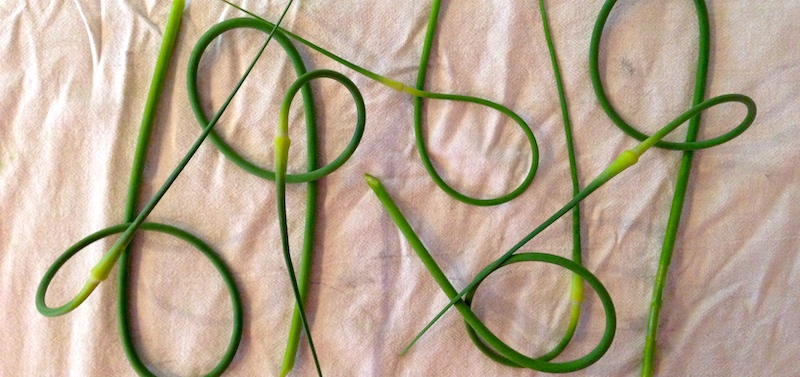
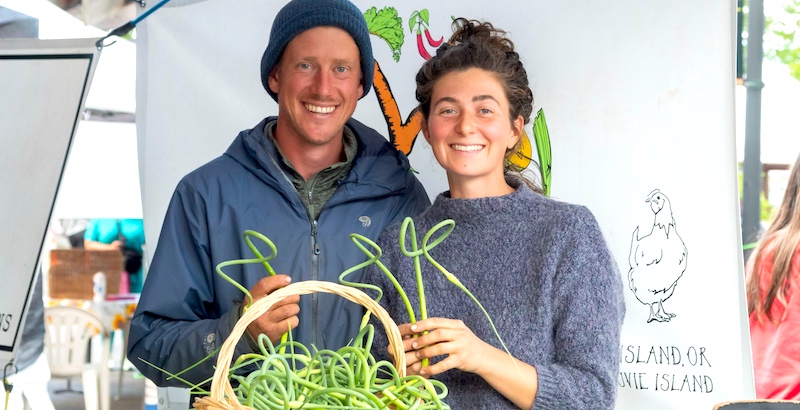
This week Market Master Ginger Rapport of the Beaverton Farmers Market sent out a primer on garlic scapes, the curly green whips that are the flowering stems of the garlic plant. They are at their tender best in late spring and early summer,  when they still have their signature curl—if they're not harvested, the stems will straighten out and point skyward, by which time they also get hard and fibrous.

Rapport quotes market vendor Emma Rollins of Sun Feast Farm (top photo), who waxed eloquent about her favorite allium:

"Solstice time feels like the right moment to talk about garlic. This is when garlic scapes, the flowering stalk of garlic, curls and twirls its leek-like body in the most fantastic way! For me as a farmer, garlic scapes mark our true turn toward summer, always arriving right around the longest days of the year.

Curly whips of garlic scapes "mark our true turn toward summer."

"As days lengthen, plants respond. Onions size up and the garlic needs you to pick the scape so its energy can go into the bulb, not up to the flower. If you left it, the garlic would flower in a purple pom-pom of little blooms. Each of these flowers turns to a bulbil, a little garlic seed, which is how garlic propagated itself before people began harvesting the bulb or head of garlic and breaking it up into the cloves to replant and propagate more that way.

“Why is garlic MY timekeeper? We plant garlic as the season closes, [at] Halloween time. Tucking cloves into the dark cold wet soil as so much of the field wilts back with frost for the season, garlic begins to turn the wheel toward the promise of next season. We finish the year planting into the next. We follow the sun by looking to the garlic that sprouts in the depth of winter, and come February, with the Persephone—when we enter over 10 hours of light a day, what a plant needs to actively grow—garlic marks this time and comes to life. There is green garlic before the bulb starts to form, then scapes for solstice [with] harvest come July when the stalks begin to dry out and sometimes tip over.”

So once you get your garlic scapes home, then what?

These flowering stems of the garlic plant present myriad delicious opportunities.

The simplest way to prepare them is simply throwing them on the grill after trimming off the end of the stalk. (Some recipes will have you coat them in oil, but I find that the oil drips off and causes the coals to flame up, which deposits a bitter film of burnt oil on your vegetables.) After a couple of minutes the scapes will brown over the fire, so turn them over and brown the other side. Then put them on a plate and drizzle with a good olive oil, salt and maybe a squeeze of fresh lemon. The easiest side dish or appetizer ever!

Just this last week I made a pesto from fresh scapes, processing five or six with a big handful of parsley from my neighbor's garden along with the requisite garlic, pine nuts (or walnuts or hazelnuts) and enough olive oil to make a smooth paste. Stir in some finely grated parmesan and you're ready to stir it into pasta or garnish a piece of salmon.

Rapport reports that her assistant market manager, Sue Poff, received a jar of garlic scape powder "made by her son who grows a ton of garlic every year" and she describes the flavor as "milder than regular garlic powder but used in much the same way." Easily dried if you own a dehydrator—drying them in the oven at its lowest setting is just as simple, though it may take longer—just slice the scapes into one to two-inch pieces and, once dried, grind them to a powder in a spice grinder or blender.

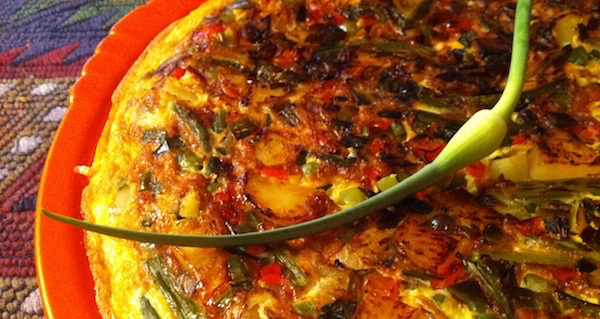
Garlic Scape Frittata

I love frittatas because they can be made from whatever vegetables or meats you happen to have on hand, sautéed and combined with eggs. Quick and easy, forgiving and always delicious, it's almost the perfect meal!

2 Tbsp. butter or olive oil
1/2 each green, red and ancho peppers, or about a heaping cup of any peppers, finely chopped
4 green onions, sliced into 1/8" slivers
4-6 mushrooms, halved and sliced thinly
5 garlic scapes, sliced in 1" pieces, leaving the bulbs intact
6 baby Yukon Gold potatoes (1 cup) chopped in 1/4" cubes
12 eggs
1/2 c. cheese, grated
Salt and pepper to taste

Melt the butter over medium heat until it sizzles. Add potatoes and sauté briefly till slightly tender. Add rest of vegetables and sauté until very tender. While vegetables are cooking, break eggs into a mixing bowl and stir until well-mixed, adding salt to taste. When vegetables are done, pour the eggs over the top, sprinkle on the cheese and cover the pan, reducing the heat to low.

When the eggs are cooked on the bottom but still runny on top, put the pan under the broiler briefly (just don't walk away or get distracted like I sometimes do!). When lightly browned on top, remove the pan from the broiler.

To serve, run a spatula around the inside of the skillet to loosen the eggs. Then invert a serving platter over the skillet and, holding them firmly together, turn the platter and skillet upside down. The frittata should plop out of the skillet onto the platter.

Top photo from Beaverton Farmers Market, a generous sponsor of GoodStuffNW.

In Season: Spring Fling

While one friend has dubbed the past few weeks "Nov-April" and is calling out the next few as "May-vember," farmers across the state are heralding the official start of spring. Farmers' markets in most communities are opening their regular season schedules this weekend, though in some places they will wait until June, so check your local market website for official dates and times.

Ginger Rapport, market master of the Beaverton Farmers Market, is over the moon in anticipation of spring's bounty. "By their very nature, the early vegetables are light, fresh, and delicate, and the dishes made with them reflect these qualities," she wrote in a recent newsletter.

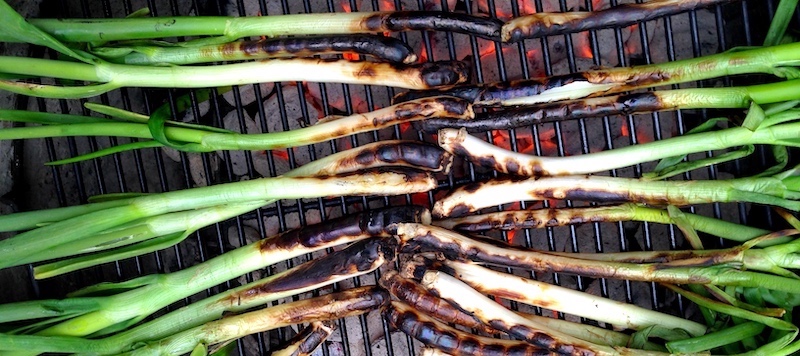
Spanish calçots are a great excuse for a spring fling!

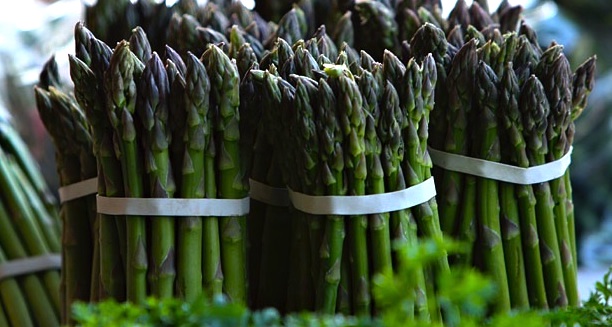
And I wholeheartedly agree with her pronouncement that the star of the spring show is asparagus. From slender varieties to more robust, meatier stalks, you'll find both green and purple asparagus in abundance at market booths. (Here Rapport reminds market-goers that purple asparagus, like purple pole beans, turns green when cooked.)

From risottos to salads to quiche to pizza, asparagus is almost infinitely versatile. Even simply roasted in the oven with a drizzle of olive oil and a shower of chopped garlic and salt—and sure, throw on some chopped preserved lemon just before serving—it threatens to outshine any main dish in the vicinity.

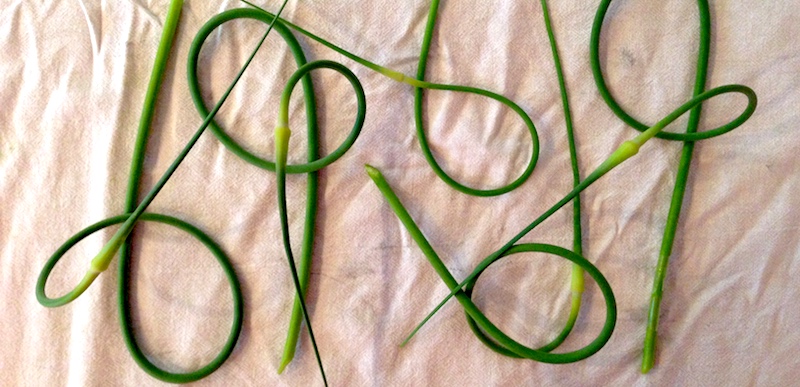
Alliums, particularly in their springy infancy, are also on display in the form of spring onions, scallions, green garlic and the fabulous Spanish calçots which have entire festivals in their honor in that countrySee my recent post on how to throw your own Calçotada with the traditional red pepper-and-almond salbitxada sauce. And don't forget the curvy whips of garlic scapes, the thin, vibrant green stalks that grow from the garlic bulb and are terrific grilled and chopped for pizza, salads and, well, almost anything!

While local strawberries are only just beginning to appear in markets, and available only to those early birds who grab them before vendors sell out, there are plenty of other stellar finds to make your trip to the farmers market worthwhile.

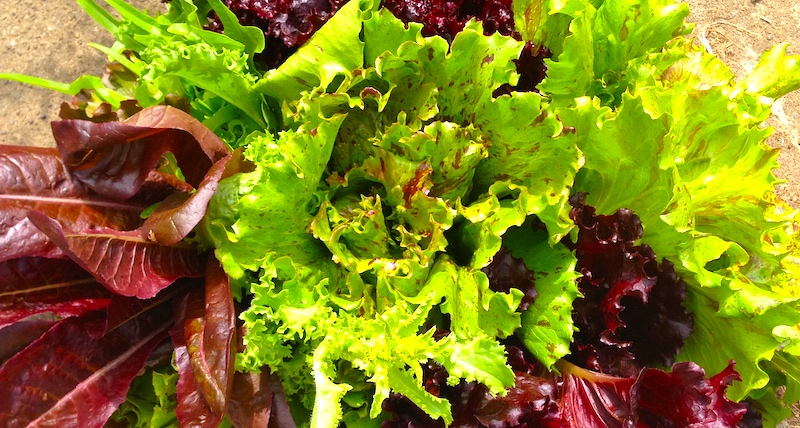
Tender and delicate spring lettuces are abundant.

On my trip to the Hillsdale Farmers Market last Sunday, I loaded up on the tender redleaf and maple leaf lettuces from Gathering Together Farm that will get a drizzle of my new favorite honey and mustard-infused red wine vinaigrette. I also picked up the cutest bunches of baby bok choy that will get roasted and incorporated into a stir fry, pizza or grain salad in the near future.

Greenville Farms from Forest Grove was full to bursting with stacks of various kinds of raabs and other sprouting greens, from collard to kale to spigarello. I can safely say that next to spring lettuces, these inflorescences are the spring vegetable I most look forward to after the end of my beloved chicory season. Read Ginger's explainer about the various varieties grown locally, along with a recipe for a balsamic reduction that is nothing short of miraculous.

Garlic scapes add zing to spring dishes.

Greens like arugula, spinach and sorrel (see my recipe for a killer sorrel salad) are seeing their day in the spring sun, too, along with local fennel and peas—both sugar snap and snow peas—which should be plentiful through May. Zucchini and other summer squashes like patty pan and the ribbed costata romanesco, all ideal for grilling or roasting, will be around into June.

And don't forget spring herbs like parsley and cilantro, oregano, chervil, thyme and chives are here, too, so chimichurries and other herb sauces are definitely called for. Microgreens and young shoots of favas and peas should also make your list. They will only get more abundant as the season rolls along.

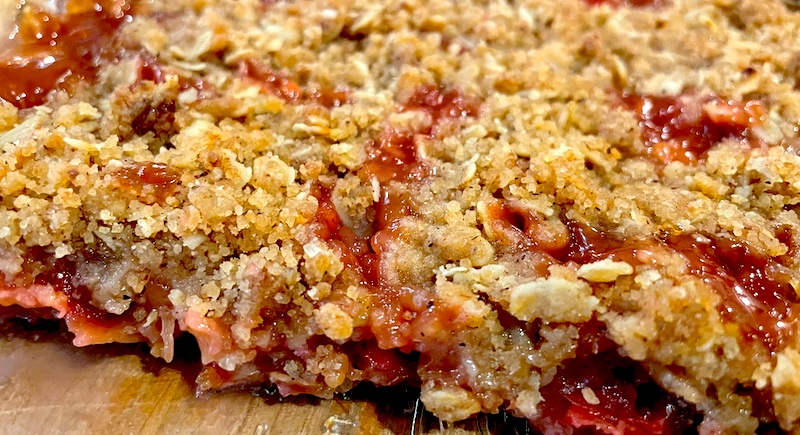
Mmmmm…rhubarb crisp!

And I can't conclude this without mentioning my true heartthrob, rhubarb, that vegetable-masquerading-as-a-fruit, that is one of the first desserts of spring, at least around here. See my version of my Aunt Nell's Rhubarb Crisp below, and be sure to make my spectacular rhubarb syrup for your summer sippers and cocktails.

Excited about spring now? I sure am!

Aunt Nell's Rhubarb Crisp

For the topping:

1 c. flour


3/4 c. uncooked rolled oats


1 c. brown sugar

1/2 Tbsp. cinnamon


1/2 c. butter or margarine, melted

For the filling:


4-6 c. rhubarb, cut in 1/4" slices

1 c. sugar


1/4 c. triple sec, Cointreau or other orange liqueur

2 Tbsp. cornstarch

Mix together dry ingredients in medium sized bowl. Pour in melted butter or margarine and stir with fork to distribute. When well-mixed and crumbly, scatter on top of fruit in pan (below).

Slice fruit into large mixing bowl. Add sugar, water, cornstarch and vanilla and mix thoroughly. Put in 9” by 12” by 2” baking pan. Scatter topping mixture evenly over the top and bake in 350 degree oven for 55 min.

In Season: Broccolini, Raab, Rabe, Rapini and Friends

Since I'm jonesing for some lively greens and saw kale starting to flower in my neighbor Bill's garden, I thought this item from market master Ginger Rapport of the Beaverton Farmers Market would be great to keep on hand for market shoppers who might be asking, "What are those bundles of greens and why are they all called something different?" 

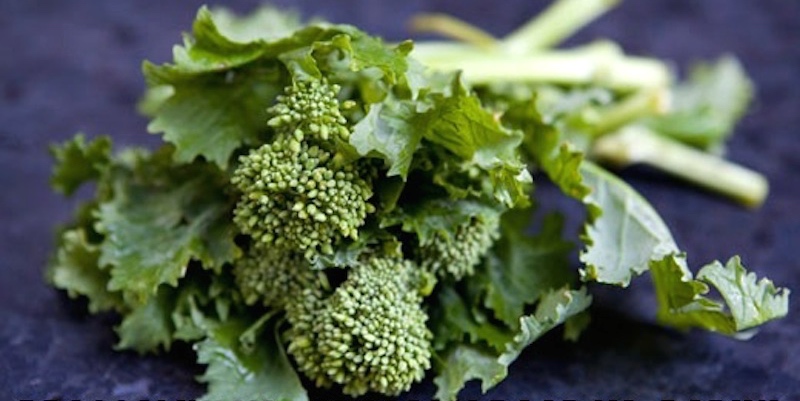
Do you get confused when you hear the words “rabe,””raab,” “rapini” or “broccolini” used in recipes? Let us help you sort this out because you will find tons of these green vegetables in the market right now.

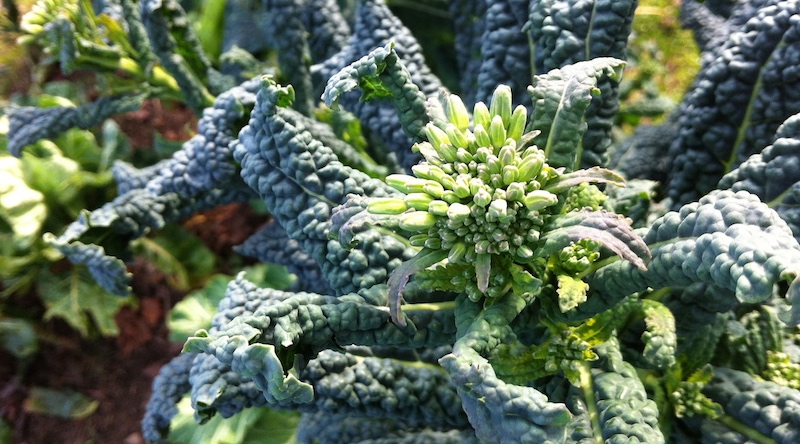
Kale raab.

First, a little taxonomy: Cruciferous vegetables are vegetables of the family Brassicacae, known as Brassicas or Crucifers. They include: cauliflower, broccoli, mustard greens, arugula, bok choy, kales and cabbages to name a few. Now, a little clarification:

  • Broccolini is not baby broccoli. It is a cross between regular broccoli and Chinese broccoli with long stems, larger florets, and less leaves. It is less bitter than some of its relatives which is why it is often thought of as baby broccoli.
  • Rapini and broccoli rabe are close cousins and are often used interchangeably. They are in the same subspecies as the turnip, hence they have the characteristically slightly bitter taste of this group. They do not form the large heads that we see in broccoli.
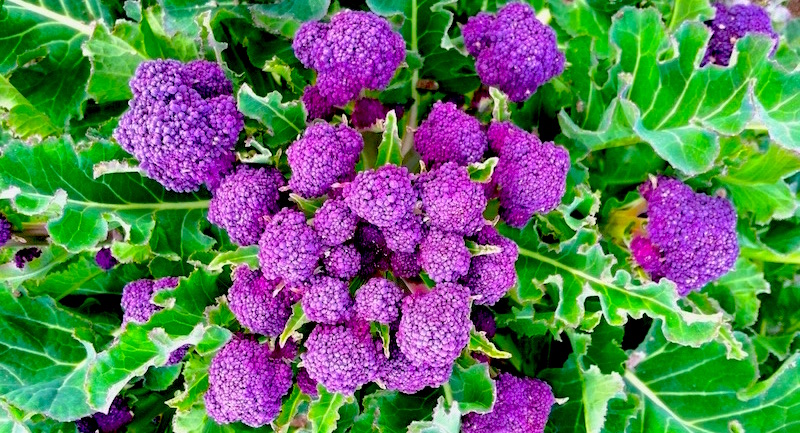
  • Purple sprouting broccoli (or PSB as the cool kids say) is, like broccolini, a separate plant from broccoli. Native to the eastern Mediterranean and Central Asia, its seeds were first listed in the French Vilmorin-Andrieux seed catalog as Sprouting Purple Broccoli in 1885, which also introduced it to the United States.
  • The flower buds of brassicas from the turnip family are often referred to as rabe, or raab, derived from raps, which means turnip in Italian. This time of the year, you will find the rabes of many types of brassicas in the market—kale, mustard greens, Brussels sprouts, turnips, bok choy and Chinese cabbage.

While each of these are from a common family there are slight differences in taste between them. With each, you are meant to eat the stems, buds and leaves, making them very easy to prep for cooking. Don’t be alarmed if the buds have begun to show their yellow flowers. Some feel that the flowers are a sweeter version of the parent plant.

Purple sprouting broccoli.

All of the aforementioned brassicas are excellent roasted, sautéed or lightly steamed. We don’t recommend boiling because it is easy to overcook the leaves in boiling water. The usual additions of garlic and a pinch of red pepper flakes makes for an easy and delicious preparation. Finish your dish with salt and pepper to taste and a squeeze of fresh lemon juice.We also suggest that you try tossing your raabs with a balsamic vinegar reduction. The reduction’s sweet finish balances the bitter quality of the greens. We like to keep a balsamic reduction in the refrigerator to have on hand as needed. It is delicious drizzled on salads, fresh vegetables, fish and meats.

Basic Balsamic Vinegar Reduction

2 c. balsamic vinegar*

Boil in a small saucepan until reduced by half (one cup). You can continue to boil for a thicker glaze type consistency. You may add a clove of garlic, minced, or fresh herbs such as thyme. Be sure to strain those out before storing.

* Note: Bottles of balsamic vinegar on store shelves labeled "Balsamic Vinegar of Modena" are a commercial grade product made of wine vinegar with the addition of coloring, caramel and sometimes thickeners like guar gum or cornflour. Authentic balsamic vinegar, labeled "Aceto Balsamico Tradizionale di Modena," is produced from the juice of just-harvested white grapes (typically, Trebbiano grapes) boiled down to approximately 30% of the original volume to create a concentrate or must, which is then fermented in a slow aging process which concentrates the flavors.

In Season: Eggplant is More Than Just Eggplant Parmesan

In the most recent Beaverton Farmers Market newsletter, Market Master Ginger Rapport waxed eloquent about the eggplants grown by one of the market vendors and included some recipes I definitely want to make.

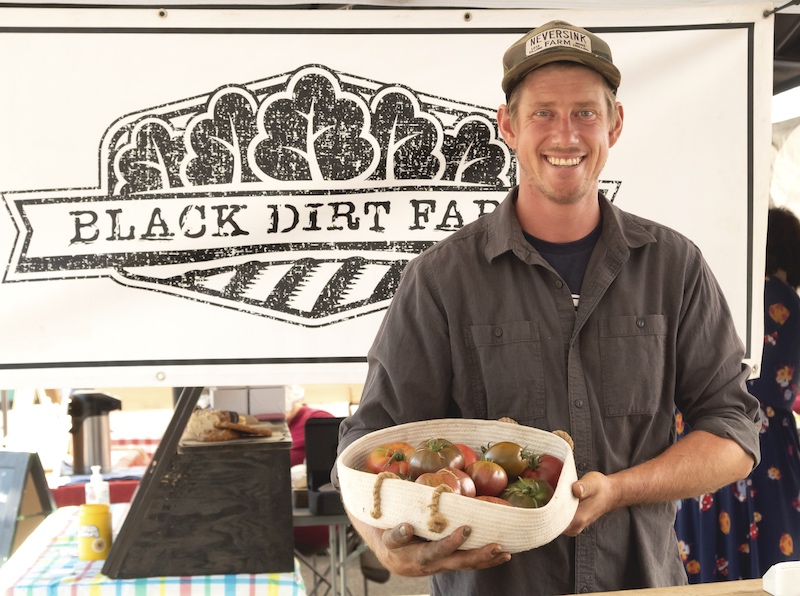
Farmer Eric Hvidsten of Black Dirt Farm was not always in love with eggplant and explained how his opinion changed since he started growing them: 

Eric Hvidsten, Black Dirt Farm.

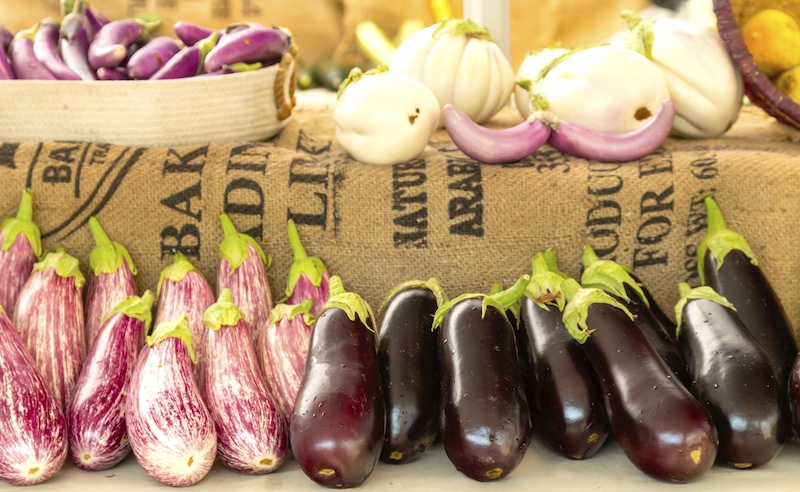
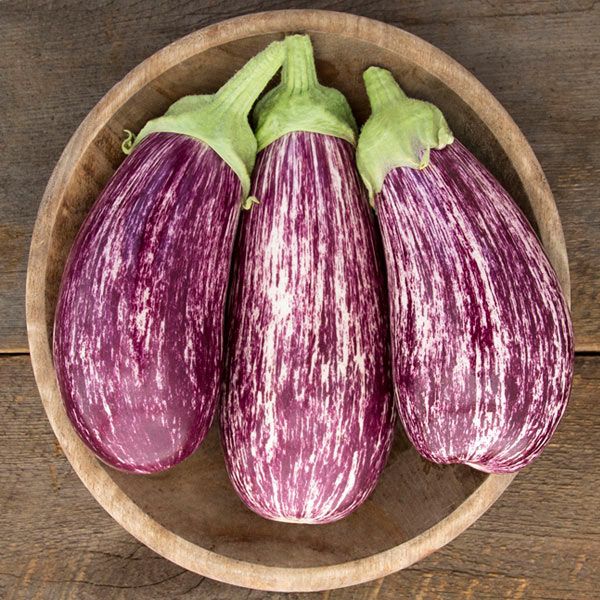
“Over the past few years, I've come to really enjoy growing eggplant," Hvidsten said. "They are absolutely gorgeous, and it's been fun exploring and experimenting with different varieties.  'Annina' is the variety that first got me hooked. Its flavor is similar to the typical Italian eggplant, but it has beautiful purple and white speckled skin that looks like marble. It looks unreal. I'm growing a long slender Japanese variety for the first time this year. It might be my favorite to cook with. Its tender skin and smaller diameter make it easy to slice into long strips or small coins. A lot of customers have recommended round Thai eggplant this year. I'm looking forward to trying these out next season.

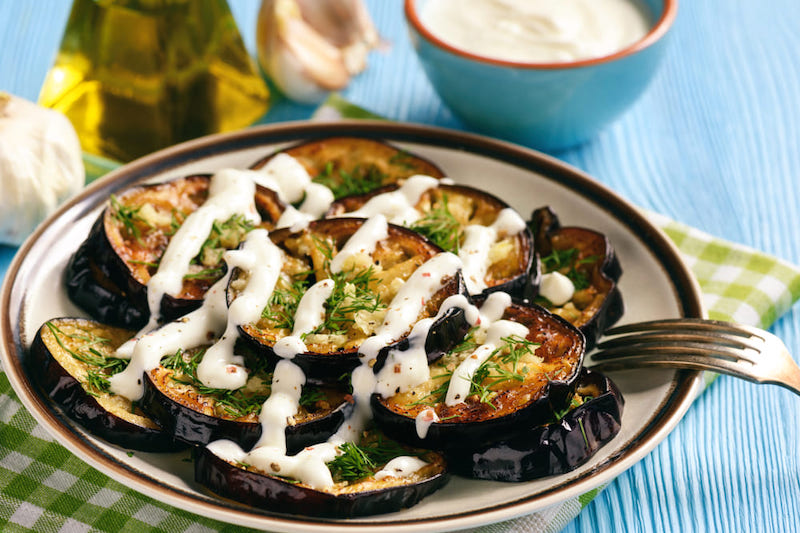
Eggplant bites (recipe below).

"Growing up, I was not a fan of eggplant.  Eggplant Parmesan was the main eggplant dish in our house. I found it mushy and sometimes bitter. As I've experimented with new dishes I've come to really enjoy them. (See recipes linked at bottom.)

"I think its flavor really shines when paired with Greek or Middle Eastern spices like za'atar. I've also found slicing it thin and frying it briefly before adding it to the rest of the dish keeps the eggplant from getting mushy. This discovery was a game-changer for me."

"Annina" got Hvidsten hooked on growing eggplants.

As for what it's like as to grow them, Hvidsten said, "Eggplant has grown well on my farm, but it can be a challenge. They are relatively heavy feeders—home gardeners will want to amend the soil well before planting. The big challenge growing eggplant in the PNW is that they like heat. I always grow eggplant in my hoop house. For home gardeners I recommend planting eggplant in the warmest spot available.”

About how he started Black Dirt Farm, Eric said, “I started Black Dirt Farm six years ago with the goal of growing good food for my neighbors in a way that would benefit my local community, economy, and environment.  I strive to work with nature to improve the soil, control pests and diseases, and grow healthy plants.  Despite the challenges, it has been a joy to grow the farm and build relationships with my customers and other growers in the area.  Growing with the seasons, and working with nature gives me a wonderful sense of connection to the world around me.  I am so thankful for all my customers who support the farm and help me live this dream.“

Simple Eggplant Bites

4 Tbsp. vegetable oil
2 medium-sized eggplants
4 Tbsp. flour
2 cloves garlic
Dill sprigs, chopped finely, plus more for garnish
2 Tbsp. plain Greek yogurt or mayo

Cut eggplants into ½ inch slices. Pat dry and dip into flour. 

Oil has to be very hot before frying the eggplants. Fry both sides for about 2 minutes each. In the meantime, crush garlic, mix with yogurt or mayo, and add dill. Once the eggplant is golden-brown, set on a paper towel to drain excess oil, sprinkle it with sea salt, and drizzle sauce on top. This makes a perfect quick appetizer!


Check out Ginger's recommended recipes for making Roasted Eggplant Salad, Eggplant Rolls, and Baba Ganoush. And here's my recipe for an out-of-this-world Eggplant Parmesan.

The Beaverton Farmers Market is a stalwart supporter of Good Stuff NW. Photo of "Annina" eggplants from High Mowing Seeds.

Farmers' Markets as Business Incubators: Bringing New Faces to Our Food System

Did you know every $1 spent at your local farmers' market generates twice as much economic activity within the region, whereas the equivalent purchases in a traditional grocery store yield only one-third of those benefits to the region’s economy?

Acknowledging those economic contributions to the local economy, in 2008 the Tualatin Soil and Water Conservation District approached the Beaverton Farmers Market with an offer of $5,000 to support a market program. The market decided to pay it forward, adding additional funds from the market to form a Vendor Development Grant Program aimed at helping vendors grow and develop their businesses. These are some of this year's recipients.

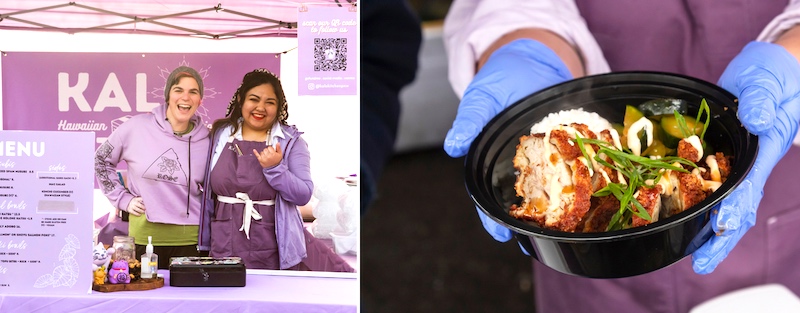
Kalo Kitchen is a popular Hawaiian food vendor.

Mountainside Lavender: Mountainside Lavender produces fragrant bouquets, essential oils and other lavender-based products and will begin their first season at the market in June. Their grant award helped them with the initial set-up costs for their booth which will help them with their first foray into farmers' markets.

Kalo Kitchen: This popular Hawaiian food vendor needed to increase production and way to keep their food fresh and warm. They applied for the grant to purchase a generator. 

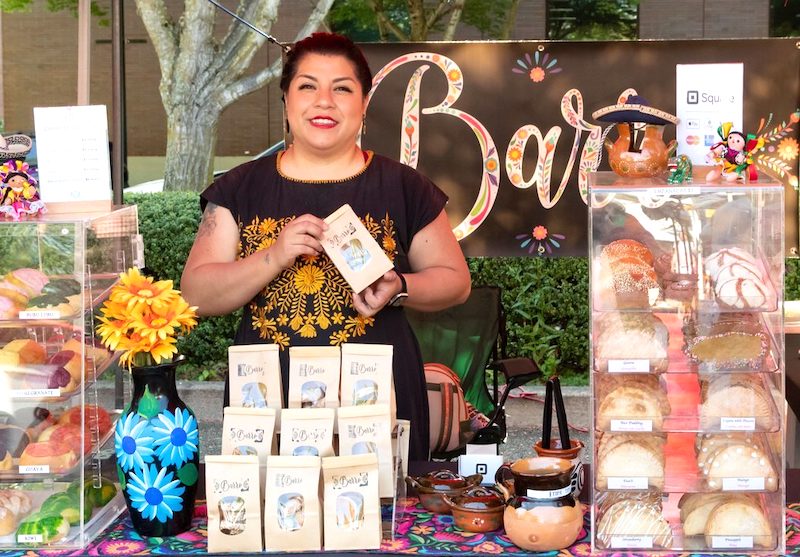
Yoli Barragan Rabadan of Barro. 

Barro: San Pedro Limon, Mexico, is where the long roots of Barro originate. Owner Yoli Barragan Rabadan takes inspiration from her grandmother, cherishing the recipes that have been in the family for four generations. This grant will help purchase a dough sheeter for next-level product capabilities.

Hapa Pizza: This Asian fusion Neapolitan-style pizzeria works hard between its new store-front in Beaverton and serving marketgoers every Saturday. This grant will help expand production capabilities at the market.

Helvetia Creamery: Home to beautiful brown-eyed Swiss cows, this local creamery has developed quite a reputation for its delicious Swiss cheese. This grant will help develop a new smoked, raclette-style cheese.

Le Petite Jardin: Growing microgreens, sprouts, greens and summer vegetables is a lot of work, and as a family farm that is constantly looking for improvement of its process, they applied for the grant to add another growing rack to their operation.

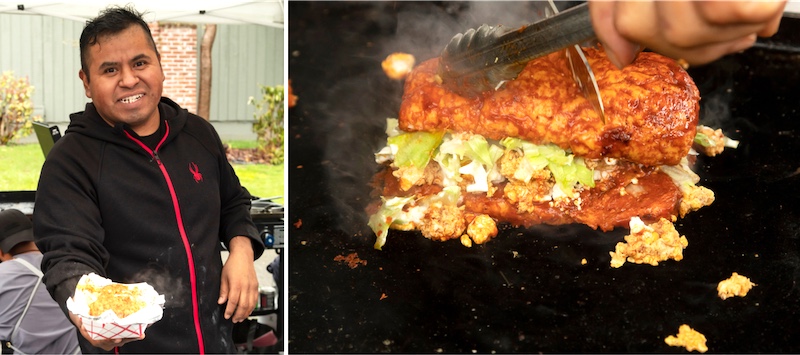
El Cuadrilatero's famous pambazo sandwich.

El Cuadrilatero: Pambazo sandwiches are unique and delicious. This grant will help them purchase a generator to improve production in their booth.

HYCH (Heat You Can Handle): High-quality hot sauces based in Salem that will tingle your taste buds. They are a great vendor to check out just in time for the grilling season. Their grant dollars went to rebranding costs when a copyright issue came up with their previous business name, Hoss Sauce.

Ajay and Guatami of Food for Thought.

Food for Thought: Ajay and Guatami make Indian desserts and snacks with a philanthropic goal. They are going to use the grant funds for advertising, legal fees for 501c3 filing, and packaging development.

Decadent Creations: Hand-made, small-batch artisan cakes, cookies, pastries and French macarons have made quite an impression on market customers. A master of her craft, Mindy Simmons needed help with new labels for her products.

Ocean Green Healing: Handcrafted and locally made CBD bath and body products are this vendor's specialty. Increased demand for their CBD bath bombs created a need for a bigger mixer in their production facility and this grant will help make that possible.

Ona Yogurt: Owner Clare McLeod’s Greek-style vegan yogurt, made from silken tofu that is high in protein and low in sugar, began with her search for a vegan product that was also environmentally friendly. Clare’s grant award will help her increase production capabilities.

Binary Brewing: Created by a couple of techies, Binary Brewing's founders have translated their love for coding into carefully brewed, refreshing beverages. Their grant funds will be used to purchase coolers that will keep their beers icy cold while at the market.

Lindsay and two of her taste testers.

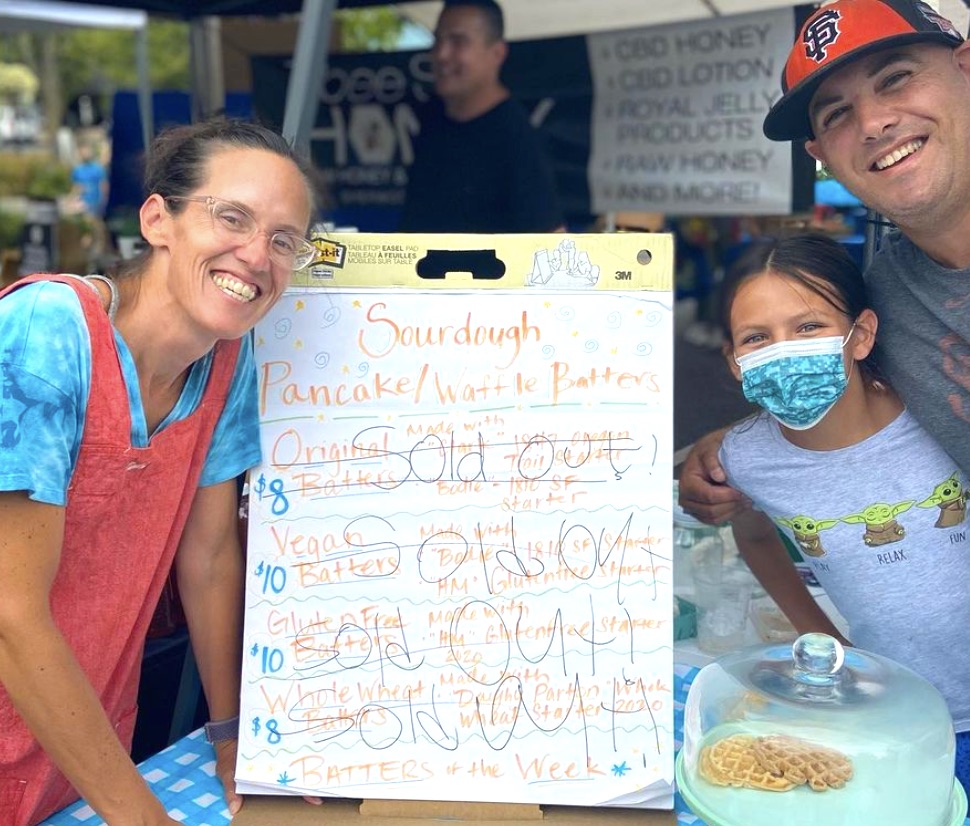
Lindsay's Sourdough: Lindsay is a busy mother of six but she makes sure everyone has access to a delicious breakfast made from her sourdough pancake and waffle batter, from the original sourdough to specialty flavors like chocolate, mango, and lemon and poppyseed. She was able to purchase a new tent with her grant funds.

Queen's Kitchen: Owner Lanisha Brown crafts body sugar scrubs that she describes as a “spa in a jar." Her grant will be used to develop a new hair product.

Rice Thief: With her Korean comfort food updated for the modern palate, Anna Lee has created recipes based on her cultural background. Her food was so popular with marketgoers that she needed to purchase a larger grill, and this grant will help her do just that.

All photos courtesy Beaverton Farmers Market.