Due to new developments in the Tillamook cheese story I posted about previously, I decided an update was needed.
If I needed more assurance that my decision to stop buying Tillamook cheese was the right one, this past week the Oregon Department of Agriculture and the state Department of Environmental Quality both gave the go-ahead to Lost Valley Farm, a 30,000-cow mega-dairy, to begin operations in the Boardman area.
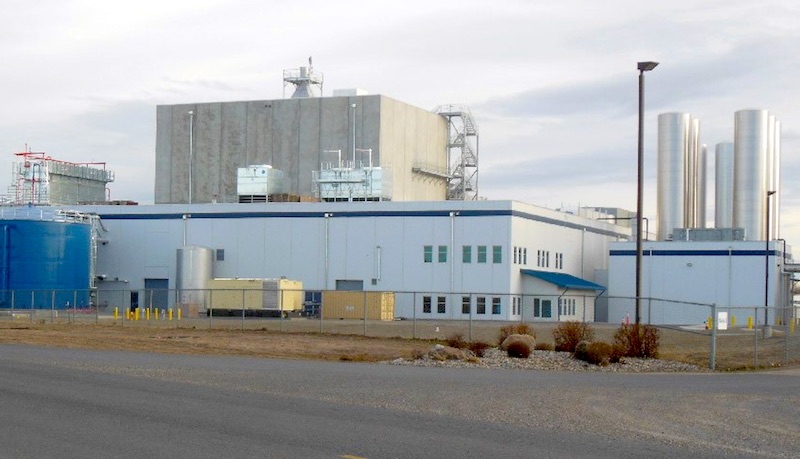
Tillamook's Boardman processing plant.
A California-owned facility, Lost Valley joins North Dakota-based Threemile Canyon Farm, with its 70,000 cows, in supplying milk for Tillamook cheese. According to a story in the Salem Statesman-Journal, "both dairies hold contracts with Boardman’s Columbia River Processing, which produces cheese for the Tillamook County Creamery Association, maker of Oregon’s famous Tillamook Cheese."
Lost Valley also had to gain the official approval of Morrow County's commissioners, although according to a story in the Oregonian, "the county [had] no legal way to stop what would be the state's second-largest dairy, and its three commissioners are deeply worried that it will sap already-limited groundwater from local farmers, and exacerbate water and air quality problems."
Lost Valley Farm began construction before obtaining needed permits.
Since the county had no choice but to approve the facility despite its deep misgivings, the article then asks, "that raises a crucial question for a coalition composed of local and federal government agencies, small farm advocates and environmental organizations: Are Oregon's rules for mega-dairies and livestock feedlots too loose?"
Ivan Maluski, Policy Director of Friends of Family Farmers, thinks so. "We've been warning for some time that Oregon's rules are too weak, and we're in danger of being a big factory farm state," he was quoted as saying.
In a recent op-ed in the Oregonian titled "The Toxic Truth Behind Oregon's Factory Farm Stench," Dr. Nathan Donley, a senior scientist in the Portland office of the Center for Biological Diversity, said, “The new Lost Valley [Farm] operation will generate as much waste as a small city that will be stored largely in open-air lagoons, then disposed of on fields.
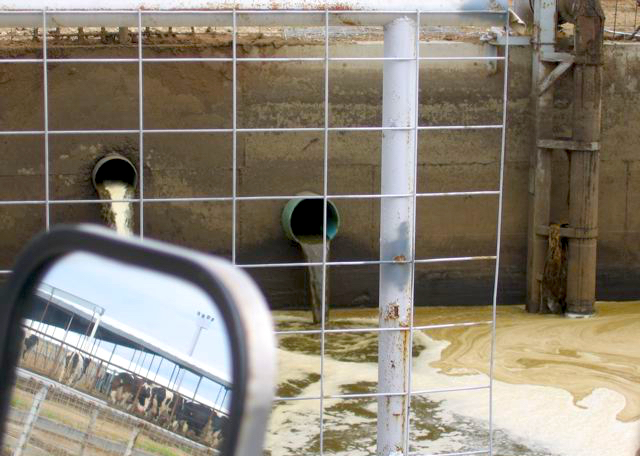
Animal sewage drains from barns at Threemile Canyon Farms.
“Without adequate oversight, there can be no question that every time the state approves a new factory farm it will be opening the door to dangerous health risks—not only for workers but for all those families unfortunate enough to have no choice but to breathe the air around those facilities.”
As I noted in my previous post, Tillamook's slogan is "Dairy Done Right." I disagree. There is a bill, SB 197, before this session of the Oregon Legislature that will set common-sense regulations for air emissions from these facilities—there are no regulations currently on the books for the ammonia and other gasses they emit—so please consider e-mailing your legislator with your concerns and ask them to support this bill.
Suggested text for a message to your senator: "I am a constituent and I am contacting you to ask that you support SB 197's passage out of the Senate Environment and Natural Resources committee and into the legislature for a vote. Oregon’s air quality should not be compromised by out-of-state mega-dairies flocking here to take advantage of our lax regulatory system. Thank you. (Signed, your name and address)"
UPDATE: Lost Valley Farm, mentioned above and one of the Boardman-area factory farms supplying milk to Tillamook, has been the subject of intense scrutiny due to owner Greg te Velde defaulting on loans, getting arrested in a prostitution sting operation and for possession of meth, as well as a history of failure to maintain the standards set out in the facility's state permit. Read that story here.
"As Oregonian as a lumberjack sharing a craft beer with a beaver, no one does cheese like Tillamook." - New Seasons sale flyer
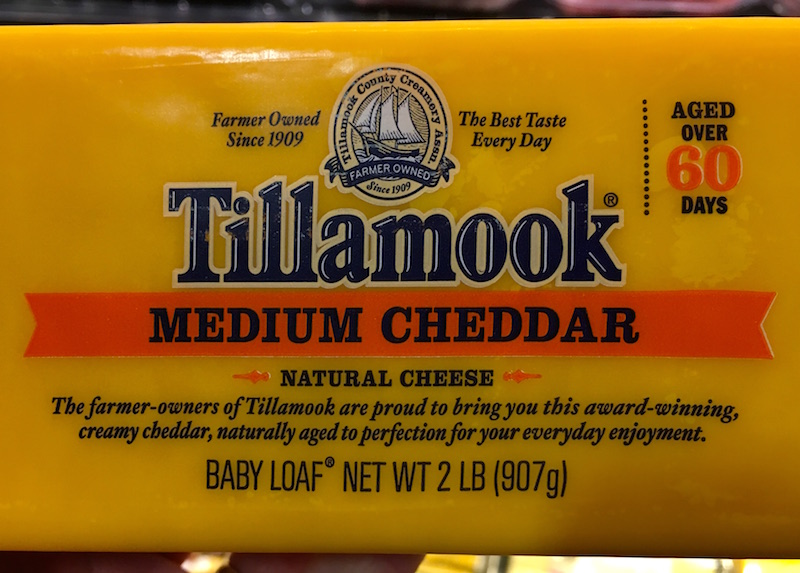
Their packaging says "Thank you for buying Tillamook and keeping our family farms strong."
Since childhood I've been a fan of Tillamook cheese. Molten and gooey inside grilled cheese sandwiches, grated into mac and cheese and melted over just about anything you can think of, its bright orange hue has been a color theme weaving through my life. On trips to the coast my parents would stop the station wagon at the cheese factory to follow the steps that the milk took from liquid to curd to sliced chunks which were finally pressed into logs, aged and dipped in wax (now wrapped in plastic) to be displayed on refrigerated shelves.
"Keeping our family farms strong."
On those same trips my parents would point out the cows munching grass in the brilliant green coastal pastures of Tillamook County, their pendulous udders swaying as they moved to the barns to be milked twice a day. "That's where our cheese comes from!" we'd think.
That's why it is with a heavy heart that I've finally decided to give up Tillamook cheese. It's not because the flavor has somehow fallen off of a cliff, or that I've discovered a better product—their extra sharp white cheddar had become our house cheese after my husband developed an intolerance to lactose. (Lactose is converted to lactic acid by cultures added to the cheese, and the longer it's aged, the less lactose remains.)
So why have I reached this decision?
Tillamook's Columbia River Processing plant in Boardman.
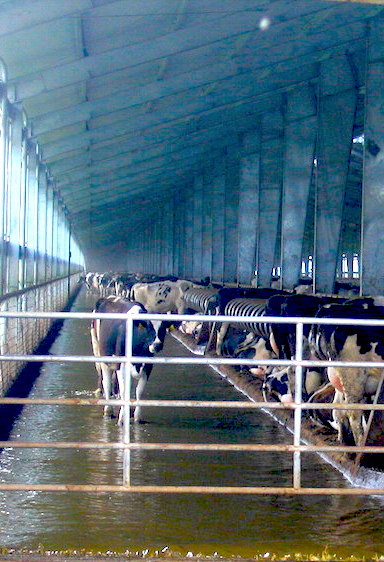
It turns out that only a portion of the milk that is used by the Tillamook County Creamery Association (TCCA)* to make their famous cheeses is produced by those cows munching that rich, coastal grass. Instead, Tillamook has partnered with Threemile Canyon Farms in Boardman on the Columbia River, a factory farm that produces around 2 million pounds (that's 233,000 gallons, folks) of milk per day from 30,000 milk cows kept during the entirety of their short lives in confined barns. Add to that another 40,000 animals consisting of calves and "replacement heifers," young females that will be added to the milking herd at two years old.
Dairy cow standing in manure slurry at Threemile Canyon Farms.
An article in the Tillamook Headlight Herald from 2012, announcing layoffs of 50 employees doing packaging at the Tillamook processing facility—outsourced to companies in Utah and Idaho—quoted then-TCCA CEO Joe Rocha as saying that "all ice cream is made in Tillamook. Other Tillamook brand products, such as yogurt, butter and sour cream, are licensed products produced by other companies. All local milk is processed in Tillamook."
Tillamook has also built a large cheese processing facility, Columbia River Processing, near Threemile Canyon Farms in Boardman that was designed to produce 58 million pounds of cheese a year at full operation. In 2014 it built a 64,000-square-foot expansion project to process whey, which is used in products like infant formula, performance nutrition products and products that "help manage some of the impacts of aging."
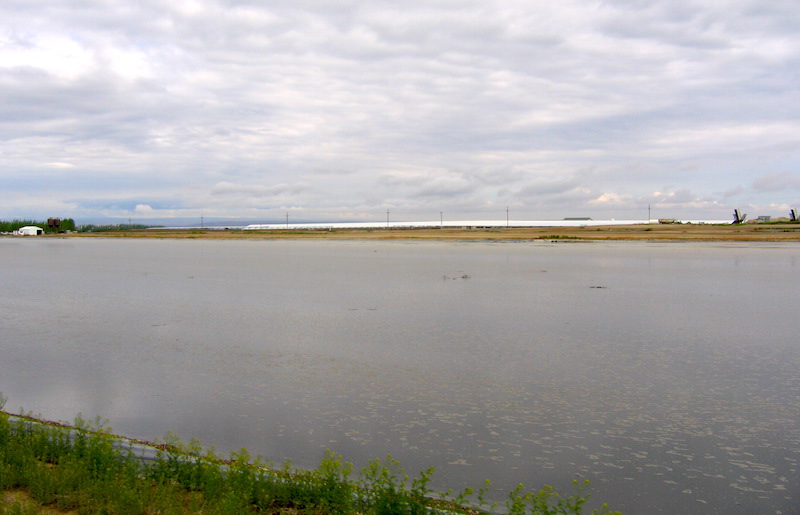
An open-air manure lagoon at Threemile Canyon covers 20 acres.
According to an article in the East Oregonian, the system is a "closed loop" where the milk cows "are loaded onto slowly rotating carousels where their udders are sprayed with a disinfectant and attached to automatic pumps. Each spin lasts just a few minutes before the cows are unloaded back where they started." The rest of the loop is made of the waste from the 70,000 animals—estimates are around 436 million gallons of liquid manure every year—that go into digesters and open lagoons that is then spread on fields of grain corn and triticale which is used to feed the cows or is made into animal bedding.
The manure spread on the fields is supposed to be carefully managed to avoid having the runoff pollute area groundwater, but an article on another proposed mega-dairy in the area, Lost Valley Farm, reports that it would add an additional 30,000 dairy cows and their waste to the already beleaguered groundwater system in the county. "The area is home to the Lower Umatilla Basin Groundwater Management Area, where the level of nitrates in the groundwater already exceeds the federal safe drinking water standard," the article notes.
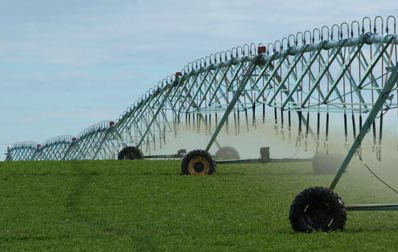
Manure slurry is sprayed directly on crops.
There are also concerns about air pollution, and groups like the Center for Food Safety, Friends of Family Farmers and the Socially Responsible Agriculture Project are pushing for new rules to regulate air contaminant emissions (SB197) from large dairy operations. In 2007, Oregon exempted large-scale livestock operations from air-quality oversight, even though elevated concentrations of ammonia from Threemile Canyon Farms have been linked to acid deposits in the Columbia River Gorge, and nitrogen compounds are contributing to elevated levels of ozone in the vicinity of these operations.
The nail in the coffin was driven in, for me, when I started to look into what these mega-dairies were doing to Oregon's small, family-owned dairy farms. As Jon Bansen, a third-generation dairyman who is hoping to someday turn his farm over to his son, wrote in an editorial in the Salem Statesman-Journal, "when the last mega-dairy, Threemile Canyon Farms, came into Oregon, an average of nine family dairy farms went out of business per month between 2002 and 2007. Mega-dairies flood the market with milk, driving down milk prices and making it increasingly difficult for family farmers to stay afloat."
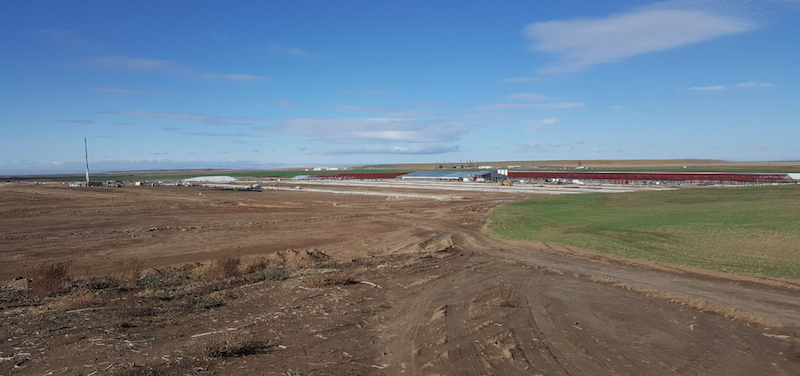
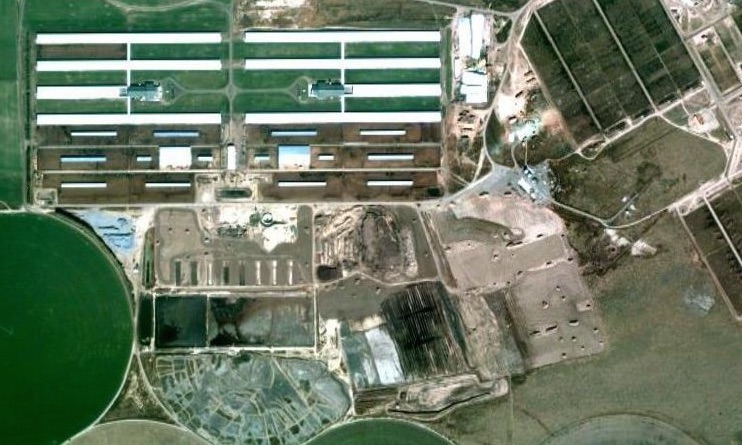
Each barn (in white) is roughly a quarter-mile long.
Mega-dairies also degrade the lives of local communities. Bansen goes on to say that "the ways in which family dairy farmers and mega-dairies contribute to a community are drastically different. When something breaks, family farmers typically buy parts from the local store. When their animals need veterinary attention, they call the local vet. They support their feed stores, tractor-supply stores and more. After a hard day on the farm, family farmers often engage in their community, schools, civic groups and churches." Employees at mega-dairies have neither the time nor the money to spend in their communities; equipment is bought from the cheapest (mostly non-local) sources; and profits are sent off to corporate, often out-of-state, offices.
So for all of these reasons I'm looking for a new, delicious source for my cheese, and I'll try to buy from small cheesemakers who source their milk from small, family farms. It'll no doubt be more expensive than the cheap-for-a-reason stuff, but I'm willing to spend a little more and use a little less if it helps to support local families and communities.
The Tillamook slogan is "Dairy Done Right." I disagree. How about you?
UPDATE: If I needed more assurance that my decision to stop buying Tillamook cheese was the right one, this past week the Oregon Department of Agriculture and the state Department of Environmental Quality both gave the go-ahead to Lost Valley Farm, a 30,000-cow mega-dairy in the Boardman area. A California-owned facility, Lost Valley joins North Dakota-based Threemile Canyon Farm in supplying milk that goes into making Tillamook cheese. According to a story in the Salem Statesman-Journal, "both dairies hold contracts with Boardman’s Columbia River Processing, which produces cheese for the Tillamook County Creamery Association, maker of Oregon’s famous Tillamook Cheese."
Lost Valley also had to gain the official approval of Morrow County's commissioners, although according to a story in the Oregonian, "the county [had] no legal way to stop what would be the state's second-largest dairy, and its three commissioners are deeply worried that it will sap already-limited groundwater from local farmers, and exacerbate water and air quality problems."
Since the county had no choice but to approve the facility despite deep misgivings, the article then asks, "that raises a crucial question for a coalition composed of local and federal government agencies, small farm advocates and environmental organizations: Are Oregon's rules for mega-dairies and livestock feedlots too loose?"
Ivan Maluski, Policy Director of Friends of Family Farmers, thinks so. "We've been warning for some time that Oregon's rules are too weak, and we're in danger of being a big factory farm state," he was quoted as saying. (Read an extended version of this update.)
UPDATE: As if I needed any more reinforcement of my decision to quit buying Tillamook products, a massive dairy sewage spill—more than 190,000 gallons—that flooded neighboring properties and entered the water systems that eventually run into Tillamook Bay has closed the bay to commercial shellfish production, according to an article in the Salem Statesman-Journal. This is the third time in the last month that dairy sewage has spilled from storage tanks or drainage ponds and caused fecal coliform readings hundreds of times higher than the standard allows. These leaks have been the subject of lawsuits on the part of local fish and shellfish operators, who often have to shut down for weeks or months twice a year during rainy periods when flooding can occur. The economic impact of this latest spill to individual fishing families and shellfish operators has not been estimated, but the cumulative effect of the shutdowns and spills to local fishing and farming communities over the years cannot be underestimated.
UPDATE: My article for Edible Portland on the dairies that supply milk to Tillamook, titled "Big Milk: Big Issues for Local Communities," expands on the topic of industrial agriculture's creeping influence in Oregon, challenging long-held traditions of our state’s agriculture as one based on small, family-scale farms.
UPDATE: Lost Valley Farm, mentioned above and one of the Boardman-area factory farms supplying milk to Tillamook, has been the subject of intense scrutiny due to owner Greg te Velde defaulting on loans, getting arrested in a prostitution sting operation and possessing meth, and a history of failure to maintain the standards set out in the facility's state permit. Read that story here.
* I contacted the Tillamook County Creamery Association Consumer Relations department for this post and was told they could not comment on the facts referenced in this post because "production numbers like the kind you are seeking are not figures that we generally share with the public."
This series interviews farmers, food activists, politicians and policy wonks to try to get a handle on the seismic shift in our local food landscape due to the change of administrations in Washington.
Elected to represent Oregon in the United States Senate in 2008, Jeff Merkley replaced conservative Republican Senator Gordon Smith in a hard-fought battle for the state's junior seat. The son of a millwright, he was born in the timber town of Myrtle Creek, Oregon, and was the first in his family to attend college, graduating with an undergraduate degree in International Relations from Stanford and a graduate degree in Public Policy at Princeton's Woodrow Wilson School of Public and International Affairs. After college Merkley worked as a national security analyst at the Pentagon and at the Congressional Budget Office, then returned to Oregon in 1991 to take a position as the executive director of Portland Habitat for Humanity. His work to provide housing for Oregonians led him to consider running for office, and he was elected to the Oregon House of Representatives in 1998, eventually becoming Speaker of the House. In his life outside of politics, he enjoys hiking and recently completed an IronMan event with his daughter. Impressive!
What are the critical issues affecting agriculture and our food system a) here in the Northwest and b) in the country as a whole?
Genetically modified organisms (GMO) labeling and climate change.
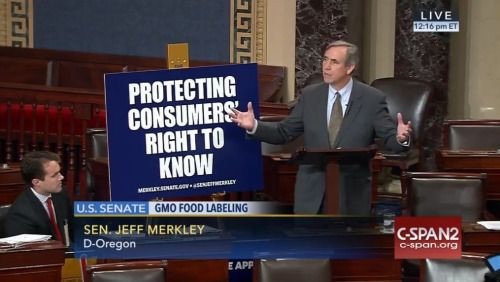
GMO labeling gives consumers easy access to the information they need to make informed food purchasing decisions. There are Federal requirements for disclosing whether fish is farm-raised or wild-caught, or whether juice is from concentrate or fresh squeezed; the same should be true for genetically modified ingredients. After all, 64 other countries—including China—allow their consumers to know whether products contain GMOs.
I have been deeply immersed in this issue, and last year introduced the Biotechnology Food Labeling Uniformity Act, which would deliver a 50-state solution instead of a potentially complicated patchwork of GMO labeling laws. Major food companies like Campbell’s, General Mills, and Mars have listened to the nine out of 10 American who agree that GMOs should be labeled, and have taken steps to voluntarily disclose this information on their products. These companies are demonstrating that it is possible to give consumers the information they want without raising costs at the grocery store.
Merkley speaking before the Senate on GMO food labeling.
As a ranking member on the Agriculture and Rural Development Appropriations subcommittee, I’ve been advocating for consumers, and organic and small farms; traditional “big” crops like corn and soybeans are already well represented by lobbyists. I will continue to advocate for Oregon’s specific agricultural needs and consumers’ right to know what’s in their food.
The devastating effects of climate change are already being felt by food systems here in Oregon—baby oysters are dying as the ocean becomes more acidic; wildfire season is longer and more intense; prolonged drought is crippling farms and ranches. And yet we have a president who believes climate change is a hoax, and an Environmental Protection Agency chief who doesn’t think humans have contributed to global warming.
Since we can’t count on the current administration to act on climate, in the coming months I’ll introduce a “100-by-50” bill to achieve 100 percent clean and renewable energy by 2050. The would provide a roadmap to clean the electric grid, electrify transportation, and promote investments in new technologies to end the use of polluting fossil fuels.
The “100-by-50” framework is something every group or organization can sign onto: Commit to operating on 100 percent clean and renewable energy by 2050, and develop a framework for how you’ll get there incrementally. Every garden club, cooking class, and family can contribute to reducing carbon emissions and curbing the effects of climate change on our food systems.
What do we as citizens need to be paying attention to? What are the best sources for information on the issues?
There is a constant barrage of misinformation coming from the current administration. I suggest you identify a favorite traditional news source—one whose information is vetted and verified—to stay informed. Find an issue that you’re passionate about and get involved.
In your opinion, what’s the most effective action citizens can take in the short term? In the long term?
The grassroots uprising by ordinary Americans has had a real effect on Congress. As we go forward, the impact of citizen action is directly proportional to the amount of individual effort it takes. If you sign a petition or send a form e-mail, you’ll help spread the message. By making a phone call or writing a personal e-mail, your message will be a little louder. The biggest impact is showing up—to town halls, to rallies, to demonstrations. Seeing hundreds or thousands or hundreds of thousands of people coalesce around an issue effectively sends a message.
Dinner at my family's table growing up was a product of the then-new and novel notion of convenience for housewives. Why spend hours preserving fruits and vegetables when you can simply open a can and have dinner on the table in less than half an hour? Cookbooks, women's magazines and television commercials touted "open a box" instant gratification for puddings, cakes, hamburger helpers and soup mixes with brand names that became part of the family—think Duncan Hines, Campbell's, Lipton and, yes, Betty Crocker.
With three kids and a husband to feed every night, and especially when she started working full time, my mother needed all the help she could get. I've joked that during my childhood I thought that Campbell's cream of mushroom soup was the glue that held the universe together. Even when I was on my own, a good tuna casserole needed that special touch that only one product—I've since found a superior recipe—could achieve. My future husband wooed me with lunches he made himself with cream of tomato soup (Campbell's to the rescue again!) and grilled cheese sandwiches.
So, as with that tuna casserole, recreating the flavors I remember and the satisfaction they provided has become a bit of an obsession. A cream of tomato soup like the one from the can with its smooth, silky, tomatoey flavor—we always made it with water rather than milk—that filled your mouth and warmed your belly is one that has been at the top of my "figure this out" list.
Lots of recipes I researched called for various herbs and spices to be added; some add vinegar or honey, probably to balance out the acidity of the tomatoes. But I was looking for a recipe that was simple to make and that would have been easy enough for my mom to whip up for her family's dinner after a long day at the office, a glass of wine in one hand (would that she would have allowed herself that) and a wooden spoon in the other.
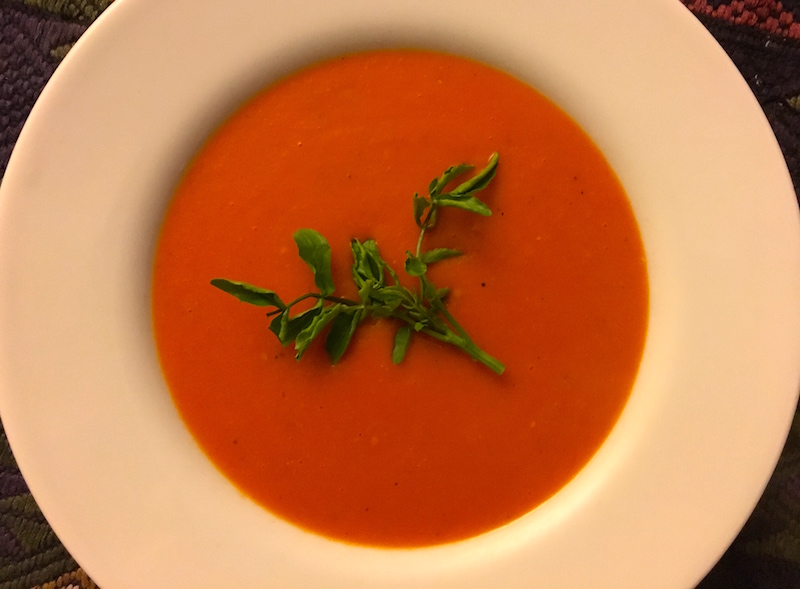
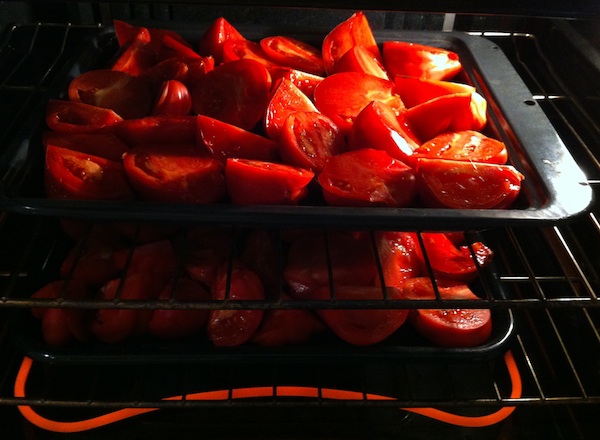
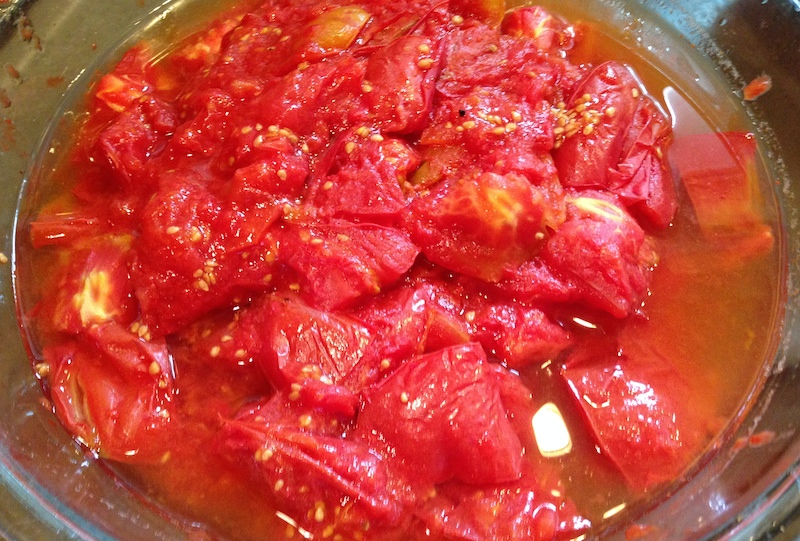
With a good supply of frozen, roasted astiana tomatoes in the freezer, I was all set with the main ingredient, and their perfect balance of sweetness to acidity made the notion of adding anything else just so much unnecessary froo-froo. Having made this soup a few times now, both with and without grilled cheese sandwiches, it's always brought back those days of yore, but with the satisfaction of knowing I no longer need help from the folks at Campbell's.
Creamy Roasted Tomato Soup
8 Tbsp. (1 stick) butter 1 large onion, chopped fine 3 cloves garlic, minced 1/4 c. flour 2 qts. (8 c.) roasted tomatoes or 3 28-oz. cans crushed tomatoes with their juices 2 c. chicken broth 1 Tbsp. kosher salt plus more to taste 1 tsp. celery salt 1/2 tsp. black pepper
In a Dutch oven or large soup pot, melt butter over medium heat. Add onion and sauté until tender and translucent. Add garlic and continue to sauté 2 minutes. Add flour and stir, making sure it doesn’t stick to the bottom of the pan, for 3 minutes. Add broth, tomatoes, salt, celery salt and pepper. Bring to a boil, then reduce heat to simmer for 30 minutes, stirring frequently to make sure nothing sticks to the bottom of the pan. Remove soup from heat and, using an immersion blender, purée the soup thoroughly until smooth*. Add more salt to taste, if needed. Serve.
* I don't mind a little texture from any bits that don't get totally blended in, but if you want a completely silky smooth finished product, you can press it through a sieve, which will catch any remaining seeds or other bits.
It's officially fall. The ash trees surrounding our house are turning golden, coloring the light that spills in the kitchen windows. The leaves that have fallen are dry and crispy, crunching under the feet of the neighborhood children walking to school. The urge to kick through the drifts of leaves on the parking strip is almost impossible to resist, and I can hear that most autumnal of sounds as the kids (and sometimes their parents) succumb to their siren song.
Nighttime temperatures are getting down into the 40s, requiring the addition of thick comforters to the beds, and mornings are brisk, with just enough of a chill to require pulling on a fleece jacket to walk the dogs first thing. The days warm up to the 70s by noon, and a glass of wine on the porch of an evening as the sun sets isn't out of the question just yet, warmth-wise.
This is what my parents used to call nigh-perfect Indian summer weather in the Northwest, though I'm beginning to think of it more and more as the onset of braising weather, time to pull out the Dutch oven for the season of low and slow-cooked meats and vegetables.
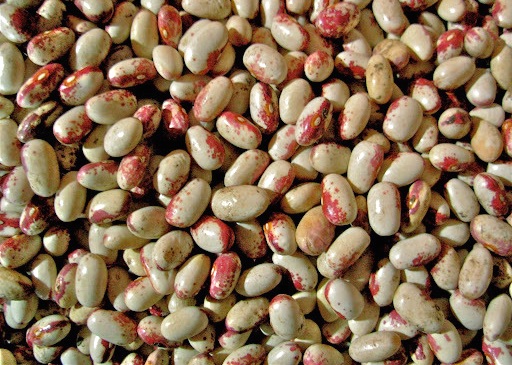
This year's crop of dried beans have begun showing up at the farmers' markets, and I was recently gifted some Rockwell beans from Willowood Farm on Washington's Whidbey Island. This variety was originally grown by an island pioneer, Elisha Rockwell, in the late 1800s, and it was brought back into production recently by farmer Georgie Smith when she took over the land her family had been farming on Ebey's Prairie since the 1890s.
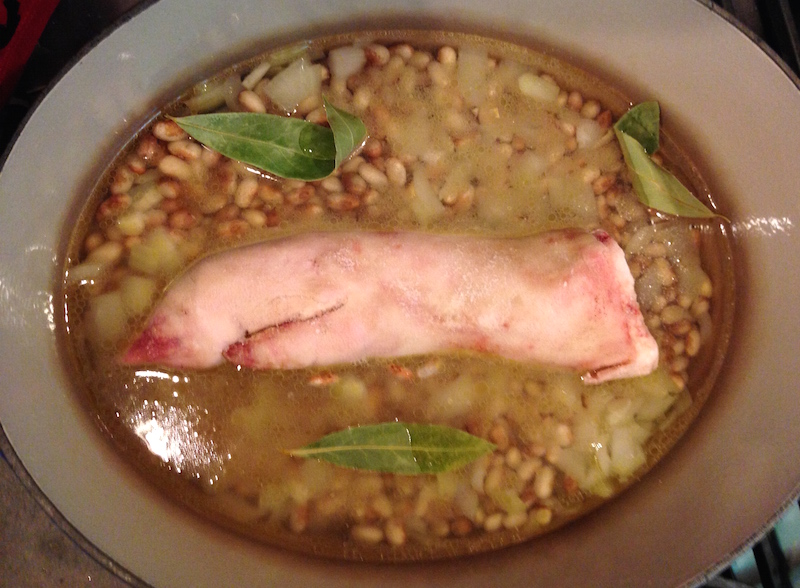
Beans don't need much besides water, onions and garlic to make a mighty tasty main course, served with a hunk of hearty bread and maybe a drizzle of olive oil, but I happened to have a pig trotter (top photo) from the Square Peg Farm pig I'd butchered last winter. Beans and pork are a natural pairing, and the fattier the cut of pig the better. Trotters are almost all fat, and over several hours it gave a porky unctuousness to the pot. A half pound of bacon works well, too, and can be chopped or shredded before or after braising. Even a pound of pork shoulder will do its work on the beans, and can be shredded afterwards to make a beany, porky chili.
Regardless of how you decide to cook them, grab a few different kinds of beans from your local farmers' market and take them for a spin in a pot. I guarantee you'll find one (or more) you'll love, not to mention they'll warm up your family's bellies on these crisp fall nights.
Basic Braised Beans
1 lb. dried beans 3 Tbsp. olive oil 1 onion, chopped roughly 3 cloves garlic, chopped fine Water 1 Tbsp. salt, plus more to taste
Depending on the type of bean, you may need to soak them overnight in water (cover by 2"). Check with the farmer or follow directions if they're packaged. Drain and rinse prior to cooking.
Preheat oven to 300°.
On top of stove over medium heat, add oil to pot and heat until it shimmers. Add onion and sauté until tender, then add garlic, sautéing briefly until it's fragrant but not browned. Add drained beans and cover with fresh water by 1". Add salt and stir briefly. Add bay leaves and pork if using.
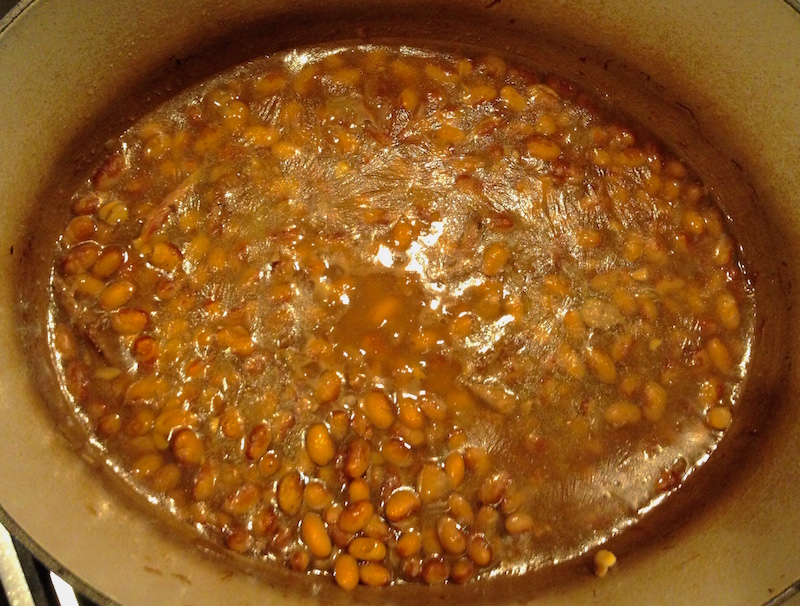
When it comes to a simmer, cover the pot and put it in the oven for at least four hours or until beans are tender and meat (if used) is falling apart. Check occasionally and add water to cover if the beans have absorbed it all (the amount of water needed will vary with the type of beans and if they have been presoaked). If meat has been used, remove it to a cutting board and chop or shred it, then add it back to the beans.
This can also be done on top of the stove. Simply keep the beans on a low simmer, covered, and check occasionally to make sure all the liquid hasn't absorbed.
I made this soup the other night, and if you looked up "comfort" in the dictionary, it wouldn't show your mom or your teddy bear or your pillow or your fuzzy slippers. It would be a picture of this soup along with the recipe. (BTW, I puréed it this time…what can I say but OMG.) Warm, terrifically flavorful and fill-your-belly delicious, it's easy and perfect for the season. And, though I don't do this often, I'm rerunning the original post I wrote two years ago. Enjoy.
Just before the holidays I was out at Ayers Creek Farm helping Carol and Anthony get ready for the big holiday market at Hillsdale. Well, I say "helping" but it's more like "trying to not seriously f*** things up" while packing boxes of preserves, weighing and measuring beans, polenta and wheat into little bags with a big scoop.
One of the great things about these days at the farm, aside from getting to wear my boots if outside work is required, is sitting down at the table for a big lunch of soup or stew, a hefty loaf of bread and a nice chunk of cheese. On this day, a bit before lunchtime, Carol asked me to pull a big pot out of the fridge that contained braised leeks and potatoes in a white-ish liquid.
While that warmed on the stove, Carol and I went just outside to the kitchen garden to gather a few leaves of sorrel that hadn't yet gone dormant. (Note to self: plant this next year!) It was chopped and thrown into the pot, a cup or so of sour cream was stirred in with some salt and we had a classic "Potage Bonne Femme," a potato leek soup rather like vichysoisse only with more leeks than potatoes.
Carol prefers to use water to cook her vegetables rather than chicken stock, feeling that the flavor of the leeks is more pronounced. In my attempts to recreate this at home, I used half chicken stock and half water and it didn't seem to overwhelm the leeks, and also added a little richness. I've made it with both real sour cream and (purists don't choke) Tofutti sour cream—Dave's lactose intolerant, remember—and both were amazing, even according to my very choosy son who's not crazy about substituting tofu products for the real thing.
It's a comforting, rich and company-worthy meal that is super simple to make in an hour or so. Add a crusty loaf of bread and some cheese with an ice-cold glass of French chardonnay alongside and you're going to get raves from your crew.
Potage Bonne Femme (Potato Leek Soup)
3 Tbsp. butter 4 leeks, halved and cut into 1/2" slices, about 4 c. 3 Tbsp. flour 2 c. water 2 c. chicken stock 4 med. Yukon gold potatoes, peeled and chopped into 1/2" or so cubes 2 tsp. salt 1 c. sour cream 1 c. coarsely chopped sorrel (optional) 3 Tbsp. chives, minced (optional)
Melt butter in soup pot or large Dutch oven over medium heat. Add chopped leeks and cook slowly for 5 min. Remove from heat, add flour and stir. Put back on heat and cook, stirring constantly and without browning for a minute. Add water and stock, stirring well. Add potatoes and salt. Bring to boil and lower heat to simmer for 50 minutes. Add sour cream and chives and stir to heat. Adjust salt to taste. Serve, garnished with chopped chives.
Option: Purée with immersion blender before adding the sour cream or cool and purée in a food processor (or blender) in batches. For a vegetarian or vegan version, substitute margarine for the butter and use water or a vegetable stock and Tofutti sour cream. Really, it'll be fantastic.
cognitive dissonance: the discomfort experienced when simultaneously holding two or more conflicting cognitions: ideas, beliefs, values or emotional reactions. In a state of dissonance, people may sometimes feel "disequilibrium": frustration, hunger, dread, guilt, anger, embarrassment, anxiety, etc.
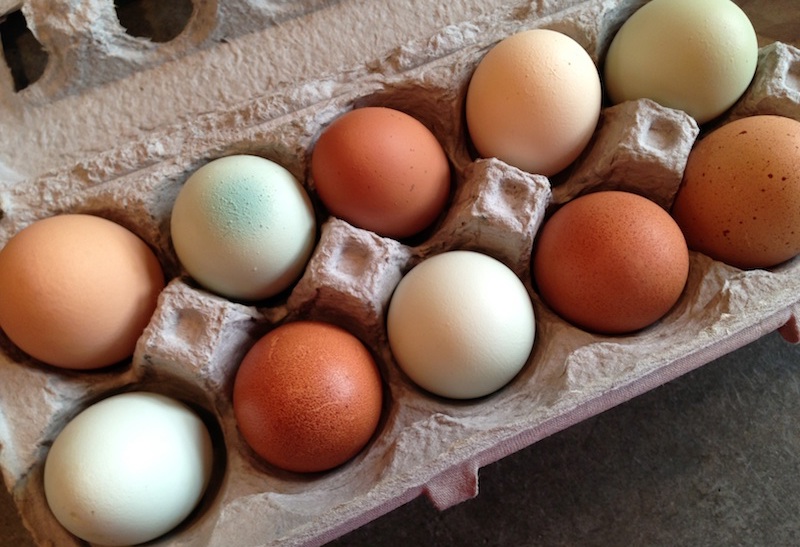
This is the perfect definition of my state of mind at this time of year, though my situation is probably not what psychologists were considering when they came up with the term. To wit: I love farm fresh eggs, whether purchased at the farmers' market or my favorite independent farmer, with their pastel green, beige, brown, dark brown or even bronze shades and variously speckled or, as my 3-year-old nephew says, "sparkly" shells. (I let him pick out his own eggs for scrambling—he always chooses the sparkliest.)
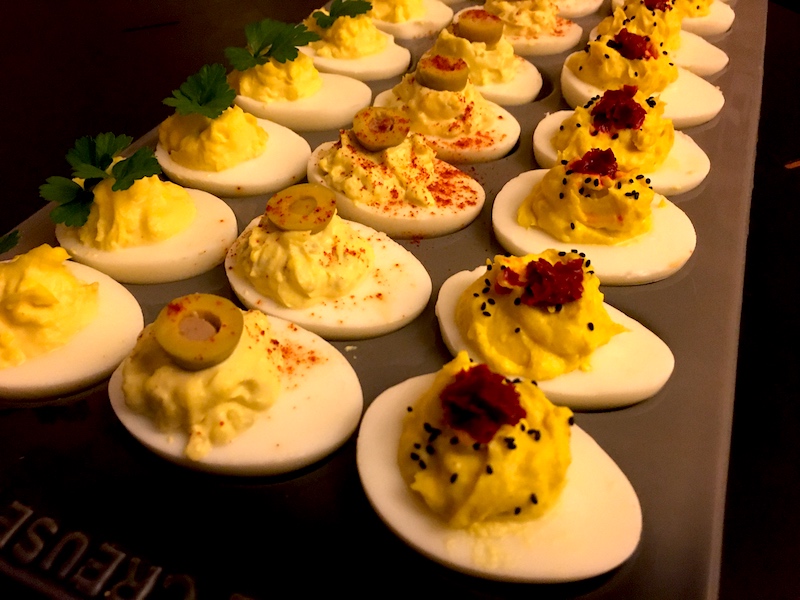
The problem comes when I need to hard-boil them for potato salad or, worst, for deviled eggs where the solid whites need to be pristine holders for the fluff of yolk that sits in their convex cups. The magic of the preparation dims substantially if the whites look more like 4-wheel-drive tire treads, and I've struggled with various techniques to make these fresh eggs easier to peel. I've even gone so far as to buy store-bought eggs in a desperate moment, knowing that they're likely at least a month old and the membrane surrounding the white has started to break down, releasing its sticky hold on the shell.
Some research gave me a new, and even deadly, superpower. With it I can now hard boil the freshest of fresh eggs and they'll peel like a dream, practically falling off the egg with the slightest of tugs. I'm sharing it with you so that your summer can be full of the loveliness of those dreamy yolks and pristine whites. But, like all superpowers, you must promise to use it only for good.
Hard-Boiled Fresh Eggs
Make sure your eggs are at room temperature. This will reduce cracking when submerging them in boiling water.
Bring a pot of water to boil over high heat.
Slowly lower the eggs into the boiling water.
When boiling resumes, set timer for 15 min. and reduce heat to keep at a low boil.
When timer goes off, drain eggs and submerge in ice bath until chilled, then peel.
With salmon filets and steaks running up toward twenty bucks a pound at the fish counter, this time of year, when I'm craving it, I buy the whole fish, head on, for much less per pound. This way you get the (cleaned) fish, which you can throw on the grill with herbs and lemon stuffed into the cavity. You can also have your fishmonger filet it, or you can slice it into steaks yourself. But any way you choose to cook it, make sure to save the head, fins and tail to make a terrific fish broth for your next risotto or paella.
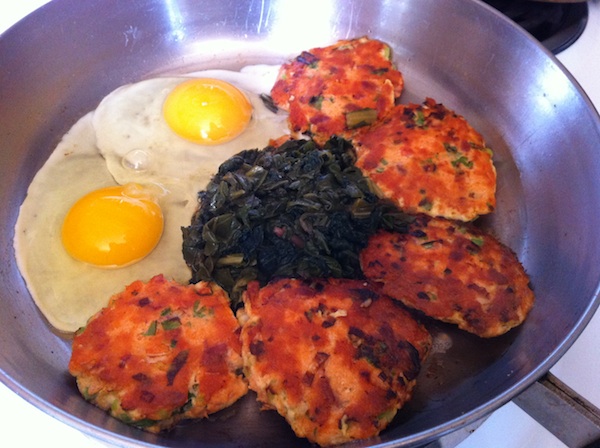
Cakes for breakfast!
With out-of-town friends coming over for dinner, and wanting to share some of the crazy goodness of the Northwest, we grilled a whole salmon with a side of wild mushroom risotto and a salad of seasonal greens. Throw in some local red to go with the fish, a fruit crisp made with the last of the frozen berries to top off the meal, and they were putty in our hands. Even with everyone eating their fill, there was a good amount of fish left over…which fit into my clever plan to make salmon cakes for dinner a couple of nights later.
These cakes are great as an appetizer or with a salad for a simple dinner, and they also make a great breakfast with eggs, sautéed greens and a slice of homemade bread. It's not necessary to have all the ingredients—the fish, mayo and eggs are the critical ingredients—so the seasonings can go in any direction you desire. These are meant to be mostly meat, with just enough of the other ingredients to (barely) hold it together.
And if you ever happen to have any leftover smoked salmon (does that really happen?), that would be the gilding on this particular lily.
Salmon Cakes
2 c. cooked salmon, flaked 1-2 Tbsp. mayonnaise 1/4 c. minced red or green onion 2 cloves garlic, minced 1 serrano pepper, seeded and finely minced 2 Tbsp. cilantro, minced 1/4 c. bread crumbs Zest of 1 lime Juice of 1 lime 1 egg
Combine salmon with other ingredients (except oil) and mix thoroughly. Form into loose cakes about 2" across. Can be refrigerated at this point, which will firm up the cakes a bit, but it's not necessary. Heat 2 Tbsp. olive oil in medium frying pan until it shimmers. Put cakes in pan, but don't crowd them—do them in batches if necessary. Cook until browned, then carefully flip them over and brown on the other side. Makes about eight cakes.
I love my little upright freezer. It allows me to buy berries with impunity, pulling them out on cold, rainy days when I desperately need a reminder that summer will, indeed, come again. And because I usually had my nose in a book when my mother was hauling out her big speckled enamel canner, all I have to do now is dump the roasted tomatoes from the grill into freezer bags and pull them out when pizza or pasta requires saucing.
On those nights when it's time for dinner (again???) and ideas are in short supply, I can open the door, survey the stocks, meats and sauces and come away with armloads of inspiration.
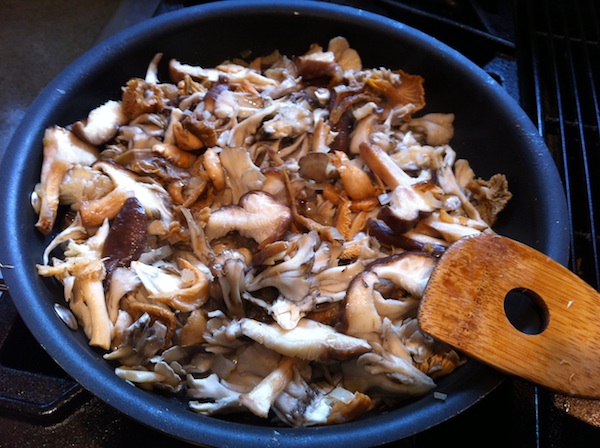
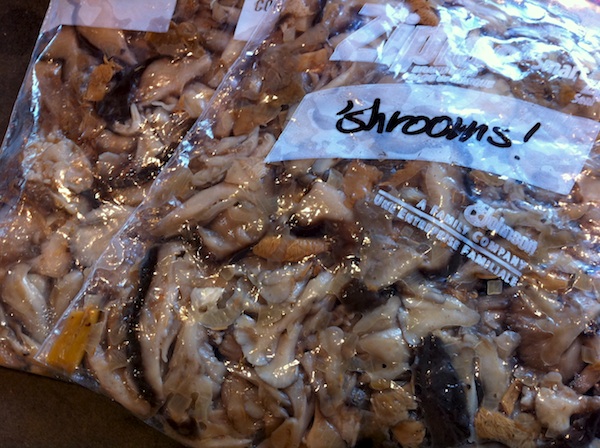
So when a couple of pounds of Springwater Farms' gorgeous fresh mushrooms followed me home from the Hillsdale Farmers' Market, I tore them up, sautéed them with some shallots and white wine and spooned them into a couple of freezer bags. It's pretty much guaranteed that soon I'll open that door again and hear a whisper about ragu or risotto or chowder.
Wild Mushroom Duxelles
2 lbs. wild mushrooms 2 Tbsp. olive oil 2 shallots, minced 1/4 c. dry white wine or dry vermouth
Tear or slice mushrooms into bite-sized pieces. Heat oil in a skillet, add minced shallots and sauté briefly to warm them. Quickly add mushroom pieces and sauté until they release their juices and pans looks dry. Add wine and sauté till most of the moisture is evaporated. Allow to cool. Can be used immediately or put in freezer bags and frozen for later use.
Cows, sheep, chickens…sure. Normal farm animals. Stretch a little and maybe you'll come up with birds, bees, bugs. Even coyotes or other predators. But contributor Anthony Boutard of Ayers Creek Farm in Gaston has noticed yet another creature that calls his farm home.
Moss Animals
Our trips to the irrigation pump are less frequent as temperatures moderate. We are starting to withhold water from the annual crops. For the berries, however, watering through September is critical so the primocanes, which will bear next year's crop, can put on as much growth as possible. Heavy canes bear better fruit. Winter crops like the cabbages, chicories and parsnips must also receive a good dose of water for good root development. When starting the pump, we watch the water carefully for any changes in quality.
This week, a new creature appeared near the pump station. A large moss animal, or Bryozoan, was drifting in water (top photo). A gelatinous mass about the size of a soccer ball, it is known to bryozoologists as Pectinatella magnifica (left, from Wikimedia). It is the largest of the 22 freshwater moss animals found in North America. Most are delicate creatures that go unnoticed by all but a handful of dedicated professionals. Pectinatella is hard to ignore, and brought us back to invertebrate zoology class.
The bryozoans are invertebrate animals with a nervous system and a gut, and in the same general evolutionary branch as sea urchins and lamp shells. They feed on bacteria and algae using feathery tentacles reminiscent of corals. Like corals, they are colonial animals, and the large mass drifting in our irrigation channel is actually a colony of individuals that are fused together in the gelatinous matrix. Ambling along the bank, we saw several other colonies ranging in size from a softball to a medicine ball. They need warm, clean water. As the water temperature drops below 60 degrees (15 C), the colonies will die. The species carries on by producing a resting stage called a statoblast, and next year these will grow into new colonies.
Most of 4,000 or so bryozoans are marine animals, and attach themselves to rocks, piers and ship hulls. Of the many animal orders covered in invertebrate biology class, we would nominate a bryozoan as an unlikely resident of a Willamette Valley farm. Obviously, we weren't paying attention to the mention of 50 freshwater species separated into the Class Phylactolaemata, and their preference for clean, still waters.
Water is every farmer's vulnerability. We fret constantly about the supply, delivery and quality. Seeing this stately creature drifting slowly in the water, with its ancestry stretching back 450-million years to the Ordovician Period, provided a comforting benediction on the irrigation ditch.



 Nighttime temperatures are getting down into the 40s, requiring the addition of thick comforters to the beds, and mornings are brisk, with just enough of a chill to require pulling on a fleece jacket to walk the dogs first thing. The days warm up to the 70s by noon, and a glass of wine on the porch of an evening as the sun sets isn't out of the question just yet, warmth-wise.
 This year's crop of dried beans have begun showing up at the farmers' markets, and I was recently gifted some Rockwell beans from
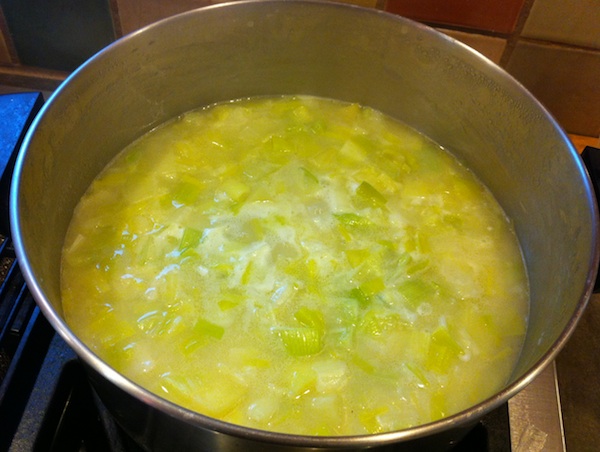 One of the great things about these days at the farm, aside from getting to wear my boots if outside work is required, is sitting down at the table for a big lunch of soup or stew, a hefty loaf of bread and a nice chunk of cheese. On this day, a bit before lunchtime, Carol asked me to pull a big pot out of the fridge that contained braised leeks and potatoes in a white-ish liquid.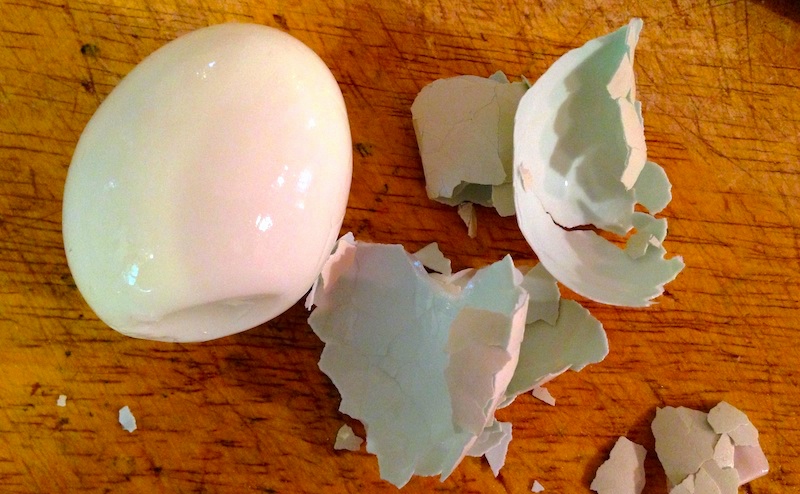
 The problem comes when I need to hard-boil them for potato salad or, worst, for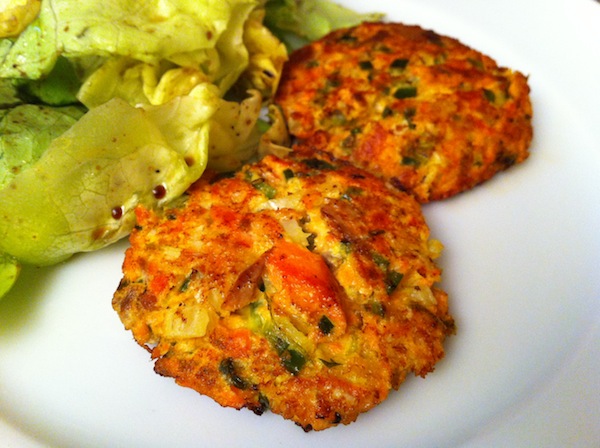
 On those nights when it's time for dinner (again???) and ideas are in short supply, I can open the door, survey the stocks, meats and sauces and come away with armloads of inspiration.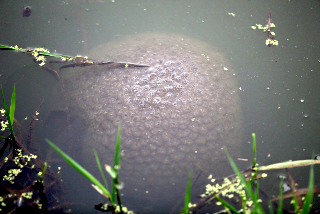
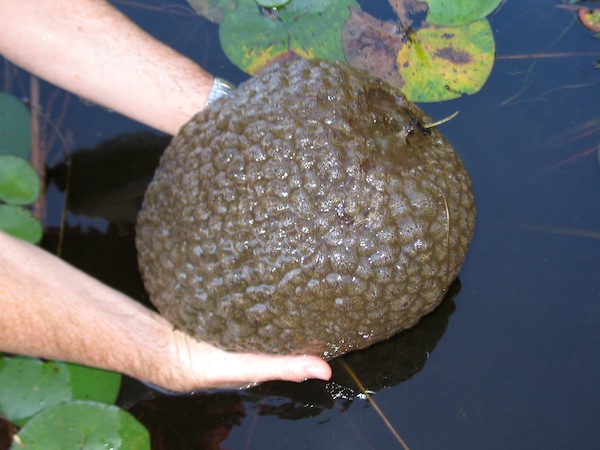 This week, a new creature appeared near the pump station. A large moss animal, or Bryozoan, was drifting in water (top photo). A gelatinous mass about the size of a soccer ball, it is known to bryozoologists as Pectinatella magnifica (left, from Wikimedia). It is the largest of the 22 freshwater moss animals found in North America. Most are delicate creatures that go unnoticed by all but a handful of dedicated professionals. Pectinatella is hard to ignore, and brought us back to invertebrate zoology class.