No, in case, after reading this post's title, you're thinking, "Whaaaaat?"…Henry David never went to Alaska. (Just wanted to clear that up before we went any further. See end of this post for details.)
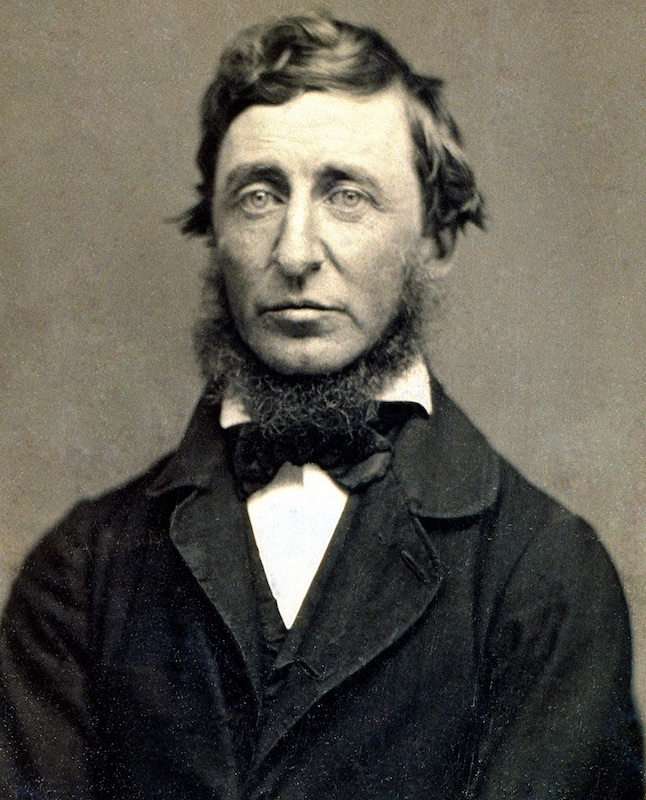
Henry David Thoreau in 1856, age 39.
In fact, Thoreau rarely left the region surrounding Concord, Massachusetts—a few trips to Maine, New Jersey and Connecticut notwithstanding—preferring to make an intimate connection with the flora and fauna of his New England home. Despite that, in Henry David Thoreau, A Life, author Laura Dassow Walls places him squarely in the middle of the great debates and characters of his time, flying in the face of my impression of him as a hermitic recluse living in a hut by a pond.
Thoreau was just shy of his 28th birthday when he moved from his family's home in town and into the simple cabin he built on Walden Pond, the subject of his most popular book. A little more than two years later, he returned to his family's home and lived there for much of the rest of his life. Thoreau earned his primary living as a surveyor, but pursued his writing, speaking tours and correspondence with the likes of poet and philosopher Ralph Waldo Emerson, a lifelong friend; the poet Walt Whitman; abolitionist Frederick Douglass; Margaret Fuller, a journalist and women's rights activist; and the well-known naturalist Louis Agassiz, with whom he had several very public disagreements.
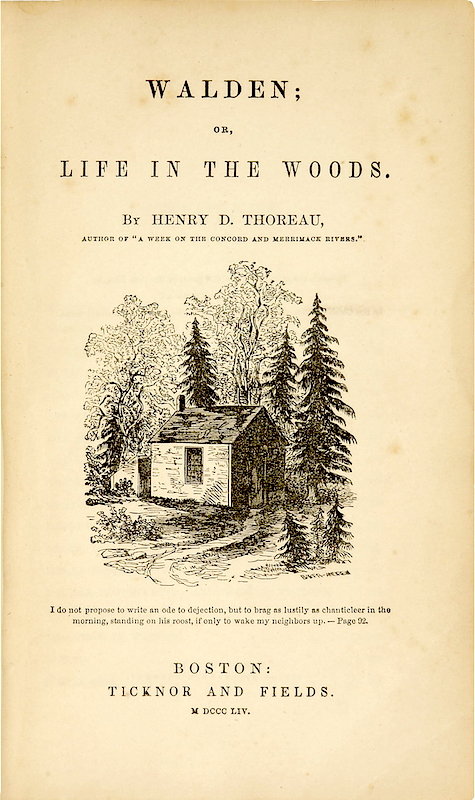
Title page of Walden, drawing by his sister Sophia.
Despite recurring bouts of chronic tuberculosis which he'd contracted as a young man, he traveled widely throughout New England, lecturing on a range of topics, from Trancendentalism to the abolition of slavery—he raised money and defended the campaign of John Brown, even issuing a fiery defense after Harper's Ferry—and, of course, the need to conserve the nation's natural areas for future generations.
Immensely engaging and well-written, this biography is going on my own list of books I've loved. Walls quotes extensively from Thoreau's writing and personal journals but, rather than being pedantic, it drew me into his inner life and thoughts, breathing life into a colorful, fascinating man I only thought I knew.
Meet Jon Bansen, a pasture-based dairyman in Oregon's Willamette Valley, in this profile I wrote for Civil Eats' Farmer of the Month series.
Fourth-generation farmer Jon Bansen translates complex grazing production systems into common-sense farm wisdom.
In the U.S., the dairy industry is a tough business for organic and conventional producers alike, with plunging prices and changing consumer demand leading to a spate of farm shutdowns and even farmer suicides. And in Oregon, where dairy is big business—accounting for 10 percent of the state’s agriculture income in 2016—the story is much the same.
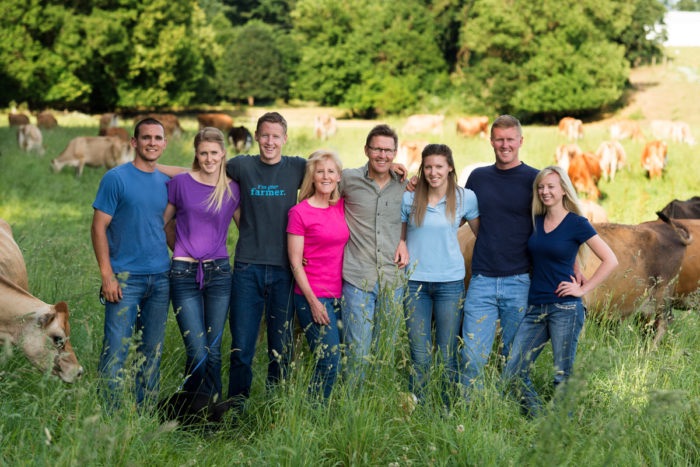
But Jon Bansen, who has farmed since 1991 at Double J Jerseys, an organic dairy farm in Monmouth, Oregon, has throughout his career bucked conventional wisdom and demonstrated the promise of his practices. Now he’s convincing others to follow suit.
Bansen and his wife Juli bought their farm in 1991 and named it Double J Jerseys, then earned organic certification in 2000. In 2017, he switched to full-time grass feed for his herd of 200 cows and 150 young female cows, called heifers. He convinced his brother Bob, who owns a dairy in Yamhill, to convert to organic. His brother Pete followed suit soon after. (“He’s a slow learner, that’s all I can say,” Bansen joked.)
He’s someone who prefers to lead by example, which has earned him the respect of a broad range of the region’s farmers and ranchers, as well as its agricultural agencies and nonprofits.
“Jon is an articulate spokesperson for organic dairy in Oregon and beyond,” said Chris Schreiner, executive director of Oregon Tilth, an organic certifying organization. “His passion for organic dairy and pasture-based systems is contagious, and he does a great job of translating complex grazing production systems into common-sense farmer wisdom. His personal experience … is a compelling case for other dairy farmers to consider.”
George Siemon, one of the founders of Organic Valley, the dairy co-operative for which Bansen produces 100 percent grass-fed milk under Organic Valley’s “Grassmilk” brand, believes the switch to 100 percent grass is a direction that Bansen has been moving in all along.
“He’s just refined and refined and refined his organic methods,” said Siemon, admitting that Bansen is one of his favorite farmers. “He’s transformed his whole farm. It’s a great case when the marketplace is rewarding him for getting better and better at what he does and what he likes to do.”
Deep Roots in Dairy Farming
Dairy farming is baked into Bansen’s DNA, with roots tracing all the way back to his great-grandfather, who emigrated from Denmark in the late 1800s, settling in a community of Danes in Northern California. His grandfather followed in the early 1900s, hiring out his milking skills to other farmers until he saved enough to buy his own small farm near the bucolic coastal town of Ferndale in Humboldt County.
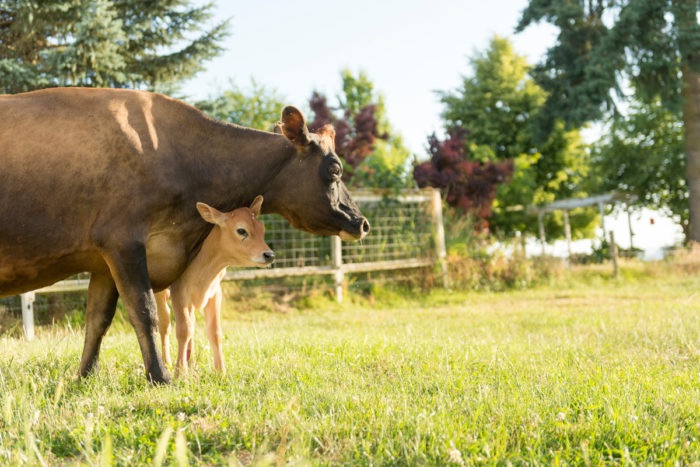
Bansen was about 10 years old when his father and their family left the home farm to strike out on their own in Oregon’s Willamette Valley. They bought land in the tiny, blink-and-you’ll-miss-it town of Yamhill, about an hour southwest of Portland.
A typical farm kid, Bansen and his seven siblings were all expected to help with the chores. “You fed calves before you went to school, and you came home and dinked around the house eating for awhile until you heard Dad’s voice beller at you that it was time to get back to work,” Bansen recalled. “I was a little envious of kids that lived in town and got to ride their bikes on pavement. That sounded pretty sexy to me.”
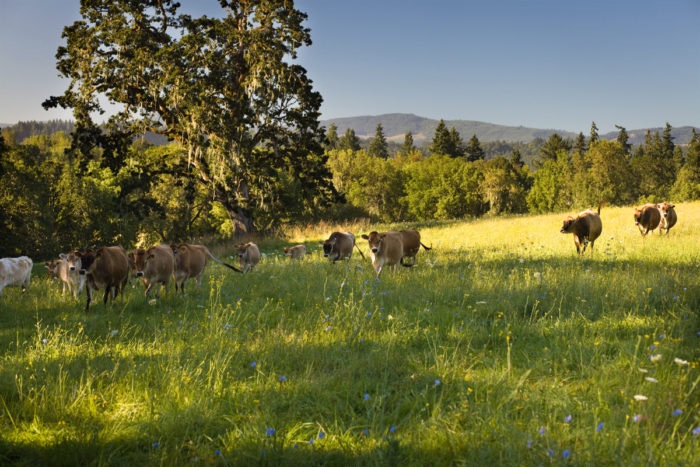
After studying biology in college in Nebraska and getting married soon after graduating, Bansen and his wife worked on his dad’s Yamhill farm for five years and then began talking about getting a place of their own. They found property not far away outside the sleepy town of Monmouth. It had the nutritionally rich, green pastures Bansen knew were ideal for dairy cows, fed by the coastal mists that drift over the Coast Range from the nearby Pacific Ocean.
One day, a few years after they’d started Double J Jerseys, a man knocked on their door. He said he was from a small organic dairy co-op in Wisconsin that was looking to expand nationally. He wondered if Double J would be interested in transitioning to organic production, mentioning that the co-op could guarantee a stable price for their milk.
It turned out that the stranger was Siemon, a self-described “long-haired hippie” who’d heard about Bansen through word of mouth. “He was reasonably skeptical,” recalls Siemon. “He wanted to make sure it was a valid market before he committed, because it’s such a big commitment to go all the way with organic dairy.”
For his part, Bansen worried that there wasn’t an established agricultural infrastructure to support the transition, not to mention the maintenance of an organic farm. “I was worried about finding enough organic grain,” he said.
On the other hand, however, the young couple needed the money an organic certification might bring. “We had $30,000 to our name and we were more than half a million dollars in debt” from borrowing to start the farm, Bansen said.
After much research and soul-searching, they decided to accept Siemon’s offer and started the transition process. It helped that his cousin Dan had transitioned one of his farms to organic not long before and that generations of his family before him had run pasture-based dairies.
“My grandfather, he was an organic dairy farmer, he just didn’t know what it was called,” Bansen said. “There were no antibiotics, no hormones, no pesticides. You fed your cows in the fields.”
The Organic Learning Curve
During the Bansens’ first organic years, they had to figure out ways to eliminate antibiotics, hormones, and pesticides—all of which Bansen views as “crutches” to deal with management issues.
To prevent coccidiosis, a condition baby cows develop when they don’t receive enough milk and are forced to live in overcrowded conditions, for example, Bansen fed his calves plenty of milk and made sure they had enough space.
To prevent cows from contracting mastitis, an infection of the mammary system, he changed the farm’s milking methods.
Another learning curve had to do with figuring out the balance of grain to forage (i.e., edible plants). Originally Bansen fed each of his cows 20 pounds of grain per day, but after switching to organic sources of grain, he was able to reduce that to four or five pounds a day. This switch cut down grain and transportation costs dramatically.
He also had to learn to manage the plants in the fields in order to produce the healthiest grazing material possible. Since the transition to organic, Double J has grown to nearly 600 acres, a combination of pastures for the milking cows, fields for growing the grass and forage he stores for winter, when it’s too cold and wet to keep the animals outdoors.
“It’s not a machine; it’s a constant dance between what you’re planting and growing and the weather patterns and how the cows are reacting to it,” said Bansen. “There’s science involved in it, but it’s more of an art form.”
Read the rest of the article and find out why Bansen made the decision to transition to a grass diet for his cows, and why he's "sick of farmers bitching about the price of milk and [then] going down to Walmart to buy groceries and taking their kids out to McDonald’s. You have no right to bitch about what’s going on in your marketplace if you’re not supporting that same marketplace."
This post summarizes media coverage involving incidents at Lost Valley Farm, one of two mega-dairies in the Boardman area that supply milk to the Tillamook County Creamery Association (TCCA) for its dairy products, including Tillamook cheese. Source materials used are listed at the bottom of the post.
Even before it opened, the Boardman-area mega-dairy known as Lost Valley Farm, owned by Greg te Velde of Tipton, California, was skirting state regulations by starting construction of the dairy without having the proper permits in hand.
An article in the Salem Statesman Journal reported that "Oregon regulators approved te Velde’s Lost Valley Farm in March [2017], despite formal objections from a dozen state and national health and environment organizations that raised concerns about air and water pollution, water use and health impacts on nearby communities."
According to an article in the Capital Press, in its first year of operation alone, it:
Was sued by Daritech, a dairy equipment manufacturer, in federal court for allegedly failing to pay in a timely fashion more than $340,000 for the installation of equipment.
Was sued by IRZ Consulting for not fully paying for labor, equipment, materials and other services related to the construction and improvement of real estate.
Was sued by Laser Land Leveling, Inc., which sought to recover $1.4 million for labor, materials and other services. (The suit was settled out of court.)
Did not report as required on wastewater from the dairy that had overflowed into a pit not authorized for storage.
Did not maintain adequate lagoon storage capacity to deal with runoff in case of a storm.
Did not report as required that liquid and solid manure had discharged from a tank, flowing into areas unauthorized for waste storage.
Was issued three notices of non-compliance with its CAFO permit between late June and late November of [2017], which required corrective actions.
Then the Statesman-Journal reported that te Velde had been convicted in July of 2017 of "careless driving contributing to an accident" after he hit an Oregon Department of Transportation truck on Interstate 84 in Hood River County and was fined $450. The same article reported that te Velde was arrested in August in a Tri-Counties, Washington, prostitution sting on charges of patronizing a prostitute and possessing methamphetamine. He was booked into the Benton County jail and subsequently released on bail.
At the time of his arrest in the prostitution sting, the same article reports, the Tillamook creamery, which processes the milk from Lost Valley and another mega-dairy in Boardman for most of its dairy products, issued a statement saying "we were extremely disappointed to learn of these allegations, and they very clearly go against the values and behaviors we hold true at the Tillamook Creamery Association." The article quotes Tillamook as stating that "the staff that we’ve worked closely with at Lost Valley are hard-working and dedicated to supplying high-quality milk, and we recognize that the alleged personal actions of one individual should not tarnish the professional reputation of everyone involved in the operation. That said, we expect the Lost Valley Farm organization to respond swiftly, responsibly and with a high degree of accountability in regards to this situation."
Lost Valley's problems didn't end there.
In February of 2018, the Capital Press reported that the State of Oregon had slapped Lost Valley with a $10,640 fine for allegedly discharging waste in violation of permit conditions, an amount that many critics called a slap on the wrist considering the number of violations found and the four citations the facility had been issued. Then in late February, the state decided to sue the mega-dairy for "repeatedly endangered nearby drinking water by violating environmental laws" and saying it should be shut down immediately, according to an article in the Statesman-Journal.
The Oregonian reported that "in the state’s lawsuit, inspectors said that te Velde and [Lost Valley manager] Love stored waste and wastewater in areas not permitted for it; never completed building all the required lagoons and other facilities to store it; the existing facilities regularly overflowed when it rained; they removed parts from a storage tank after agreeing not to; and the container that held dead animal bodies leaked."
Love and te Velde issued a dramatic written response to the state's lawsuit, which the Statesman-Journal reported as saying "the injunction would put them out of business, forcing them to lay off 70 workers, euthanize their cows, lose a $4 million per month milk contract, and default on local creditors."
The article continued: "'The department’s order would have significant ramifications to the local community where the dairy is located,' te Velde [wrote]. 'Many of our employees are Latino and rely on the dairy to support their family.'"
The Tillamook creamery, for its part, is reported to have said in an e-mail to the Statesman-Journal at the end of February that "based on a number of recent factors that indicate deterioration of the Lost Valley operation, Tillamook has initiated the process to terminate our contract with Lost Valley Farm."
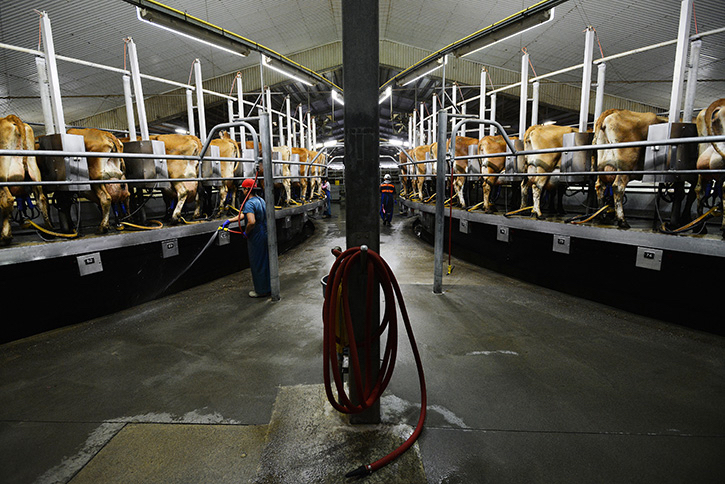
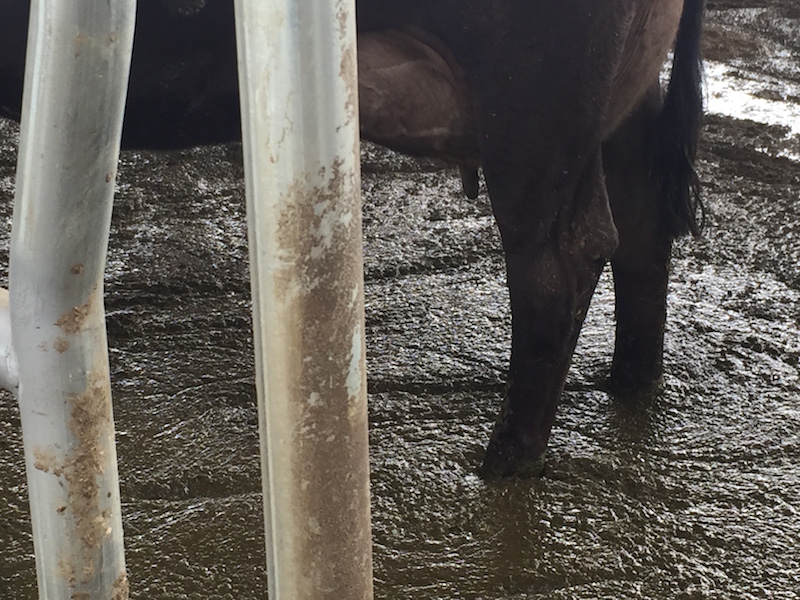
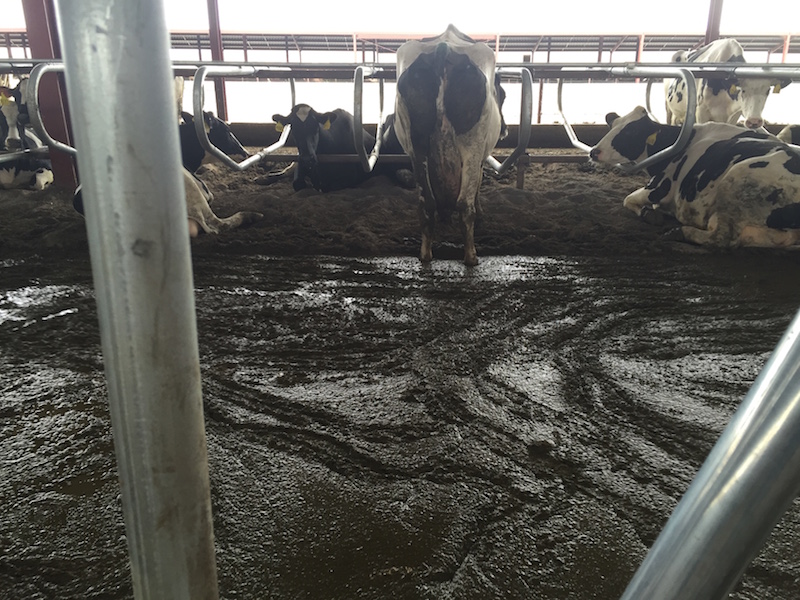
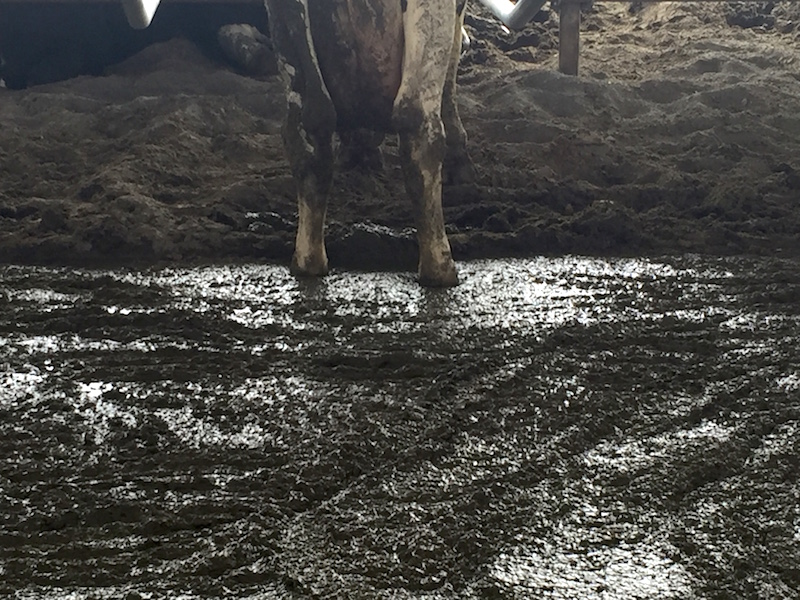
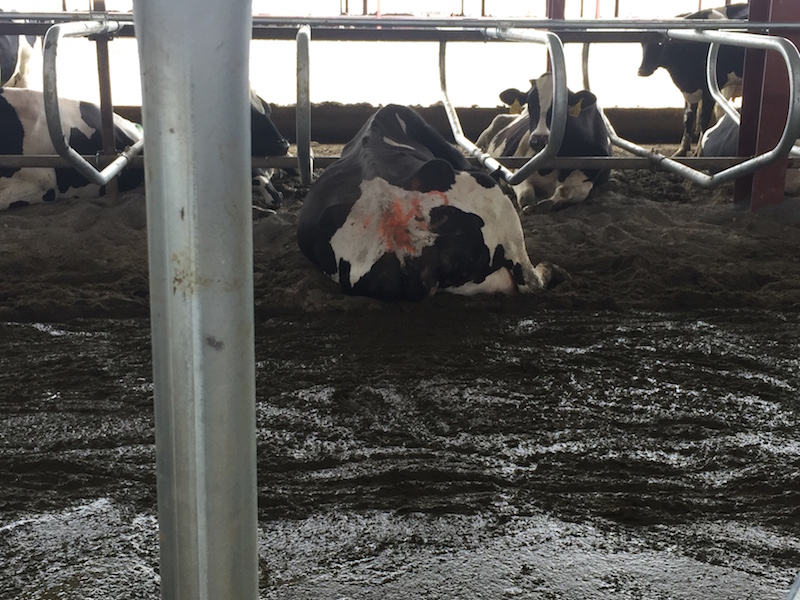
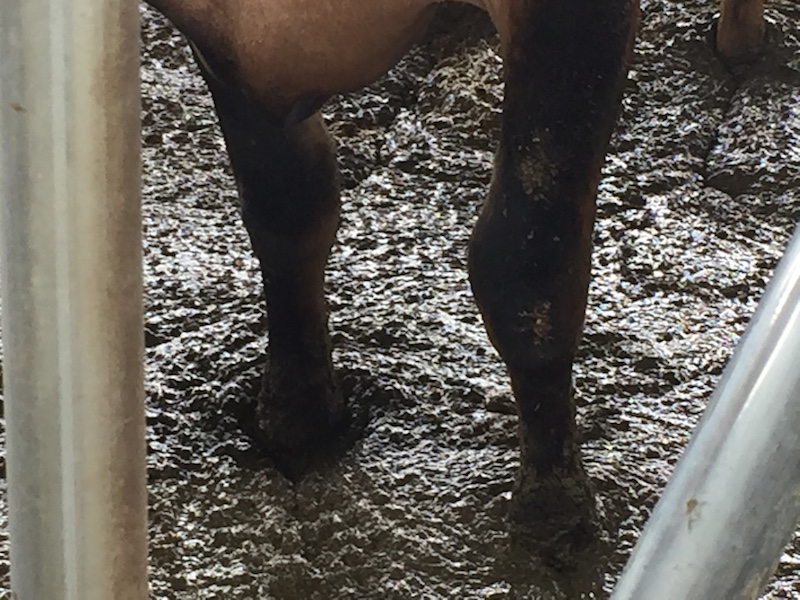
Despite this, as of the end of March, Tillamook was still buying milk from the dairy, according to an article in The Oregonian, which also contained photos taken by an Oregon Department of Agriculture (ODA) inspector showing the horrendous living conditions of the cows at the dairy. The article quotes a spokeswoman for Tillamook as saying "it is better for the cows and environment to keep a relationship with the dairy."
Also in late March the State of Oregon announced it had reached a settlement with Lost Valley to allow it continue operating. An article announcing the settlement said that "under the new agreement, Lost Valley can generate up to 65,000 gallons of wastewater per day compared with the 514,000 the dairy estimated it would need. It also must comply with other terms of its permit, such as notifying the state if there is a wastewater or manure spill. And the dairy must remove 24.4 million gallons of liquid manure from its overloaded storage facilities by summer, so that it can avoid polluting local water sources during a heavy rainstorm."
Reactions to the settlement were swift.
"The state’s settlement barely requires more than compliance with the permit already in place—it’s a status quo deal that lets Lost Valley off the hook. The Governor and ODA should have continued seeking to close the operation, which they should never have approved in the first place,' said Tarah Heinzen, staff attorney with Food & Water Watch, in a press release issued by a coalition of farm, environmental and animal welfare organizations.
"If ODA refuses to use its authority to stop factory farms with repeated and serious violations, Oregon clearly needs stronger water and air pollution laws to bar such irresponsible proposals in the first place,” said Scott Beckstead, rural affairs director for the Humane Society of the United States. “For example, Oregon does not require air pollution permits or monitoring at factory farms, and legislation to establish air quality protections from the industry failed last year."
Amy Van Saun of the Center for Food Safety said in the press release that the organization was extremely disappointed in the state for not using its authority to prevent this factory dairy from coming in. "And now that disappointment continues with a weak settlement despite numerous, disturbing permit violations that endanger public health and the environment. We warned ODA and the Governor that this would happen, especially with an operation of this enormous size, and business-as-usual is not an acceptable response."
In the settlement, weekly inspections by the state to insure compliance were agreed to for a period of one year. If Lost Valley complies for that period, it will be allowed to return to operating under its original permit. Specifics have not been made available as to how te Velde and Lost Valley would rectify the violations outlined in the lawsuit and meet the new conditions for waste limits and removal while maintaining the same number of cows at the facility.
UPDATE: Lost Valley's owner, California businessman Greg te Velde, has been drawing water from a protected aquifer in the Boardman area, with the tacit permission of Oregon Governor Kate Brown, her staff and the directors of at least three state agencies, according to a damning article in The Salem Statesman-Journal posted on March 23rd.
It says te Velde "moved ahead without the necessary permits, using a loophole in Oregon law to pull water out of an underground aquifer that’s been off limits to new wells for 42 years, alarming neighboring farmers who say their water supplies are now at risk." The paper said it has documents showing that Brown and state officials "knew the dairy would fall back on the loophole if a proposed water trade was challenged."
The article said that te Velde drilled three wells into the aquifer that is used for drinking water by area residents. The aquifer, which local residents use for drinking water, was designated a Groundwater Management Area (GWMA), so named because nitrate concentrations in many area groundwater samples exceed the federal safe drinking water standard.
When state officials found out about the illegal wells, te Velde agreed to truck in water, but the newspaper reports that "records show he brought in little water. Instead, Water Resources officials discovered months later that te Velde actually drew most of the water from one of the wells, claiming an exemption for watering stock — just as the earlier memos among the governor's staff and state agencies had predicted.
"And when ordered to install a monitoring device on the well, te Velde put in one with an unauthorized reset button, according to Water Resources officials. Now, the state's water officials say they have no idea how much water the dairy is taking out of the aquifer."
UPDATE: A recent report in the East Oregonian newspaper indicated that Rabobank, a Dutch agricultural lender, claimed that Greg te Velde, owner of Lost Valley Farm, had defaulted on part of $60 million in loans for the Boardman dairy and two other dairies te Velde owns in California. "John Top, owner of Toppenish Livestock, said they will begin preparing next week for the auction, which is scheduled for April 27," the article stated. "However, according to a preliminary injunction filed in Morrow County, te Velde has not given the auctioneer permission to enter the dairy."
Today (Thursday, 4/5/17) I was able to reach Cody Buckendorf, Operations Manager at Toppenish Livestock, who said that an on-site auction was going ahead on Friday, April 27th, and that the auction company had been given access to the property. He said that their first day on the property to process cows prior to auction was yesterday, (Wednesday, April 5), and that the bank was estimating there would be 19,000 cows auctioned. When questioned about the conditions he observed at the dairy, he said that, contrary to the photos taken by the inspector that led to its shutdown (photos, above), "it was one of the cleanest dairies I've seen." Read the full post.
Read my article on Big Milk, Big Issues for Local Communities about the issues mega-dairies pose to Oregon's air, water, environment and communities, as well as Why I'm Quitting Tillamook Cheese and other coverage about factory farms in Oregon. Photos obtained via a public records request by Friends of Family Farmers which shared them with media outlets.
I first heard about The Bread Lab from reading a New York Times article three years ago describing it as a "project to reinvent the most important food in history." It depicted Dr. Stephen Jones, the lab's founder, as looking like "a lovably geeky high school teacher," albeit one bent on nothing less than a revolution in how we think about bread.
From the article:
"What most people picture when they think of flour—that anonymous chalk-white powder from the supermarket—is anathema to Jones. Before the advent of industrial agriculture, Americans enjoyed a wide range of regional flours milled from equally diverse wheats, which in turn could be used to make breads that were astonishingly flavorful and nutritious. For nearly a century, however, America has grown wheat tailored to an industrial system designed to produce nutrient-poor flour and insipid, spongy breads soaked in preservatives. For the sake of profit and expediency, we forfeited pleasure and health. The Bread Lab’s mission is to make regional grain farming viable once more, by creating entirely new kinds of wheat that unite the taste and wholesomeness of their ancestors with the robustness of their modern counterparts."
The Bread Lab's Dr. Stephen Jones.
In the intervening years since that article was written, Jones's project, part of Washington State University's College of Agricultural, Human and Natural Resource Sciences, has achieved national and international recognition for breeding, testing and rejuvenating forgotten varieties of wheat, barley, buckwheat and rye. It's also helped improve the prospects of farmers in Washington's Skagit Valley, where Jones built his lab in order to be closer to the fields and the farmers who test the grains.
"We’ve seen the addition of seven new businesses and about 200 new jobs because of the Bread Lab," said Patsy Martin, director of the Port of Skagit. "Farmers are making a profit off their crops and value is being added to the crops by new businesses. It’s our goal to have the number of businesses continue to grow and add more good jobs. A resilient agricultural economy will keep the Skagit Valley unique, special and viable into the future."
Dave Hedlin of Hedlin Farms, a Bread Lab partner.
Today Clif Bar and Company, in association with King Arthur Flour, announced the funding of a $1.5 million endowment to enable the Bread Lab to continue its research breeding grains adapted to organic farming practices in perpetuity.
Matthew Dillon, Clif Bar's senior director of agricultural policy and programs (profiled recently here), said, "Public sector land grant universities like Washington State have seen their funding for organic agricultural research cut year after year at the state and federal levels. With the endowment, [Clif Bar and Company] is putting a stake in the ground for organic’s future because we believe the Bread Lab can improve the good that organic brings to farmers, consumers and the planet."
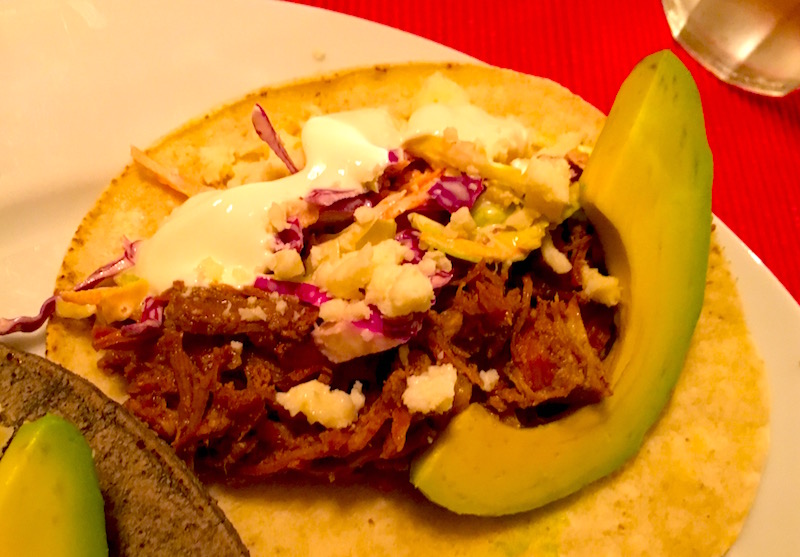
I'd been jonesing for tacos for days, and just hadn't got around to making them. Then, fortuitously, some friends said they were going to be in the 'hood one evening, which gave me the perfect excuse to try a new method for making carnitas. (And yes, I'm one of those people who tries out new recipes on guests, much to the chagrin of my mother who considered it much too risky.)
I'd already pulled a four-pound pork shoulder out of the freezer, it being a weekend and the perfect time for a nice slow braise on the stove. So I picked up some cotija cheese made by Albany's Ochoa's Queseria, cabbage for slaw, plus an avocado, salsa and tortillas. (I'm a huge fan of the organic tortillas from Three Sisters Nixtamal. It's a local company that makes masa using a traditional process called nixtamalization, where dried corn kernels are soaked in slaked lime, then ground and made into dough.)
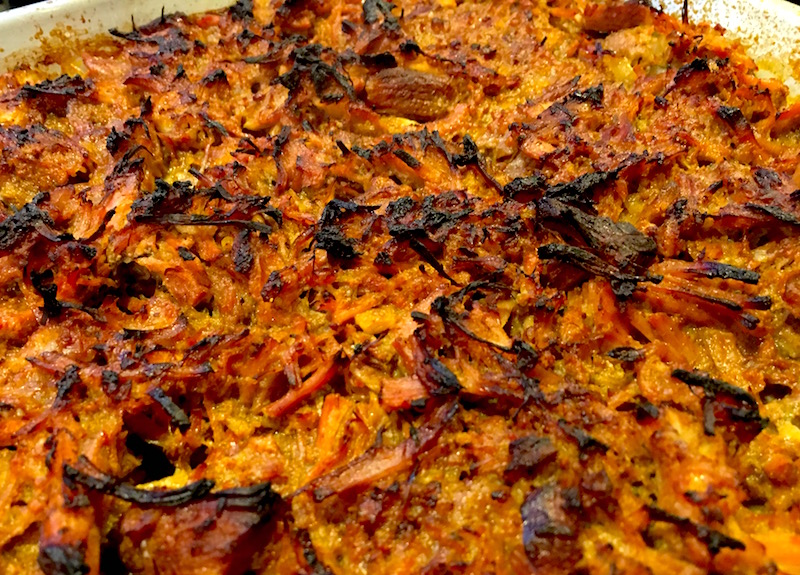
Carnitas, which means "little meats," is made by simmering chunks of pork with citrus and spices for several hours until it's tender and on the verge of falling apart. I had some whey left over from making ricotta, so I decided to use it for the braising liquid, since the acids in the whey would help to break down and tenderize the meat. The method I used then calls for shredding the meat, roasting it in the oven (or in a cast iron pan on the grill) until any remaining liquid evaporates and the meat is crispy.
Warming the tortillas on a griddle is quick and easy, though I'm always tempted to pile them with heaps of fixin's, but exercising a teensy bit of restraint is worth the reward of the perfect bite, instead of bursting the taco or losing too much on your plate. Plus it means I can enjoy a few more of those longed-for tacos!
Carnitas
4 lbs. boneless pork shoulder 1 qt. whey, water or stock 1 onion, sliced in half lengthwise, then crosswise into 1/8” slices 8 cloves garlic 2 tsp. oregano 4 bay leaves 2 tsp. ground cumin 1 orange, quartered 1 Tbsp. kosher salt
Put all ingredients into large Dutch oven and bring to a boil. Reduce heat to simmer for 2-3 hours until meat is starting to fall apart and liquid is almost gone. If there is quite a bit of liquid left, remove the meat to a roasting pan, disposing of the orange peel and bay leaves. Bring the liquid in the pot to a boil and reduce until there is less than 1 cup remaining.
While liquid reduces, heat oven to 450°. When liquid has reduced, pour over meat in roasting pan and place in oven for 20-30 minutes or until it starts to brown. Shred any remaining large pieces.
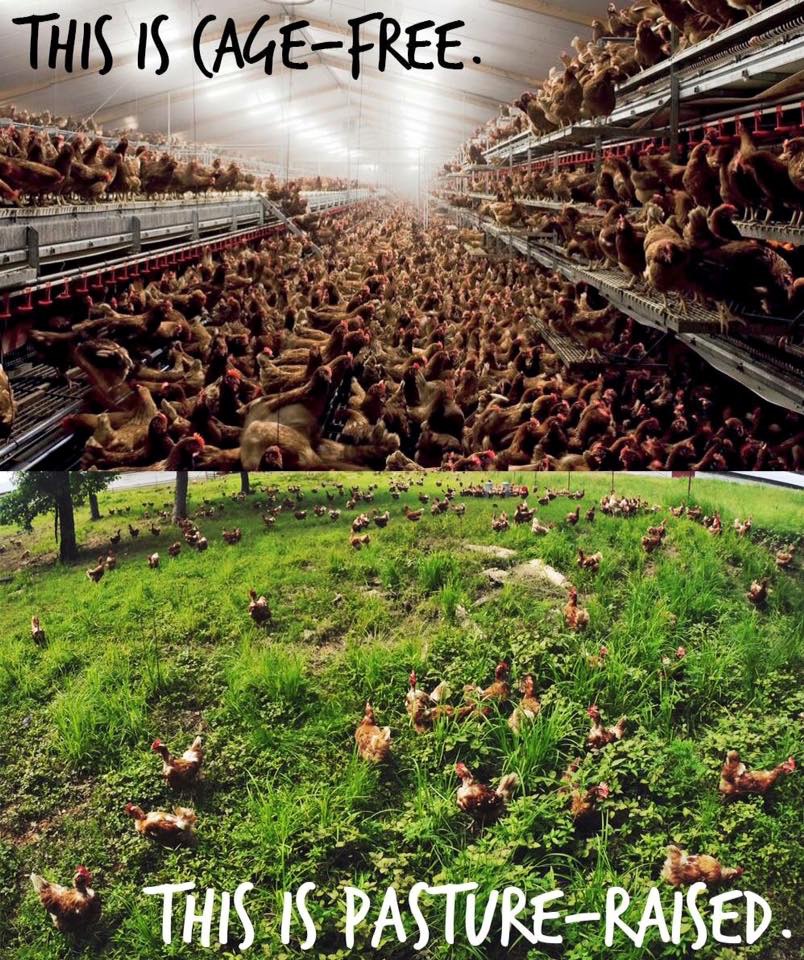
The video above shows what organic egg production looks like at one Oregon factory farm. Crowded into closed-in barns, with "outside access" limited to a roofed-in, screened, cement-floored patio, with panels preventing the chickens from even seeing outside, is not what people imagine when they see the words "cage free" on the carton.
And it's about to get a lot worse unless you act now.
The demand from consumers for organic products has caused that segment of the grocery industry to explode. It's caught the attention of large agribusiness, which has been seeing its portion of the market starting to decline.
A new rule, carefully developed over the last decade, setting consistent and humane animal welfare standards for organic production, was about to go into effect when the current administration delayed its implementation. Over the holidays, USDA Secretary Sonny Perdue announced he was going to completely withdraw the new rule from consideration, a step that corporate agribusiness has been pushing for.
The USDA's Agricultural Marketing Service (AMS) is accepting comments on its decision through Wednesday, January 17, so action is needed immediately. The Center for Food Safety has provided a simple form to submit a comment on this rule. It may sound alarmist, but the integrity of the organic label, including our health, and that of our communities and the environment, is at stake. I sincerely hope you consider signing it.
Giant factory farms are moving to Oregon, bringing with them concerns about our rural communities, the environment, and how we want to grow our economy, as well as challenging long-held traditions of our state’s agriculture as one based on small, family-scale farms. This is an excerpt from an article I wrote for Edible Portland magazine that was picked up by Civil Eats (full article here).
It’s important to respect “the cow-ness of the cow,” says Oregon dairyman Jon Bansen, a member of the farmer-owned cooperative Organic Valley. He's quoting sustainable farm guru Joel Salatin in explaining what differentiates his pasture-raised cows from those living their lives in closed buildings on a factory farm.
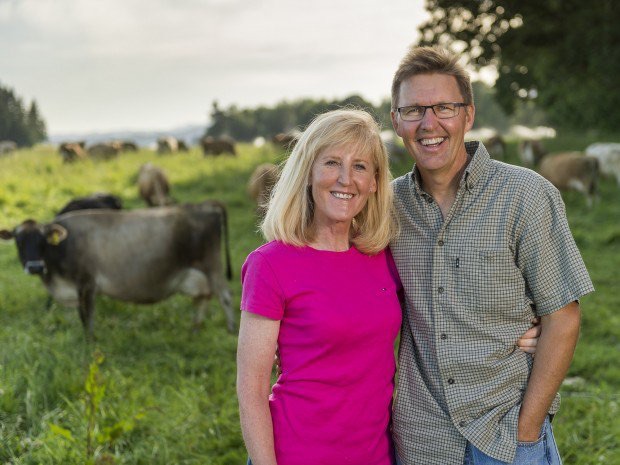
Monmouth dairy farmers Jon and Juli Bansen.
“It turns out that some things get more efficient with size, but biology doesn’t,” he says of the large mega-dairies that have taken up residence near the small Columbia River town of Boardman at the east end of the Columbia River Gorge. “To be standing on concrete, fed high levels of grain, treated like a widget instead of a biological being—it shortens their lifespan.”
Animal welfare isn’t the only reason to worry about mega-dairies. Another cost of these giant factory farms is to Oregon’s small dairies. In 2001, mega-dairy Threemile Canyon Farms, a 70,000-cow facility near Boardman, began supplying milk to the Tillamook County Creamery Association’s manufacturing plant nearby. One of the results of this move was that an average of nine family-owned Oregon dairy farms went out of business each month between 2002 and 2007.
Why did this happen?
“Mega-dairies flood the market with milk, driving down milk prices and making it increasingly difficult for family farmers to stay afloat,” Bansen wrote in an editorial in the Salem Statesman Journal.
Mega-dairies also degrade the lives of local communities. Bansen wrote that “the ways in which family dairy farmers and mega-dairies contribute to a community are drastically different. When something breaks, family farmers typically buy parts from the local store. When their animals need veterinary attention, they call the local vet. They support their feed stores, tractor-supply stores, and more. After a hard day on the farm, family farmers often engage in their community, schools, civic groups, and churches.”
Bansen emphasized that employees at mega-dairies have neither the time nor the money to spend in their communities because of low wages and the long hours demanded of them. And any equipment needed at the dairy is bought from the cheapest (mostly non-local) sources, and profits are sent off to corporate, often out-of-state, offices.
Waste and Groundwater
To give an idea of how large these mega-dairies are, all you have to do is refer to their corporate websites. Threemile Canyon’s cows—consisting of 25,000 milk cows, 30,000 replacement heifers, 7,000 steers, and an 8,000-calf nursery—produce 165,000 gallons of milk per day. If you look at a satellite view of the property, you see that the buildings the cows live in are so vast that employees have to drive to get from one end to the other.
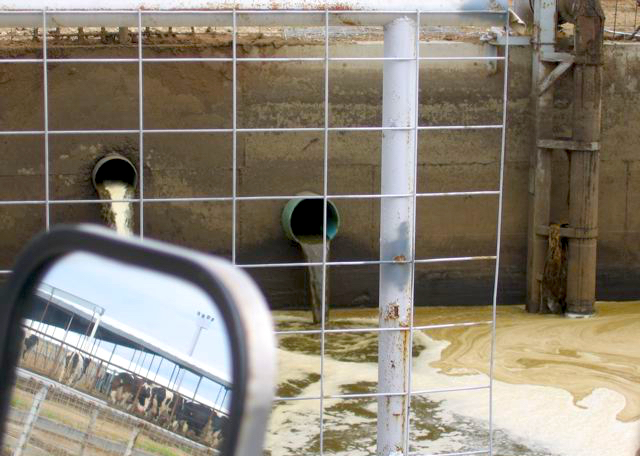
Waste runoff at Threemile Canyon Farms.
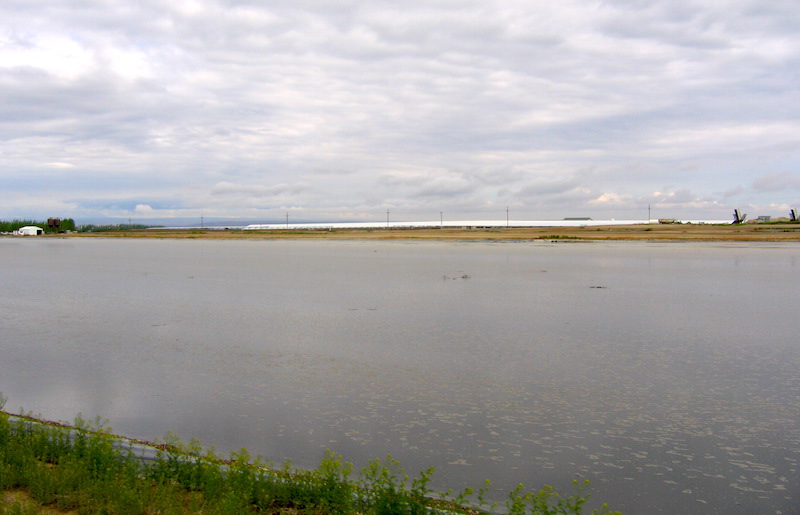
The amount of waste that these 70,000 cows produce is also mind-boggling—estimates are around 436 million gallons of liquid manure every year. One of the several open-air, double-lined waste pits, called lagoons, covers more than 20 acres. While these large facilities have permits for discharging waste under the Clean Water Act, a state statute (ORS 468B-025) prohibits any of it from entering “waters of the state.”
“It says in very broad terms that no person in Oregon shall place or cause to be placed waste where it may enter waters of the state by any means,” says Wym Matthews, fertilizer program manager of the Confined Animal Feeding Operation (CAFO) for the Oregon Department of Agriculture (ODA). “There’s the broad thought in Oregon that folks should be responsible and not allow material they are managing—waste or not—to get into the waters and cause a problem.”
In other states, leaks from lagoons have endangered the drinking water of cities that rely on rivers as a water source, and manure from the spills has been responsible for the deaths of thousands of fish in waterways. Recently, a major liquid manure spill from a dairy operation in the Tillamook area caused the closure of Tillamook Bay due to contamination from fecal coliform, which had a significant economic impact on commercial oyster growers in the area.
The thing that worries Ivan Maluski, policy director for Friends of Family Farmers (FoFF), an organization that supports socially and environmentally responsible family-scale agriculture in Oregon, is that much of the reporting and monitoring is left up to the operations themselves.
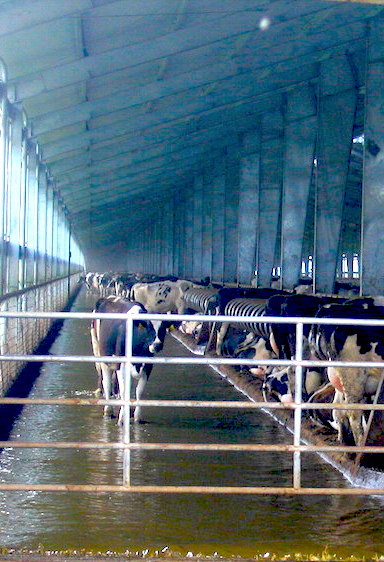
Cow standing in waste at Threemile Canyon Farms.
“The reality is that it’s not possible for there to be no discharge at all, so it’s a bit of an aspirational permit, if you will,” Maluski says. “They often rely on the CAFOs themselves to report a problem because [ODA inspectors] visit them typically once a year. Or, if someone says, ‘Hey they’re spreading manure out there, and it looks like it’s going in the creek’ on a Saturday, if ODA can’t get out there until Monday, they might not see anything.”
And now that another mega-dairy—30,000-cow Lost Valley Farm, just 30 miles from the Threemile Canyon operation—has received a permit from the ODA, farm organizations like FoFF and the Socially Responsible Agriculture Project (SRAP), as well as consumer protection groups like the Center for Food Safety (CFS), are on high alert.
The land occupied by these two factory farms is one of three sites in Oregon designated as a Groundwater Management Area (GWMA), so named because nitrate concentrations in many area groundwater samples exceed the federal safe drinking water standard. “What’s so concerning about putting another mega-dairy in an existing groundwater management area is that the Lower Umatilla Basin was designated in the ’90s as a place where there were already too many nitrates in the water—water people use for drinking,” says Amy van Saun, an attorney for CFS. “This is only going to make it worse.”
Wym Matthews doesn’t disagree. “I would describe the groundwater-monitoring well data from the Lower Umatilla GWMA as mixed,” he says. “There are some wells that are staying stagnant and not getting better or worse, some that are getting better, and some that are getting worse.”
Open-air waste lagoon at Threemile Canyon Farms covers 20 acres.
Asked how the ODA could issue a permit in such a sensitive area, Matthews says that the only way a permit could be issued is if the agencies believe that the permit is restrictive enough so that if there was discharge, it would violate the discharge standard. For Lost Valley, the department has set the discharge standard at zero.
“How can the state say yes to [Lost Valley Farm], which is clearly going to add a risk of nitrates leaching into the groundwater, when you’ve already got an area that’s impaired and not getting any better?” Maluski asks. “When they were digging their manure lagoons for that facility, they actually hit groundwater at 10 feet, so they had to get a special water right to pump groundwater away from their lagoons. It’s just absurd. Obviously, they’re going to have a couple of liners, but if those liners fail, you’ve got a very serious direct contamination of the groundwater.”
Emissions and Air Pollution
As many restrictions as there are related to the potential release of waste from these industrial farms into groundwater and nearby waters, there are no such restrictions on the very real emissions that are released into the air. Nearly a decade ago, the Oregon legislature passed a bill to address air emissions from these mega-dairies. Called the Oregon Dairy Air Quality Task Force, it was comprised of stakeholders from across the political spectrum, including representatives from government, academic institutions, the dairy industry, and public interest groups.
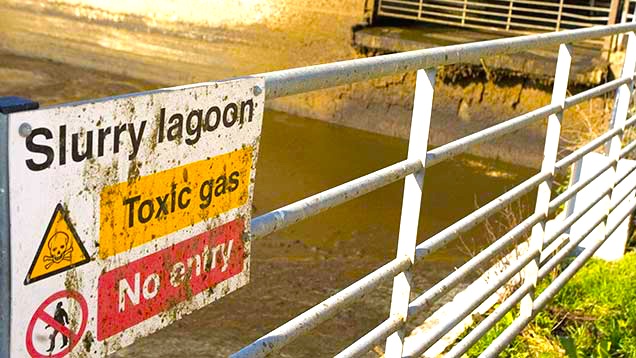
Warning sign at a confined facility.
The task force studied the current scientific literature relating to air pollutants, such as ammonia, hydrogen sulfide, methane, volatile organic compounds, nitrogen oxides, and particulate matter emitted by these operations.
“Ten years ago, that task force came up with some really strong recommendations for how the state could move forward with some rules around air quality in order to get ahead of the problem of these operations coming in and having a lack of regulations to mitigate emissions,” says Kendra Kimbirauskas, a member of the task force and the current CEO of SRAP. “And 10 years later, none of those recommendations went anywhere despite the fact that it was a consensus list of recommendations.”
Kimbirauskas says that at SRAP, which works across the country with communities that are directly impacted by factory farms, she’s seen what these operations do to rural communities. “It’s just like every other extractive industry,” she says, comparing factory farms to extraction industries like mining and industrial timber that threaten forests and wild lands.
“This is the same model with a different face,” Kimbirauskas continues. “It’s the idea that these out-of-state companies or corporations can come in, and they can call themselves family farms. But you can put lipstick on a cow, and it’s still a factory farm cow. They come in, and they’re extracting local resources. They’re extracting the water, they’re extracting the local wealth, and they’re sending it off to faraway places. They’re externalizing all of their costs of production, first and foremost, on the local community, on the local environment, and on the state.
“If we’re not careful, and we’re not paying attention to these issues now,” she warns, “by the time it does become in our face, it’s going to be too late, and what we love about Oregon agriculture and the local farm economy will be threatened.”
When asked about Threemile Canyon Farms and Lost Valley Farm claims to have “closed loop” systems, FoFF’s Maluski says he has to laugh.
“Threemile likes to talk about a closed-loop system where they’re capturing their manure, they’re fertilizing with it, and then they’re feeding the animals everything from the corn and alfalfa they grow to potato scraps and onion scraps,” he says. “But they’re ignoring a number of major elements, such as their methane output.” They’re not a closed loop on methane, he emphasizes, arguing that their much-touted digester only captures about a sixth of their total methane emissions.
Maluski notes that a 2005 Toxic Release Inventory from the Environmental Protection Agency (EPA) said that Threemile Canyon Farms, which at the time had only 50,000 animals on-site, was one of the nation’s biggest sources of ammonia emissions, estimated at 12,000 to 16,000 tons per year. “So if you conveniently ignore a major part of their operation then, OK, maybe you can get to closed loop,” he says. “But you’ve got to do that by ignoring a bunch of big loopholes in the loop.”
Van Saun at the CFS agrees. “It’s not so closed when you’re putting out enough ammonia that you’re in the top of all industry emissions, the highest single emitter of ammonia in the state,” she says. “That’s an externalized cost that they’re not paying for.”
Local Control
Part of the reason that large operations are flocking to the state—in 1997, the U.S. Department of Agriculture census found that Oregon had eight mega-dairies with more than 1,000 cows, and as of 2012, it had 25 such facilities—is that Oregon’s land use system, while it was important in preserving agricultural land when it was created in the early 1970s, did not anticipate the emergence of large factory farms.
So, for instance, when Lost Valley Farm applied for a permit to site its 30,000-cow facility on land zoned for exclusive farm use, Morrow County commissioners had no choice but to say yes. An Oregonian article reported that the county had no legal way to stop what would be the state’s second-largest dairy, and that its three commissioners were deeply worried that it would sap already-limited groundwater from local farmers and exacerbate water and air-quality problems.
“When it comes to agriculture, communities don’t have any local control over what kind of agriculture is acceptable in the community and what kind of agriculture they want to limit or regulate,” Kimbirauskas says. “That’s because local control has been pre-empted in this state, meaning that policy on agriculture can only really be set at the state level.”
But for Monmouth dairyman Jon Bansen, it boils down to putting efforts where they will do the most good for the animals, the communities, and the environment.
“There’s different ways of making food, and I think some of them are more beneficial to human health,” he says of the reason he chose to operate a small, pasture-based organic dairy. “If you’re going to eat dairy, you should eat dairy that comes from cows that get to do what ruminants do: Go out, graze pastures, and live their lives on the soft earth, not on hard cement. To do what a cow is supposed to do. And if the animal’s really healthy, then the product it’s producing is going to be healthier for the consumer. That’s why we do what we do.”
Top photo from the East Oregonian. Photo of Bansens from Organic Valley Co-operative. Photos of Threemile Canyon Farms from Friends of Family Farmers.
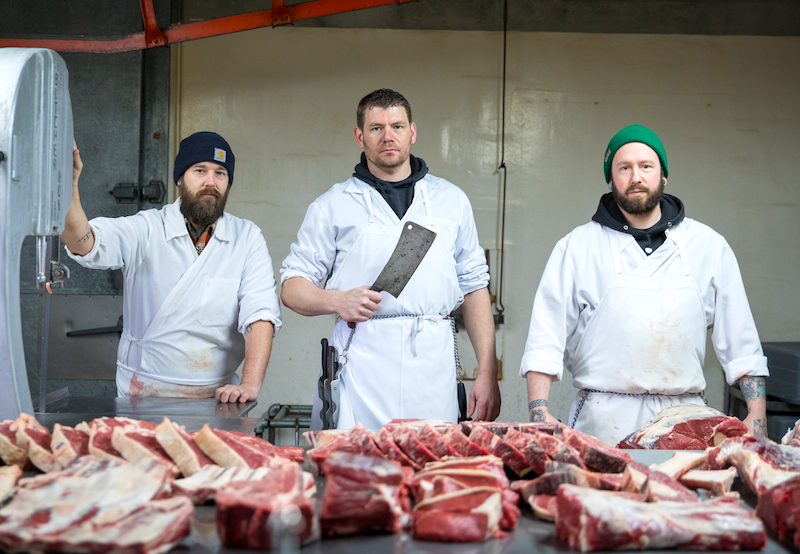
This series looks at how one small processor, Marks Meats in Canby, is transitioning from the founding owner-operators to a new generation of ownership under the name Revel Meat Company. This post was developed in collaboration with Old Salt Marketplace, a supporter of Good Stuff NW.
"The first thing to note about Ben Meyer is not his polite Midwestern manners, his oh-so-Portland uniform of stocking cap, flannel shirt and scruffy beard or that he's opened two restaurants in what were then—and still are, to some extent —underserved areas of the city. It's not even that he's been interviewed by the likes of Forbes and the Wall Street Journal wanting to hear about the local pasture-raised beef and pork he features on his menus. The key to Meyer is that this evangelist for whole animal butchery, whose walk-in is chock-full of large cuts of dry-aged beef, spent 10 years as a vegan."
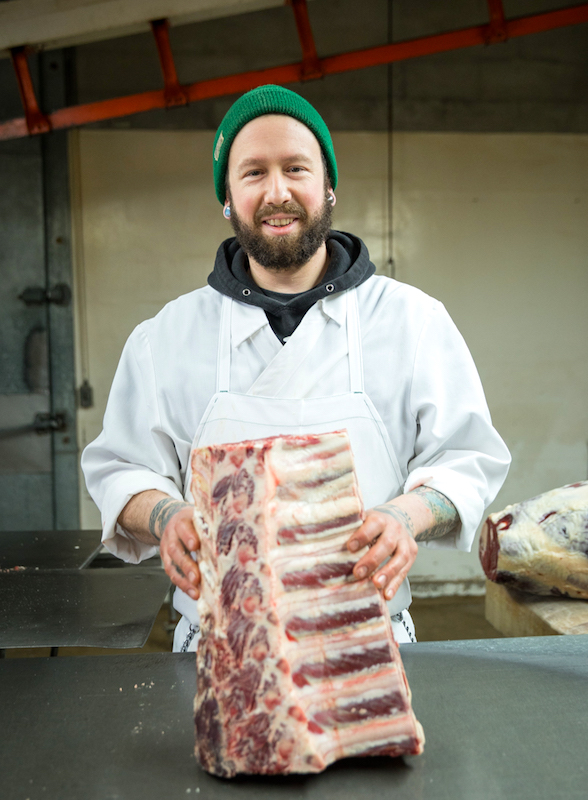
Planning the day's work.
Since the time I wrote those words three years ago for the Oregonian, the scruffy beard has come and gone (and come and gone again), the stocking cap and flannel shirt can vary with the season and his two restaurants are still putting out luscious plates of grass-fed meat and farm-raised vegetables. And this former vegan-turned-omnivore is still intent on upending a system he sees as intrinsically unhealthy for his family, his community and the environment.
"I always say that Old Salt and Grain & Gristle are a food system," Meyer said. "We buy raw ingredients from people and we turn them into all the products that we use, [like] grains that are custom-milled to turn into the breads and contract tomatoes where I give the seed to the farmer and they grow it out for us."
But in his latest venture he's diving deeper into the stream that our food travels in getting from the field to our plates. With partners Jimmy Serlin and Ryan Ramage, his Revel Meat Company is attempting to bring local meat back to local tables, in the process revitalizing a nearly extinct local meat processing industry that enables small farmers to bring their animals to a market hungry for the kind of meat they raise.
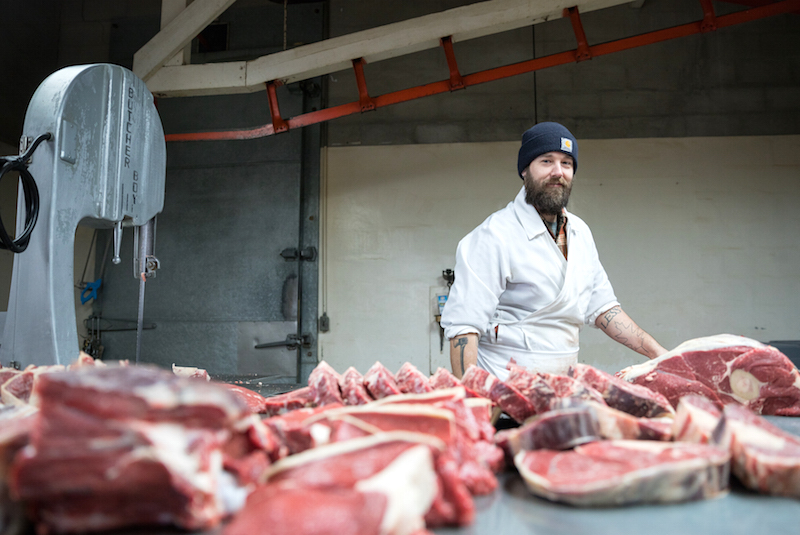
Bringing local meat to market.
In the spirit of upending the status quo they tossed around the idea of calling their venture Revolution Meat, or saluting the history of Marks by calling it High Mark Meat, but then Serlin suggested Revel Meat for what he thought of as a gustatory celebration of the best the region had to offer. The name stuck.
An unusual part of this new venture is that Meyer isn't just branding all the meat they process under the Revel Meat banner, regardless of the source. According to a 2015 article, discussing the practice of "localwashing," many large processors, like Carlton Farms in Oregon, buy animals from Canada or elsewhere, bring them to their facility for slaughter and processing, then brand the products with their name. Meyer's plan for Revel Meat is to have the name of the ranch or farm that raised the animals follow the product, whether it ends up as hamburger or sausage or charcuterie, all the way to the consumer.\
"My whole goal with all food is getting rid of the smoke and mirrors," he said. "We want to make sure that if somebody’s buying it, they know who they’re buying it from, the name of the ranch and where it is. We’re not going to co-brand it; it’s not just going be Revel Meat pork, it’s going to be Payne Family Farms pork delivered by Revel Meat."
Jimmy Serlin, co-owner of Revel Meat.
Since Meyer and Serlin are both chefs, they are intimately connected to Portland's restaurant community and have already begun wholesaling their meat products like sausages to some of the city's restaurants. But entering the wholesale business has meant adding layers of complexity to an already complicated process.
In the normal course of running his restaurants, Meyer said, he would talk to his ranchers a week ahead for pork and two weeks or more for beef so that the animals would be in the pipeline to go to the processor. They would then hang for two to three weeks, after which he would butcher and process them for his menus.
With wholesaling, not only does he need to have pork in hand to make the sausage in time to get it to restaurant chefs for their menu, he said, "I now have to plan weeks out to make sure that we have pigs lined up to get them killed, cleaned, hung up, turned into sausage, packaged, labeled and then driven up to the city. It’s just a whole other layer back."
As if that wasn't enough, the partners are adding animal husbandry into the mix, raising their own animals on two parcels of land near the facility. It means working not weeks or months, but years out, he said, with animals on the ground that are slated to come through their process two years from now.
Helping local producers thrive.
But even with intimidatingly steep learning curves on multiple fronts, this former vegan never wants to forget that he is responsible for taking the life of a living creature.
"My biggest fear is that you would become callous and not care," Meyer said. It's why he chose to take on the challenge of revitalizing a medium-sized, locally owned slaughterhouse that would serve small farmers and ranchers, rather than scaling up to operate at the same volumes as larger processors.
"You can imagine the level of care when you’re killing 340 head an hour on five different lines," he said. "That’s stunning an animal every 3.2 seconds or something. That is factory work where the cog happens to be a living creature. That is the most mortifying part to me."
"No matter how much love or care you put into the raising of an animal, if that’s how it finishes its life, you’ve broken that covenant with the animal," he added. "That covenant is the most important thing for us. If you break your part of the covenant, then we’re asking that species, this pig or that beef or these sheep or goats, to keep their end without us keeping ours. It’s not fair."
This series looks at how one small processor, Marks Meats in Canby, is transitioning from the founding owner-operators to a new generation of ownership under the name Revel Meat Company. This post was developed in collaboration with Old Salt Marketplace, a supporter of Good Stuff NW.
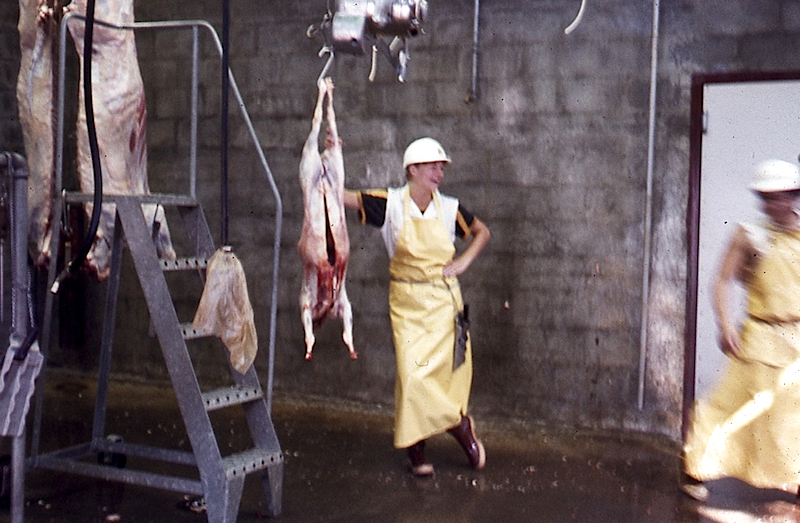
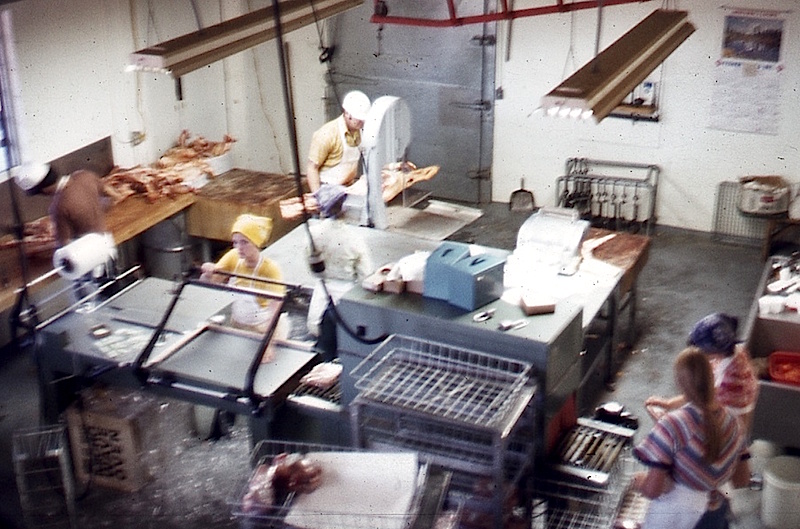
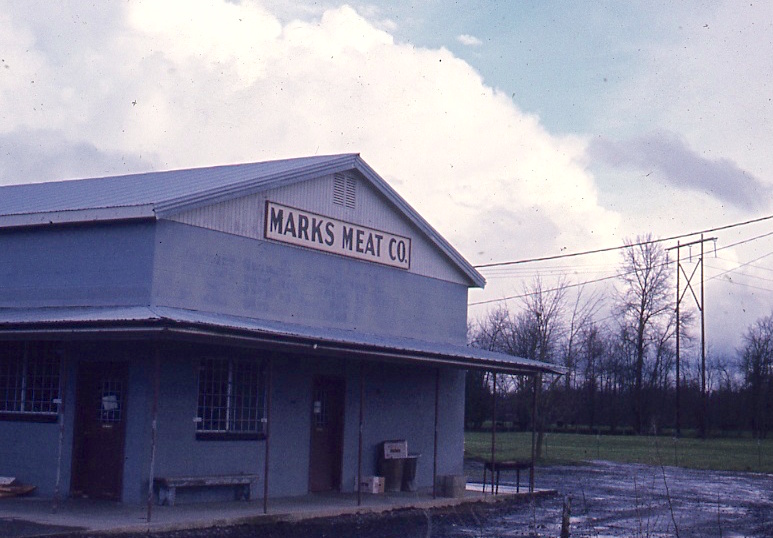
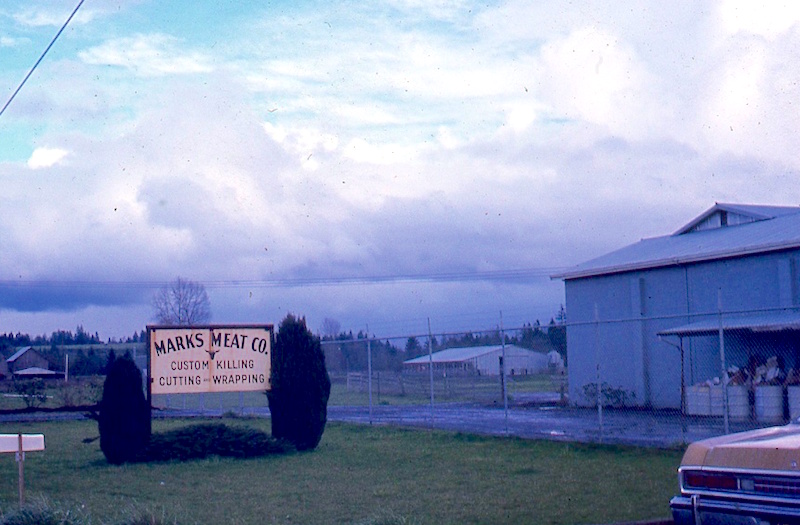
Floyd Marks opened Marks Meats on South Mulino Road in Canby, Oregon, in 1963. His daughter, Kris, who was a very young child at the time, still remembers the opening party in the brand new slaughterhouse. The band was set up on a platform over the drain where the animals were hung to bleed out, with the dance floor in the middle of the kill floor. Originally solely a slaughterhouse, Floyd designed the compact footprint of the facility to maximize efficiency and, as the business expanded, to accommodate an on-site processing facility to make sausages, bacon and smoked meats.
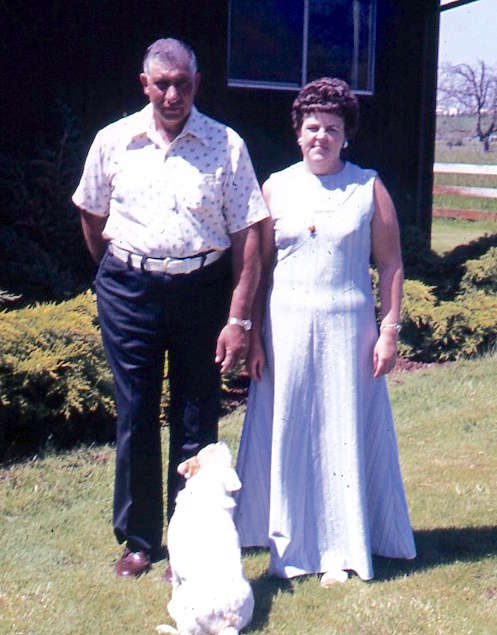
Floyd and Martha Marks (c. 1975).
In the mid-1970s, when their mother decided it was time to think about retiring from the business, she asked Kris (top photo, on the kill floor) and her sister Judy if they'd be interested in stepping in, Judy working with the animals on the kill floor and Kris managing the new processing side. By this time Kris had married her husband, Joe Akin, and they were the parents of two young children. As a teenager, Joe had applied for a job at the plant and, like Jimmy Serlin would many years later, he found his calling working there.
With the daughters' agreeing to the arrangement, their father retired and turned the business over to Judy and Kris. When I expressed surprise that a slaughterhouse might be run by two young women, she reminded me that in many old farm families it was not unusual for the women to do the butchering.
"Dealing with the animals that you raise and the vegetables that you raise and processing them all the way through, it wasn't something foreign to us."
"If you grew up on a farm, you also did that as part of it," she said. "Dealing with the animals that you raise and the vegetables that you raise and processing them all the way through, it wasn't something that was foreign to us."
Judy eventually left the business, and Joe took over running the kill floor while Kris worked on the processing side and took care of the immense amount of record-keeping required for the facility's Federal Grant of Inspection from the USDA. The grant allowed the business to slaughter and butcher animals, and involved a difficult and costly approval process, one that guarantees that procedures are in place to ensure that the meat it sells is safe and inspected before, during and after slaughter.
Processing room at Marks Meats (c. 1975).
Around ten years ago it became difficult for Kris and Joe to find trained, competent help in the slaughterhouse, so Kris stepped onto the floor to work alongside her husband. While he did the stunning—essentially rendering the animals brain-dead—at the height of their production they managed a schedule that rotated through 30 beef in a day, and other days processed 24 to 30 pigs or 75 or 80 lambs, a crushing amount of output for a small facility.
Approaching retirement age, they both knew that this kind of heavy production schedule was unsustainable, so Kris began to put the word out that Marks was looking for a buyer. An attractive prospect, the business drew several inquiries because of its up-to-date plant and that all-important grant of inspection, not to mention its accessibility to both area farms and a Portland customer base. But none had quite the right combination of factors required for a transition of ownership that would take several years to complete.
Enter Jimmy and the young crew of food revolutionaries from Let Um Eat who had bought a farm down the road and, driving by one day, saw a sign outside advertising a sale on steaks.
The young people were just customers at first, but the sudden departure of an employee left Kris short-handed, so she asked if they knew of anyone who might be be interested in helping out.
"Then Jimmy showed up because he was interested in learning what we did," Kris said, though it was obvious from the get-go that he had no idea what an immensely physical job it was. "It’s like working out at the gym for eight to ten hours. He was on the kill floor, doing skinning and pushing and pulling and different movements that you don’t normally do."
For Jimmy’s part, he said, ”I didn’t realize how excited I was about it till I started.” When his own father passed away a few weeks into his stint at Marks, a particularly heartfelt conversation with Kris and Joe about her father and the beginnings of Marks cemented his decision. "It became clear that it was something I’d wanted to do for awhile [but] I never really thought about it," he said. "Being there, I think it keeps me in line with with what my old man did."
"We’d been doing this for a long time and physically we needed to have younger people do it in order to keep the business running."
Kris remembers that fairly soon after he started, Jimmy said he was looking for something more permanent than simply being an employee.
"He wanted to know more about the business and possibly join us in some capacity," she said. "And we were wanting to get out. We’d been doing this for a long time and physically we needed to have younger people do it in order to keep the business running."
The key phrase Jimmy got from his conversation with Kris? "If you’re interested, let’s talk."
Marks Meats (c. 1975).
At that point, as far as he was concerned, the decision was made. "How can we can we all talk about Let Um Eat and the collective and not take the opportunity to take over one of the most crucial pieces to the small farm and sustainable food movement?" he remembers thinking.
The other members of the collective, however, were not on board with making that kind of long-term commitment. Or as Jimmy said, "They were like, haha, we have a thousand other things going on."
Knowing he couldn't do it alone, however, meant that he needed to find partners who could bring additional skill sets to the table. He approached Ben Meyer, who was already working with local ranchers and farmers on a whole animal program for his Portland restaurants Old Salt Marketplace and Grain & Gristle. Bringing butchery, merchandising, retailing and processing expertise, Meyer was the perfect fit. To complete the team, Meyer brought in cattle rancher Ryan Ramage of Ramage Farm in Oregon City.
Meyer had already identified that it was critical to keep Oregon's surviving small processors alive, as well as the need to add more. Crucial to this was figuring out the stumbling blocks faced by existing processors, which had been steadily closing since the '70s. "Every one we lose is another opportunity for a small rancher to process," he said. So when Jimmy presented him with the opportunity to buy Marks, he recalled, "I immediately said we need to at least talk about it."
"[Handling the physical aspect of the work] is the most important part, because if they can’t do that, the rest of the business isn’t going to work."
Meyer began working alongside Jimmy on the kill floor soon after that, with Kris teaching them the arcane, detailed and exhausting work that goes into processing in a USDA facility. Also involved were endless conversations about how to transition to new owners from a second generation, family-owned and run business.
Marks Meats (c. 1975).
Kris said that the last eight to ten months have been spent seeing if Ben and Jimmy could learn how to handle the work.
"It’s the most important part, because if they can’t do that, the rest of the business isn’t going to work," she said, emphasizing that the learning curve is a steep one. "You need to get up from kindergarten to college really fast. If you’re going into this business from an apprenticeship level up to a journeyman, it can take up to ten years. So doing it in this [short] length of time, it’s difficult."
Other complicating factors are that Marks is a corporation, with a USDA grant of inspection involved. Being the shrewd businesswoman she is, the key to a successful transition, Kris said, is that "you’ve got to make it work for a business, because you can’t make it work for everybody if it doesn’t make business sense."
When I asked what the hardest part of the process has been for Kris personally, she paused. "Probably the letting go and letting somebody else do something for me," she said. In the past, she said, "If it didn’t get done, I had to do it and make sure it got done."
Read the first post in the series, Rejuvenating Local Processing. The final post in the series focuses on the future of small processors, titled Upending the Status Quo, with an interview with Revel Meat co-owner Ben Meyer.
This series looks at how one small processor, Marks Meats in Canby, is transitioning from the founding owner-operators to a new generation of ownership under the name Revel Meat Company. This post was developed in collaboration with Old Salt Marketplace, a supporter of Good Stuff NW.
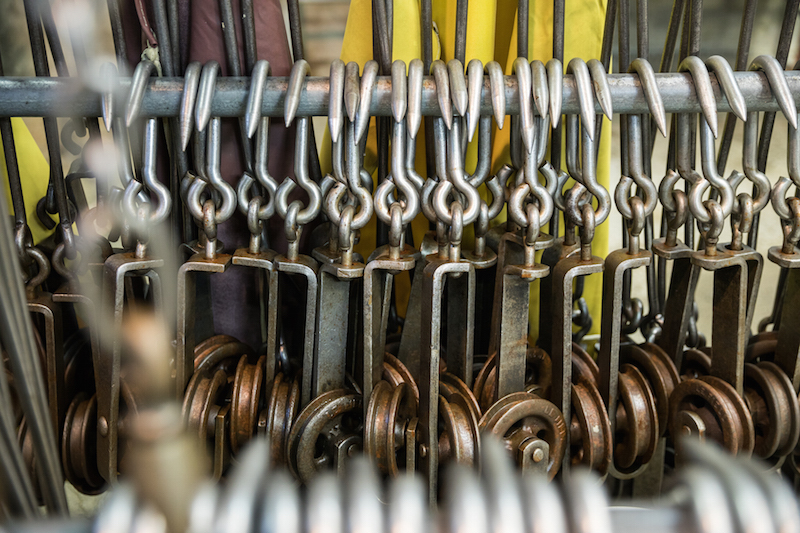
The first time in his life that Jimmy Serlin walked onto a kill floor was just about a year ago. It was lamb day at Marks Meats in Canby, and 60 sheep were scheduled for slaughter and processing. Intense, smelly, dangerous work, with trolleys weighing 15 pounds hanging 20 feet over his head, it could have been disastrous.
Instead, the words he used to describe it were more like those of someone falling in love.
“I was just instantly enamored,” he said, and remembered thinking, “This is what I want to do.”
Left to right: Ben Meyer, Ryan Ramage and Jimmy Serlin of Revel Meats.
That feeling didn’t diminish even though he recalls going home at the end of the week so tired and sore he walked in the house and flopped down on his bed. When his roommate came in and asked him how it had gone, he said, “I can’t lift my arms off the bed.”
It’s tempting to paint the picture as one of the prodigal son finding his calling, since his father had owned a wholesale meat packing business in Manhattan supplying area restaurants. Young Jimmy often skipped school to go to work with his dad, helping load the trucks for tips, but he found himself more drawn to the restaurants those trucks were heading to.
So, starting as a dishwasher at 13, he began cooking on the line soon after, eventually ending up at culinary school where he became fascinated with butchery. Stints in far-flung restaurants in New York, Vermont, Colorado and California, many with his culinary school buddy Karl Holl, cemented those nascent skills. Working for well-known restaurateur Staffan Terje at Perbacco in San Francisco, a high-rolling customer named Frank offered the pair a chance to come to Oregon and work on a start-up producing naturally raised geese for foie gras.
That, of course, went the way of many high-concept start-ups, leaving Karl and Jimmy and a few friends they’d moved with to Oregon sitting on a farm they’d leased near Salem and needing to pay the rent. But being a flexible and talented group, they decided to start a pop-up restaurant and catering business called Let Um Eat, with the lofty goal of “uniting the seeders, feeders and eaters of the food revolution.”
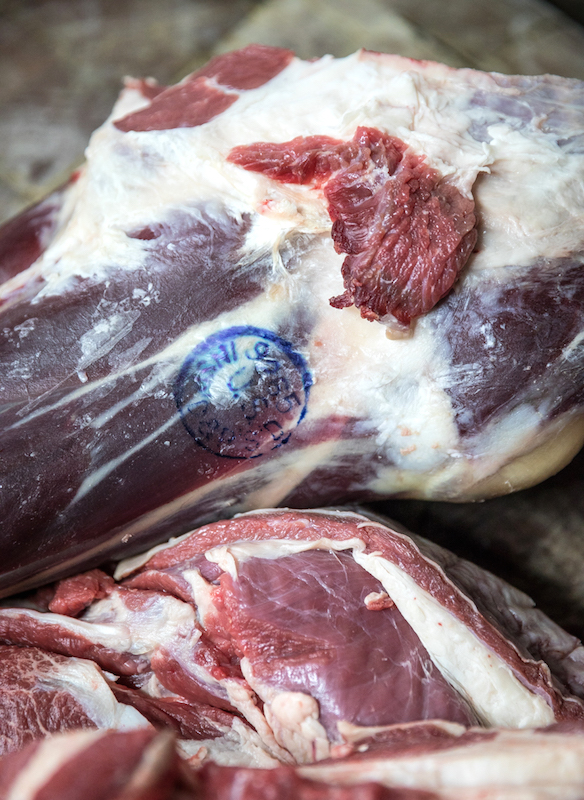
Revel Meat Co. USDA stamp.
A move to a permanent location, a farm on Milk Creek near Canby, proved to be pivotal in a way the group couldn’t have foreseen. They’d often stop down the road to buy steaks at a small meat processor, where Jimmy boasted to its owner, Kris Akin, about the Let Um Eat collective. “She, of course, looked us up on the internet and said, ‘What the hell is Let Um Eat? You guys sound like weirdos,’” he said.
Weirdos or not, Akin saw the value in the local network they had created, especially since she needed help finding qualified employees to process the animals into sausages and cuts of meat. And because she and her husband Joe were looking to turn the business over to new owners so they could retire.
The Processing Bottleneck
It’s probably a good point to “pivot,” as the au courant phrase has it, to discuss some of the history of meat processing in Oregon.
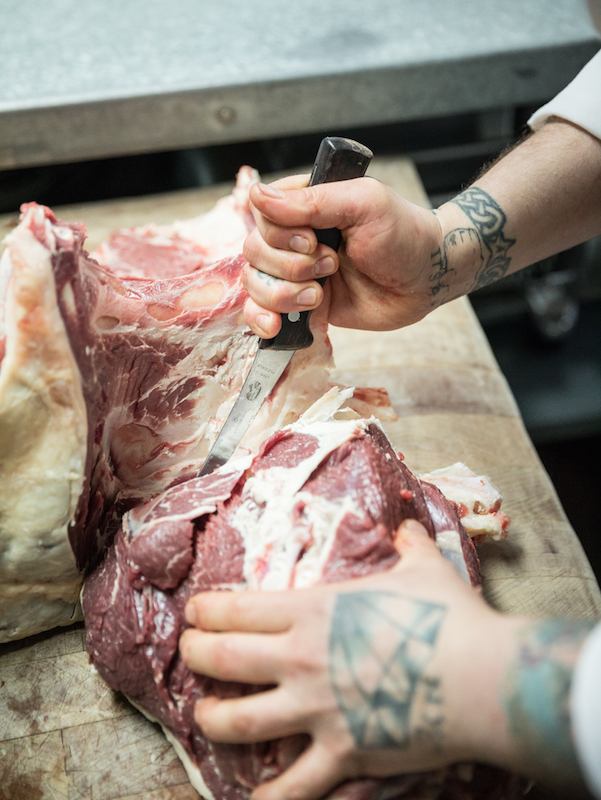
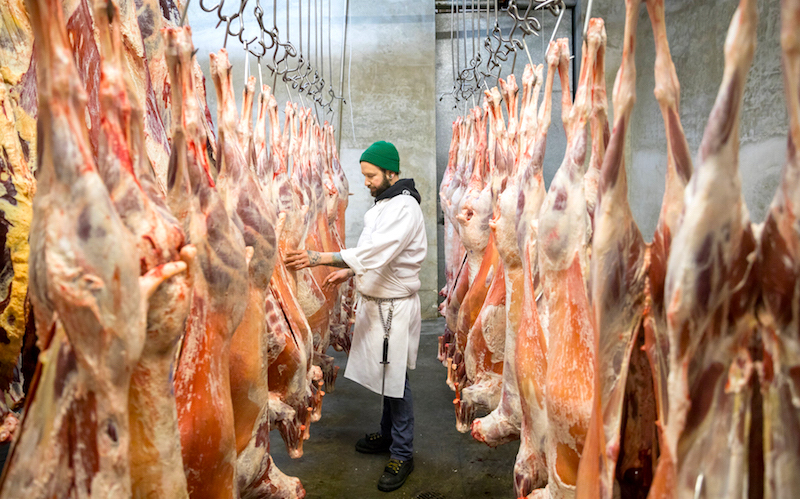
Tools of the trade.
According to Akin, in the mid-20th Century there were more than 1,000 small meat processors operating in Oregon, with one in almost every small town. They served as slaughterhouses and processing plants for local farmers and ranchers, and most were regulated by the Oregon Department of Agriculture’s (ODA) meat inspection program established in 1957. By 1967 the Wholesome Meat Act passed by Congress gave the USDA the responsibility of ensuring that animals were slaughtered humanely and that states maintained meat and poultry inspection programs at least equal to the federal program.
[Historical factoid: The Wholesome Meat Act, a reform pushed by consumer activist Ralph Nader in the 1960s, was known as “The Jungle, Part 2,” after Upton Sinclair’s book, “The Jungle,” about the deplorable conditions in meat processing plants in turn of the century Chicago, resulted in the passage of the Federal Meat Inspection Act in 1906.]
At that point Oregon turned over its meat inspection program to the USDA, which meant that small processors had to upgrade to meet federal standards—an extremely expensive proposition for marginally profitable businesses—or become “custom exempt,” meaning that they could only slaughter and process livestock for the exclusive use of the farmer and agree to inspection by both ODA and USDA once or twice a year.
Without access to funds to invest in updating equipment, hire skilled workers or do the marketing to find producers, not to mention consumers to buy their products, small facilities suffered. The implementation in 1996 of the Hazard Analysis and Critical Control Point (HACCP) system—establishing new requirements to improve food safety—and the simultaneous consolidation in the grocery industry were an “inflection point,” according to Lauren Gwin of Oregon State University’s Niche Meat Processor Assistance Network.
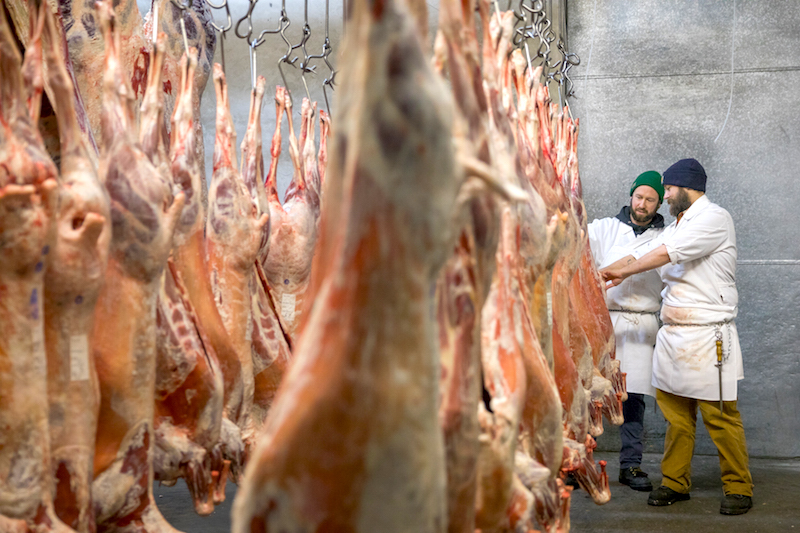
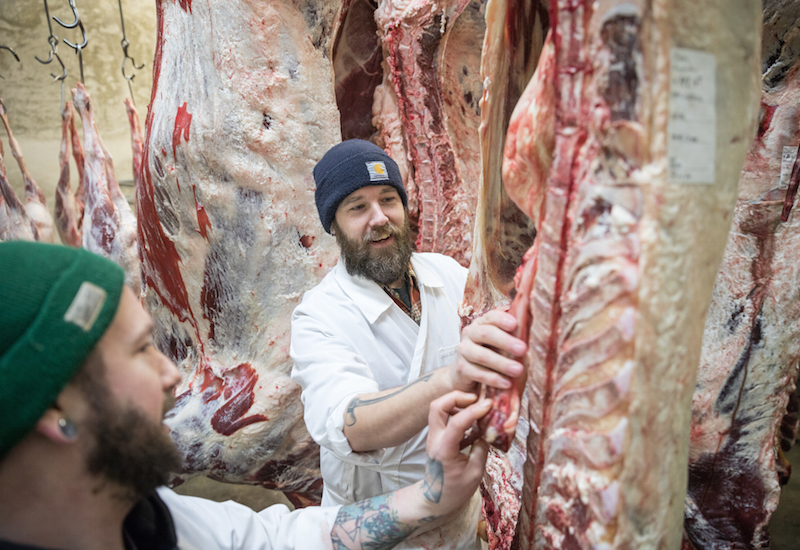
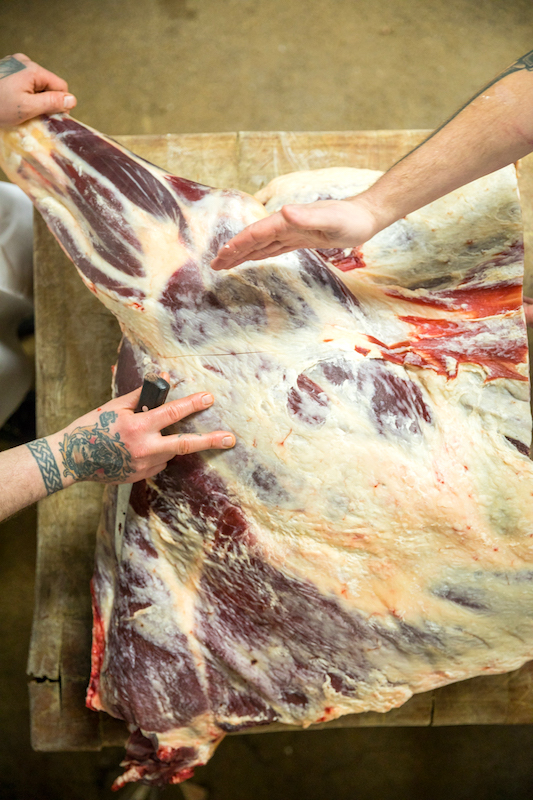
Discussing cuts.
“People blame regulations, and that shift was really hard for small plants,” she said. “But there were larger changes in the meat industry at the same time that were putting pressure on those small plants. The consolidation in the industry, including the shift to boxed meat, really changed things for the smaller plants.”
This shift from small grocers to large supermarkets, which closed butcher departments and switched to boxes of pre-cut meat from large processors, caused many of the state’s small slaughterhouses to shutter. From 2000 to 2015, mobile and custom-exempt facilities in Oregon dropped more than 30 percent, from 93 to 63, and the number of USDA-inspected slaughterhouses fell 25 percent, from 16 to 12.
Another consequence of the loss of these small processors is that farmers and ranchers have been forced to transport their animals longer and longer distances to get them slaughtered and processed, a costly and environmentally questionable practice. An article in the Eugene Register-Guard, titled “A Meaty Bottleneck,” quotes a 2005 study by Ecotrust concluding that “42 percent [of growers] said they would consider raising more animals if they had improved access to meat-processing facilities.”
Because pasture-raised and grass-fed meat from small farms is in increasingly high demand from consumers who want to know where their food comes from, including how it was raised, slaughtered and processed, it’s critical to the health and vibrancy of Oregon’s food system that small processors survive to serve them.
Read the next post in the series, an interview with Kris Akin, owner of Mark’s Meats, about the challenges of passing on a family business. The third post focuses on the future of small processors in an interview with Ben Meyer, titled Upending the Status Quo.

 But Jon Bansen, who has farmed since 1991 at Double J Jerseys, an organic dairy farm in Monmouth, Oregon, has throughout his career bucked conventional wisdom and demonstrated the promise of his practices. Now he’s convincing others to follow suit.
 Bansen was about 10 years old when his father and their family left the home farm to strike out on their own in Oregon’s Willamette Valley. They bought land in the tiny, blink-and-you’ll-miss-it town of Yamhill, about an hour southwest of Portland.
 To prevent coccidiosis, a condition baby cows develop when they don’t receive enough milk and are forced to live in overcrowded conditions, for example, Bansen fed his calves plenty of milk and made sure they had enough space.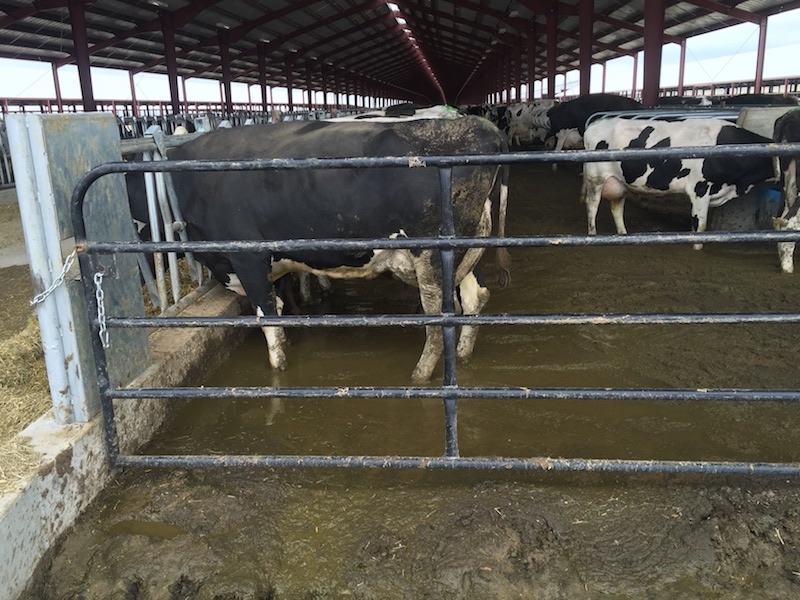
 An
An 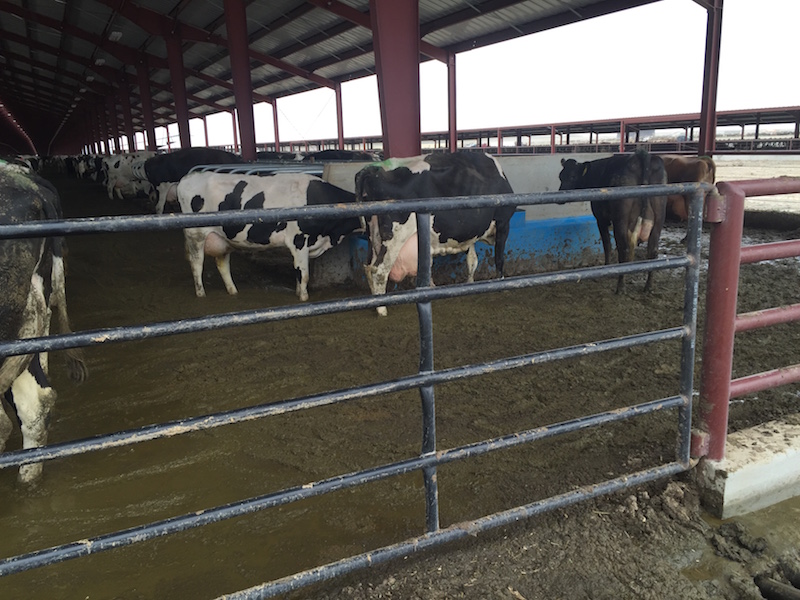 Then the Statesman-Journal reported that te Velde
  In February of 2018, the Capital Press
  Love and te Velde issued a dramatic written response to the state's lawsuit, which the Statesman-Journal reported as saying "the injunction would put them out of business, forcing them to lay off 70 workers, euthanize their cows, lose a $4 million per month milk contract, and default on local creditors."
 Despite this, as of the end of March, Tillamook was still buying milk from the dairy, according to
  "The state’s settlement barely requires more than compliance with the permit already in place—it’s a status quo deal that lets Lost Valley off the hook. The Governor and ODA should have continued seeking to close the operation, which they should never have approved in the first place,' said Tarah Heinzen, staff attorney with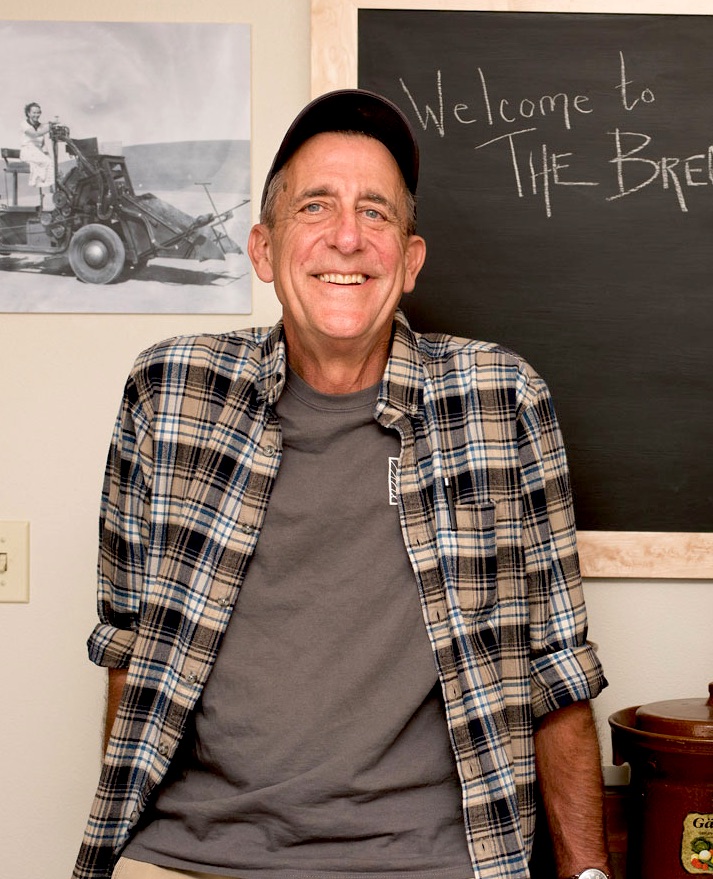
 I'd already pulled a four-pound pork shoulder out of the freezer, it being a weekend and the perfect time for a nice slow braise on the stove. So I picked up some cotija cheese made by Albany's
  And it's about to get a lot worse unless you act now.