I know, I know, calling a particular drink "the best cocktail" is hyperbole on the scale of saying one religion is the true path and everyone else is going to H-E-double toothpicks. And there are going to be comments like, "Whaddaya mean..." and "You're fulla..." But, doggone it, it's my favorite and I'm not afraid to say it.
Now, I've had lots of other great cocktails. After all, there is such a thing as due diligence in these matters and I'm all about fair play. Martinis, Manhattans, mojitos, lemon drops, G&Ts, sidecars, toddies...I could go on. But the Negroni is the one I always come back to as my touchstone, especially as made by my favorite bartender.
Serving over ice on hot summer days is allowed. (We won't tell!)
And it's not for everyone. You have to have a taste for the bitter (Campari) along with the sweet (vermouth). And the perfect accompaniment is a twist of lemon, though many practitioners are trying to substitute orange peel—in my opinion giving the drink a cloying oiliness rather than the zing that lemon rind contributes.
So if you're ready to try one, here's the recipe that we've adopted as our own.
Our House Negroni
A good friend of mine described the Negroni as "the perfectly balanced cocktail when made correctly." I've got to agree. The richness of the gin, the bitter-sweetness of the Campari, the balancing acidity of the vermouth. Measure it out if you have to, free pour if you're confident enough, just make it. This is a great old-school drink that originated in the 1930's, and is making a comeback today. Big ups for this very refreshing adult beverage.
1 part Gin 1 part Campari 1/2 part Sweet Vermouth 1/2 part Dry Vermouth
Fill your cocktail shaker halfway with ice, dump in the booze, shake then strain into a chilled martini glass and garnish with a twist of lemon.
A note on the gin: I love Beefeater and Taqueray, but with this drink I actually prefer the less assertive flavor of a Gordon's Dry Gin or a similar mid-range gin. Also, if you look in a vintage bar guide, it will invariably say one part sweet vermouth with no dry vermouth. But I was shown this half-and-half method by the bartender at Bix Restaurant in San Francisco many years ago—a great "must stop" bar for you martini fans—and this rounds out the flavors perfectly. Cheers!
It's high summer. Temperatures are soaring and no one wants to heat up the house cooking dinner. You could whizz up a blender of chilled soup—check out my favorites by clicking here—or do what we do: Set up an outdoor kitchen! All it takes is a camp stove and a camp table and you're good to go.
We've set up ours on the patio just outside the kitchen door, the better to access that all-important fridge, plus water and utensils. Our trusty two-burner Coleman will boil a pot of water for pasta on one burner while cooking up the almost-instant sauce (below) on the second burner without having to break a sweat.
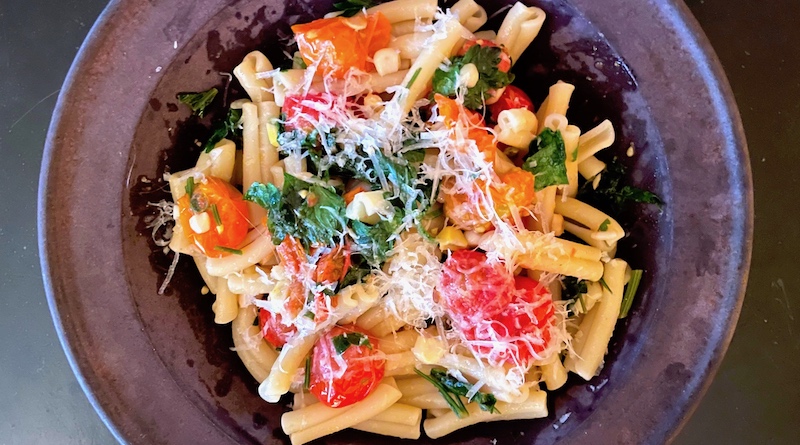
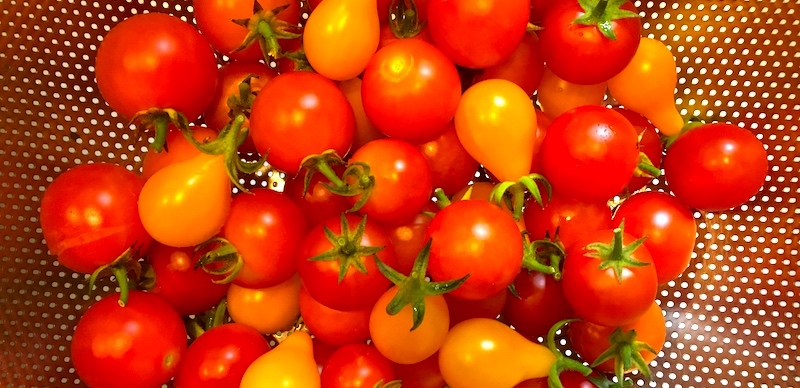
Whether you can stroll out to your garden bed and pluck your cherry tomatoes right off the vine or pull out a pint of little red orbs from your farmers' market stash, all you'll need is garlic, a tin of anchovies and olive oil to complete the dish. It's so simple you could whip it up while your guests sip gazpacho from tiny glass cups, but whether you choose to do that or just toss it in a bowl and put it in front of your family with a salad, I guarantee it'll be a dish you'll be pulling out again and again in tomato season.
Pasta with Cherry Tomatoes, Garlic and Anchovy Sauce
1 lb. pasta 3 Tbsp. olive oil 10 cloves garlic, peeled and very roughly chopped 1 tin anchovies in olive oil One pint of cherry tomatoes 1/4 tsp. red pepper flakes Salt to taste 1/4 c. Italian parsley, chopped Grated parmesan, or a 50/50 blend of pecorino and parmesan, for serving
Boil a large pot of water for pasta.
Just before the water comes to a boil, start the sauce by heating the olive oil in a deep frying pan over medium-high heat. When it shimmers, add the chopped garlic and sauté until fragrant, about 30 seconds. Add the anchovies and their oil and mash until the anchovies dissolve, then add the whole cherry tomatoes and red pepper flakes.
Add the pasta to the (now) boiling water and cook until al dente. Continue cooking the sauce until the tomatoes burst and give up their juices, then reduce the heat to low until the pasta is done. Drain pasta in a colander and place in a heated serving bowl. Pour the sauce over the pasta and sprinkle with some of the parmesan.
"Kai means group or association, Ikoi is someplace where people can feel comfortable and get together, like a shelter. I think this is a perfect name for it because it is a place where people can really be themselves and feel comfortable and absorb all of the good vibes that everybody around them is giving them." - Reverend Eisei Ikenaga*
For 45 years, Ikoi no Kai has been cooking and serving culturally appropriate meals to Portland's second and third-generation Japanese Americans from the basement of a Southeast Portland church, and providing a safe, welcoming space for the community to gather, laugh and share news over familiar, comforting food.
Thanks to the work of a small army of volunteer chefs, cooks and servers, Ikoi no Kai provides hearty mid-day meals four days a week, and once a month delivers fresh-cooked meals to homebound seniors. Most of the ingredients for those meals have come from donations from local farms and businesses like Troutdale's Mora Mora Farm and Fujii Farms, Kasama Farm in Hood River, and Umi Organic and Jorinji Miso in Portland.
The heritage vegetable garden provides some of the ingredients served at lunch.
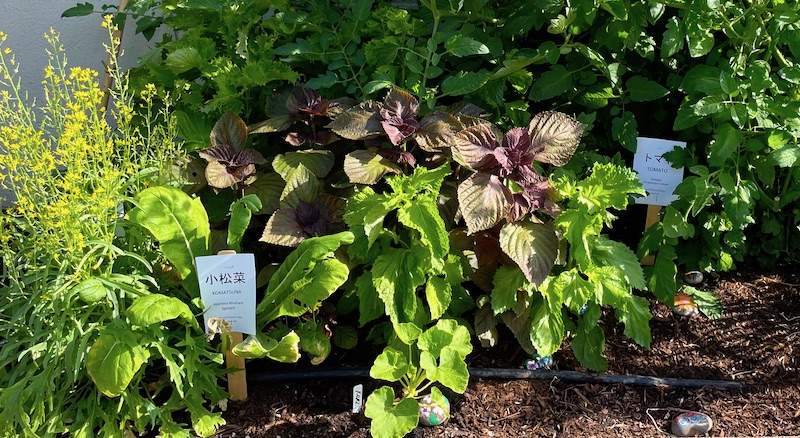
This summer, some of the eggplant in the Eggplant with Pork and Miso Sauce or the vegetables in the Chilled Udon with Tempura Vegetables served to customers might come from the onsite heritage vegetable garden stocked with culturally significant vegetables like mizuna, adzuki, ginger, komatsuna, shiso, eggplant and cucumbers. Begun by Program Director Jeannine Shinoda, it originally functioned as a display garden and educational tool. Now in its third growing season, it has become a kitchen garden for the lunch program, with seed and seedlings provided by East Multnomah Soil and Water Conservation District, donations from local farms, and an irrigation system provided by Mora Mora Farm.
Shinoda has also greatly expanded Ikoi no Kai's social media presence—you can follow them on Instagram and Facebook—and has begun working with local businesses like Jorinji Miso to hold pop-ups showcasing its products in the lunch program and teaching classes on making miso and koji at home. She is also currently working with the Japanese American Museum of Oregon on an exhibit showcasing the 45-year history of the program that will debut this fall.
The warm and welcoming lunches are a touchstone in Portland's Japanese community.
If you want to see this unique program in action, visitors are welcome to attend the community lunches—one fan called it "the best unknown restaurant in town." You can check out the menu here and make a reservation by e-mail or call 503-238-0775. You can also catch the Food That Connects interviews Shinoda recorded with members of Portland's Japanese American community (scroll down to "Food That Connects" section).
* From "Ikoi no Kai: Food That Connects," a Metro Community Placemaking grant to record oral histories of members of Portland's Japanese community.
Top photo from the Ikoi no Kai Facebook page. Others are from a visit to the program.
I must have been around four years old. My family lived in a fifties-style ranch on a one block-long street of similar houses in Tigard, an early patch of development in what would become the suburban sprawl that quickly surrounded Portland in the 1960s and 70s.
At the back of the house, the edge of our neatly mowed, unfenced green lawn bordered on a field of wildflowers where I'd wander, picking bouquets to bring to my mother. It would eventually become a parking lot for a giant strip mall, but to my four-year-old self it was a vast prairie, a place for catching and studying the birds and bugs that lived there or spending what seemed like hours laying there and looking up at the clouds passing overhead.
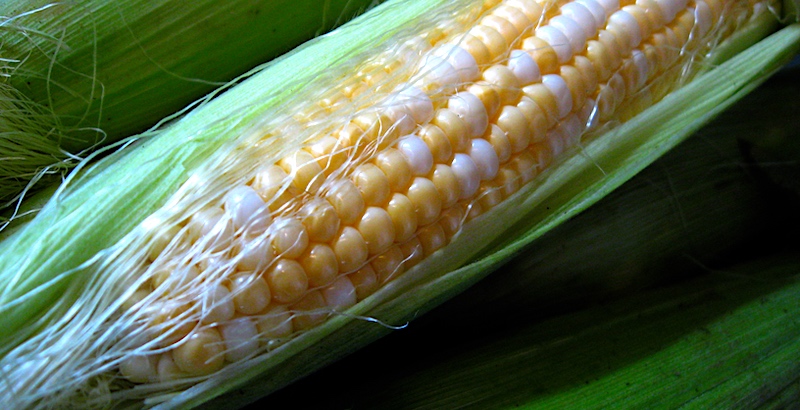
Across the street in front of our house was another row of houses identical to ours, beyond which stretched another field, this one planted with row upon row of corn. All the kids on our street would play hide-and-seek in that field, losing each other in the sameness of the shadowy stalks that stretched into the sky, their tassels glowing in the evening light. During the late summer I'd often wander off into the field on my own and pick an ear or two, peeling back the green husk and nibbling the sweet raw corn that always tasted better than anything boiled and buttered, and only emerge when I heard my mother calling from the front porch to come in for dinner.
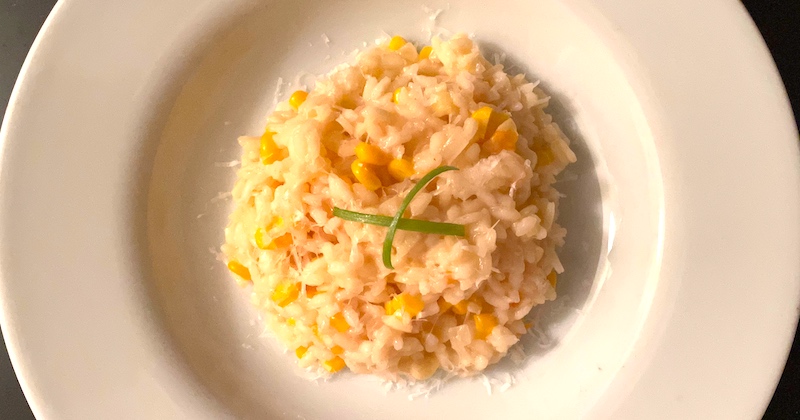
So when it's corn season and there's no field across the street to wander off into, I'll bring home an armload from the farmers' market, husk a few ears, scrape off the kernels and cook up a batch of corn stock from the cobs to make a corn risotto that brings back, if only for a few moments, that sweet memory from my childhood.
Sweet Corn Risotto
1 Tbsp. olive oil 1 Tbsp. butter or margarine 1/2 yellow onion, chopped fine 2 cloves garlic, minced 2 c. arborio rice 2 c. corn kernels 5 c. corn stock 1/2 c. parmesan Salt and pepper, to taste
To make corn stock, cut kernels off of five corn cobs. Put kernels in a bowl and set aside. Place cobs in large saucepan and cover with 5 cups water. Bring to a boil, then reduce heat to simmer for 15 to 20 minutes. Remove cobs and strain stock through wire mesh sieve to remove any debris.
Melt butter and oil in 2 1/2-3 qt. heavy-bottomed sauce pan. Add onion and garlic and sauté over medium heat till translucent. Add rice and stir for about 30 seconds till grains are hot and coated with butter mixture. Add corn and combine. Stirring frequently, add stock one ladle-full at a time, allowing rice to absorb it before adding more. When rice is tender but still slightly al dente, stir in cheese. Add salt and pepper, adjusting to taste.
My neighbors Bill and Jen have been a driving force behind many of my culinary explorations, with their extensive garden and Bill's consuming interest in fermentation. Jen, too, comes from a long line of picklers and preservers—check out her great-grandmother's refrigerator pickles recipe—and Bill turned me on to homemade shrubs like his cantaloupe and mint shrub.
Last year he gave me a bushel of purple shiso to play with, which led me to Andrea Nguyen's inspiring website, Viet World Kitchen, about all things Vietnamese—her Vietnamese Food Any Day cookbook has changed my cooking on a basic level—and her recipe for Vietnamese Shiso (Tia To) Shrub. I made several batches and we enjoyed them all summer long.
This year, just as the early July heat wave was hitting the Northwest with a vengeance, our Stoneboat Farm CSA was offering fennel as part of the share. Fennel's long wavy fronds are normally a source of annoyance since they've gone straight to the compost bin, but this time I asked my friend Melinda if there was a use for them. "Fennel fronds?!?" she exclaimed, her eyes lighting up at the thought. "Candied fennel! Syrup! Pesto!"
Okay, then—I now feel badly about dumping them all these years. But no more!
The pesto was made and enjoyed with a salmon fillet we grilled a couple of days later, and I made a syrup from the leftover stalks. It was good, but wasn't thrilling…until my son mentioned he'd made a soda with some of the syrup and had added a splash of tarragon vinegar to make it sing. And did it ever!
Don't get me wrong, I'm still in love with Andrea's shiso drinking vinegar, but this one may be the hit of this summer's beverage bar.
Fennel-Tarragon Drinking Vinegar
4 c. fennel fronds, sliced in 3" lengths 6 c. water 6 c. sugar 2 c. tarragon vinegar (see below)
In a large saucepan over medium heat, combine water, sugar and fennel fronds. Bring to a boil and turn off heat. Cover pan and allow to steep for 2-3 hours until syrup cools. Add vinegar and stir. Bottle and store in refrigerator (makes about two quarts); will keep for several weeks.
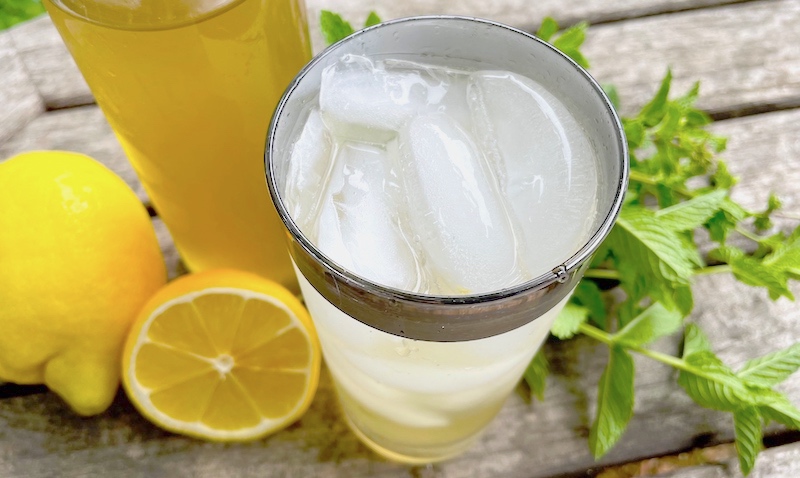
To make a beverage, fill an 8 oz. drinking glass with ice. Add 1 oz. drinking vinegar. Fill with club soda. Stir, adding more syrup or soda to taste. Garnish with lemon, mint, etc., if desired.
Tarragon Vinegar
Fresh tarragon White wine vinegar
Fill a couple of pint jars with tarragon sprigs—feel free to pack them in, but not too tightly; you need room for the vinegar, after all! Fill with vinegar to within 1/2" of rim. Place tight-fitting lid on the jar and store in a cool, dark place (like a basement) for 2 weeks. Using a fine mesh strainer, strain out the sprigs. Bottle (I save my empty vinegar bottles for just this purpose) and store in refrigerator.
If you've been seeing ads from your grocery store or fishmonger offering whole fish for a fraction of the regular retail price but you're not sure how you'd use it, I'm reposting this handy guide.
There is nothing better, or better for you, than fresh-caught, wild, local fish. Fish are packed with Omega-3 fatty acids, high in protein and low in saturated fat, and the American Heart Association advises eating fish twice a week. Trouble is, the usual price per pound for fresh fillets in the butcher case puts it out of reach for most budgets. Plus many commercially available ocean species can be high in mercury, and farm-raised fish are usually fed high doses of antibiotics—think of them as factory farms for finned creatures—due to the crowded pens they're raised in. And don't get me started on the effects of these farms on our waterways.
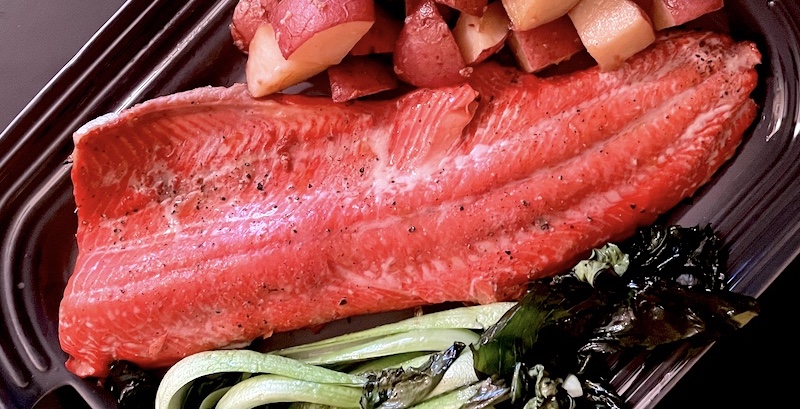
Very few dinners impress guests as much as a whole grilled fillet.
But those of us on the West Coast are fortunate to have access to some of the most delicious wild fish on the planet in our populations of native wild albacore and salmon. This year the fleet of primarily family-owned boats have been pulling in a supply of albacore from the fishery that stretches from Northern California up into British Columbia. Certified as sustainable by the Marine Stewardship Council, these albacore are young—just three to five years old, low in mercury and weighing in at 12 to 25 pounds—and individually caught with a hook-and-line system. (Want more info? Read my post, Albacore A to Z, for details.)
Wild salmon, particularly from Alaskan waters, are in plentiful supply right now, too, with stores advertising tempting steaks, fillets and roasts. But if you want to get a real deal, look for special sales events featuring whole fish.
"Whole fish?" you say. "I don't even know where to start with a whole fish!"
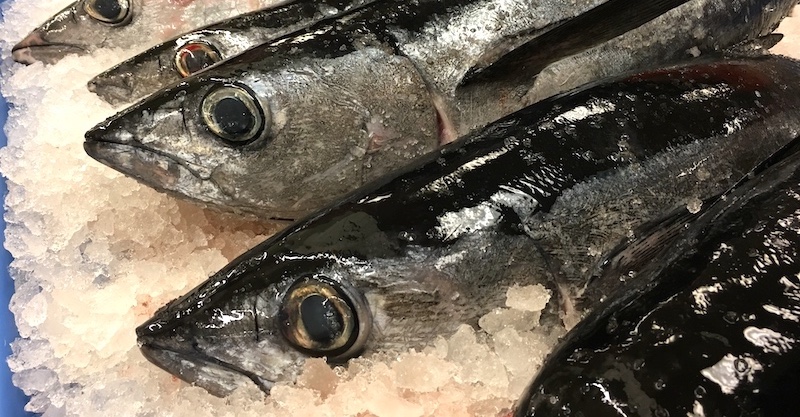
Buy from reputable fishmongers who buy from local fishing boats.
Well, let's talk about where you buy it. Make sure the fishmonger is reputable—recent studies have found that almost 20% of fish sold to consumers are mislabeled, and fish ordered at restaurants are more likely to be incorrectly labeled than fish bought at markets or grocery stores. I recently bought two whole albacore and two whole Coho salmon at New Seasons Market, a regional chain that buys its whole fish from local boats and has several one or two-day sales events per season. Find more places to buy local seafood with the Oregon Seafood Locator Map and Listings.
When you buy whole fish, you'll need to specify how you want it packaged. The fish are already cleaned, and most stores will butcher your fish at no charge, whether you want steaks or roasts or whole fillets. I always ask for the trimmings to be included, since the head, fins and bones make amazing stock for soups, chowders, risottos and paella, among many other uses. (Here's my technique for using those trimmings.)
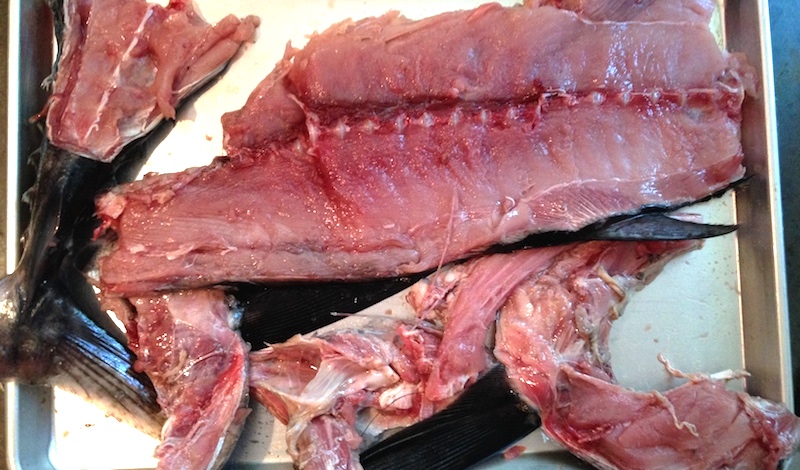
Make sure the carcass is included—roast it, pick the meat and use the remainder for stock.
And don't believe those online charts meant for chefs that say the yield from a whole albacore, gutted and without the head, is 50 percent of the weight. From the 17-pound fish (head off) that I bought from the store, my yield was more than 80 percent after removing the loins, roasting the carcass (350° for 30 min.), picking off the meat (nearly 2 lbs.) and then making stock from the bones (2 1/2 qts.). The total weight of bones, fins and detritus that went into the compost bin was only two or three pounds. (Kind of tells you about the food waste that happens in restaurants, though, doesn't it?)
If you're not going to throw the fish on the grill right away—always a good idea, and just one good-sized fillet will feed four to six—you'll need to think about how you want to store it. With a vacuum sealer it's a done deal, since properly packaged fish will keep for as long as a year. The idea is to keep air away from the meat to prevent freezer burn, so if you don't have a vacuum sealer, what do you do?
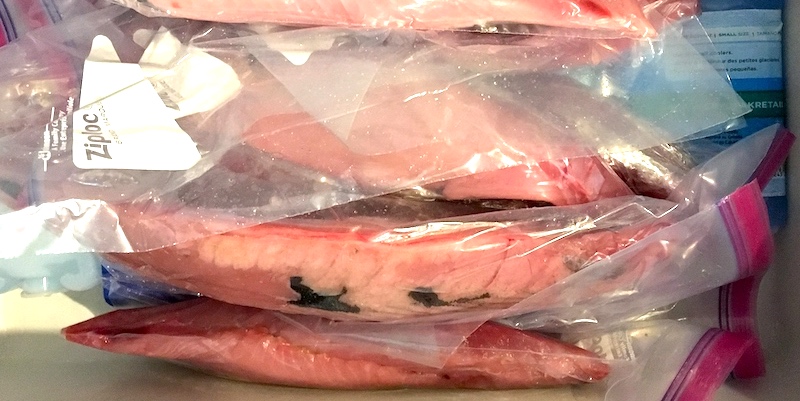
Albacore loins come four per fish and are a cinch to seal and freeze.
I quizzed the fellow at the fish counter when I bought my salmon, and he said that his dad, an avid fisherman, would put a single fillet in a zip-lock bag and submerge it in a sink full of water, holding the closure just above the water line. The water pressure pushes the air out, making an airtight seal around the fish. Not having a sealing machine myself, a little smoothing of the wrinkles in the bag while it was submerged did almost as good a job as the machine. (I found that a two-gallon zip-lock bag will hold a good-sized fillet quite nicely.)
A note: it's good to go over your fish ahead of freezing to check for pinbones or other bones that the butchers may have missed. First, it makes it easier to just throw it on the grill without worrying about biting down on a bone while you're eating and, second, it keeps those pokey bones from puncturing the bag and letting air in. Just hold the fillet and feel for any bones by running your fingers down the flesh, then use a pair of (clean) needle nose pliers to pull out the bones.
All this is to say that you can have more fresh, local, sustainable fish in your diet without paying dearly for the privilege.
In what was being termed one of the biggest threats to Oregon's land use system in 50 years, the City of North Plains, just outside of Hillsboro, attempted to double the size of the city by proposing the biggest-ever Urban Growth Boundary expansion by percentage basis and the largest by acres in the metro counties.
"A single increase of this magnitude to a city’s boundaries is unprecedented in Oregon, and most of the expansion would be for industrial and commercial use, with only about 167 acres set aside for housing," according to a 1000 Friends of Oregon article on the battle between residents, developers, city bureaucrats and state regulators.
The proposed North Plains expansion area (in red).
Local residents and farmers opposed to the land grab banded together under the banner Friends of North Plains Smart Growth, which quickly organized a coalition against the city's ballot measure on the expansion, explaining to voters what the city was attempting and notifying residents of upcoming public hearings.
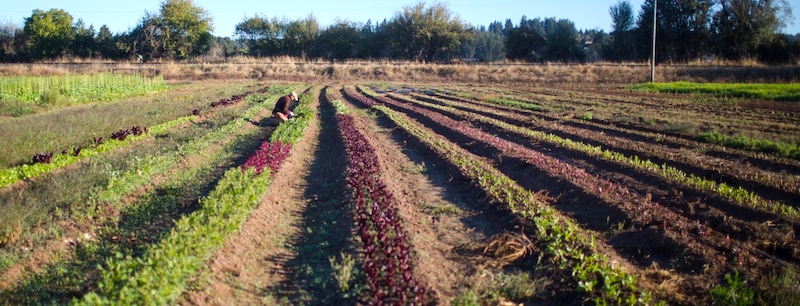
Led in large part by farmer Aaron Nichols, whose 15-acre Stoneboat Farm was just one farm removed from the city's proposed boundary expansion, the opposition effort became what he called his "second job" for a year, learning the labyrinthine intricacies of Oregon's land use system, first notifying the 500 families served by the farm's Community Supported Agriculture (CSA) subscriptions and then contacting local media and conservation organizations.
Citing an almost complete lack of public engagement, Nichols testified that "of the 26 meetings North Plains pointed to as public evidence, only three of these were public hearings that both followed proper noticing requirements and had an opportunity for the public to engage." His testimony charged that the plan itself was "poorly supported" and that much of the basic evidence was exaggerated or was simply missing, pointing out that even Dr. Brenda Bateman, the director of the Oregon Department of Land Conservation and Development (DLCD) stated that the city's plan relied on "incorrect facts."
Jesse Nichols (left), Aaron Nichols (right) and Aaron's son Asa (on tractor).
Just-released figures from the 2022 USDA Census of Agriculture show that the number of farms in Oregon decreased by six percent since 2017, and the acreage those farms occupied was down four percent in the same period. 1000 Friends of Oregon detailed that only about 16 percent of Oregon (excluding federal lands) consists of high-value soils, with only about four percent of those rated as prime farmland, and that efforts like those of the city of North Plains endanger those remaining valuable soils.
Putting those figures into perspective, 1000 Friends said that "while cities normally need to prioritize expanding onto non-resource lands or lands with lower-quality soils when proposing a UGB expansion, North Plains is surrounded almost exclusively by high-value farmland and prime soils. This means that any expansion would almost certainly pave over some of the best soils in the state and raises the ethical bar for proving that the expansion is what’s best for the greater community."
Stoneboat Farm supplies 750 local families with vegetables through its CSA subscriptions.
Expansion advocates tried to propose a separate bill (HB 4026) that was characterized as "intentionally designed to circumvent and suppress democratic participation by blocking future ballot referendums." Nichols said the efffort was a warning to those who might face challenges to their own local urban growth boundaries: "What [HB 4026] does, in fact the only thing [it] does, is have the legislature insert itself into a local issue to put a roadblock in the way of a community group. This bill forces our group to sue the state and, though as we and the city know full well the law will be quickly overturned, the city hopes that we will either be unable to raise the money for the lawsuit or it will exhaust our resources and harm our campaign. It is obvious that…placing a hurdle in the road for one side in one election, is not the place of the Oregon Legislature nor worth the time used on this bill."
On May 22nd of this year, the voters of North Plains rejected the city's ballot measure by a margin of 70 percent.
The city's response to the vote indicated the battle is not over: "The recent dialog on Measure 34-327 has highlighted a shared commitment among North Plains residents to prioritize our community’s livability and managed growth responsibilities,” said Mayor Teri Lenahan. “We are very early in assessing next steps for a future UGB expansion area." A hearing to discuss next steps is scheduled for Monday, July 15.
Summer and zucchini go together like Dizzy Gillespie and his trumpet, Einstein and relativity, Dorothy Parker and snark. Eaten raw right off the vine, lightly steamed, grilled, pickled or pulverized, their mild flavor and chameleon-like ability to mimic their surroundings makes them a ubiquitous choice for summer meals and snacking.
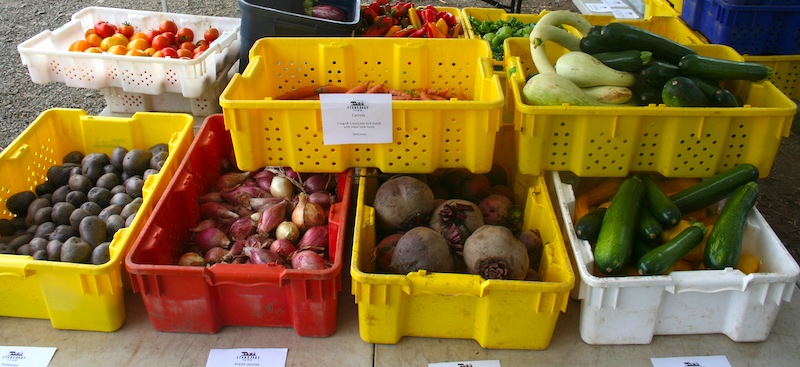
Ridiculously inexpensive to buy and so abundant in the garden that they've earned a reputation for midnight distribution on neighbors' porches, my CSA had a "take all you want" sign over a bin of them at the farmers' market last week. And since I have a hard time not taking advantage of that kind of offer, I came home with several pounds of green, yellow and striped versions.
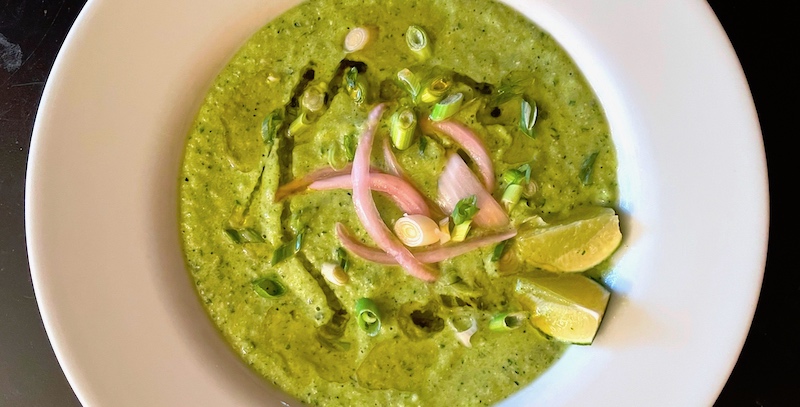
The blistering heat of the last few days made the idea of turning on a burner a complete non-starter, but I had the good fortune to run across Hetty Lui McKinnon's recipe for a cold zucchini soup—her inclusion of miso definitely intrigued me—involving nothing more than plugging in a blender, plus I had enough of the ingredients to be able to riff on her basic instructions.
With minimal chopping and a few snips of garden herbs, within 30 minutes dinner was on the table and the house was none the hotter for the effort. I'm now secretly hoping for some middle-of-the-night donations to mysteriously appear on my porch (hint, hint).
Chilled Zucchini Soup with Miso
1/2 c. raw cashews 2 c. vegetable stock (or 1 c. chicken stock 1 c. water) 6 Tbsp. lemon juice 2 lbs. zucchini, roughly chopped 1 c. herbs, roughly chopped (I used a combination of parsley, mint, cilantro and lemon basil) 1 c. fennel, roughly chopped 1/2 ripe avocado 3 garlic cloves, roughly chopped 3-4 Tbsp. white (shiro) miso Salt, to taste Condiments: Quartered limes, pickled onions, sliced green onions, extra-virgin olive oil
Place the cashews, lemon juice and just 1/2 cup of the stock in the blender or food processor. Blend thoroughly to create a creamy liquid.
Add remaining ingredients to the blender and puree; depending on the size of your blender you may need to work in batches. Adjust salt and lemon.
Get three more of my favorite cold soup recipes that'll raise the bar on your summer entertaining. And I've heard nothing but raves for Hetty McKinnon's vegetable-centric book, Tenderheart. Definitely worth checking out!
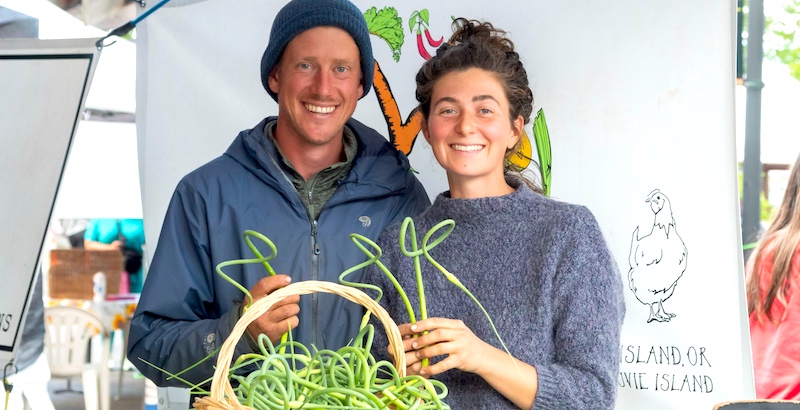
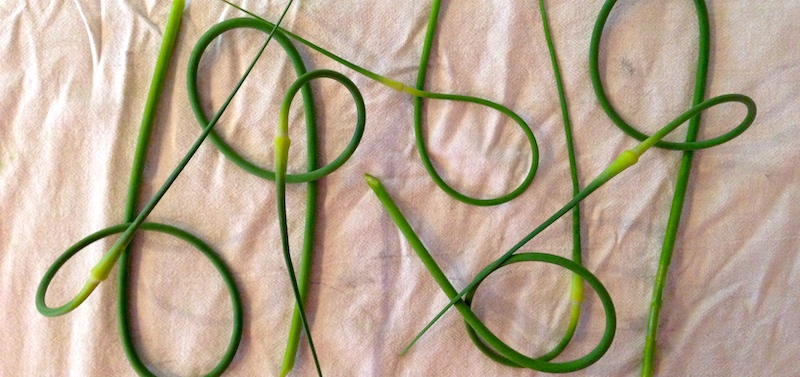
This week Market Master Ginger Rapport of the Beaverton Farmers Market sent out a primer on garlic scapes, the curly green whips that are the flowering stems of the garlic plant. They are at their tender best in late spring and early summer, when they still have their signature curl—if they're not harvested, the stems will straighten out and point skyward, by which time they also get hard and fibrous.
Rapport quotes market vendor Emma Rollins of Sun Feast Farm (top photo), who waxed eloquent about her favorite allium:
"Solstice time feels like the right moment to talk about garlic. This is when garlic scapes, the flowering stalk of garlic, curls and twirls its leek-like body in the most fantastic way! For me as a farmer, garlic scapes mark our true turn toward summer, always arriving right around the longest days of the year.
"As days lengthen, plants respond. Onions size up and the garlic needs you to pick the scape so its energy can go into the bulb, not up to the flower. If you left it, the garlic would flower in a purple pom-pom of little blooms. Each of these flowers turns to a bulbil, a little garlic seed, which is how garlic propagated itself before people began harvesting the bulb or head of garlic and breaking it up into the cloves to replant and propagate more that way.
“Why is garlic MY timekeeper? We plant garlic as the season closes, [at] Halloween time. Tucking cloves into the dark cold wet soil as so much of the field wilts back with frost for the season, garlic begins to turn the wheel toward the promise of next season. We finish the year planting into the next. We follow the sun by looking to the garlic that sprouts in the depth of winter, and come February, with the Persephone—when we enter over 10 hours of light a day, what a plant needs to actively grow—garlic marks this time and comes to life. There is green garlic before the bulb starts to form, then scapes for solstice [with] harvest come July when the stalks begin to dry out and sometimes tip over.”
So once you get your garlic scapes home, then what?
These flowering stems of the garlic plant present myriad delicious opportunities.
The simplest way to prepare them is simply throwing them on the grill after trimming off the end of the stalk. (Some recipes will have you coat them in oil, but I find that the oil drips off and causes the coals to flame up, which deposits a bitter film of burnt oil on your vegetables.) After a couple of minutes the scapes will brown over the fire, so turn them over and brown the other side. Then put them on a plate and drizzle with a good olive oil, salt and maybe a squeeze of fresh lemon. The easiest side dish or appetizer ever!
Just this last week I made a pesto from fresh scapes, processing five or six with a big handful of parsley from my neighbor's garden along with the requisite garlic, pine nuts (or walnuts or hazelnuts) and enough olive oil to make a smooth paste. Stir in some finely grated parmesan and you're ready to stir it into pasta or garnish a piece of salmon.
Rapport reports that her assistant market manager, Sue Poff, received a jar of garlic scape powder "made by her son who grows a ton of garlic every year" and she describes the flavor as "milder than regular garlic powder but used in much the same way." Easily dried if you own a dehydrator—drying them in the oven at its lowest setting is just as simple, though it may take longer—just slice the scapes into one to two-inch pieces and, once dried, grind them to a powder in a spice grinder or blender.
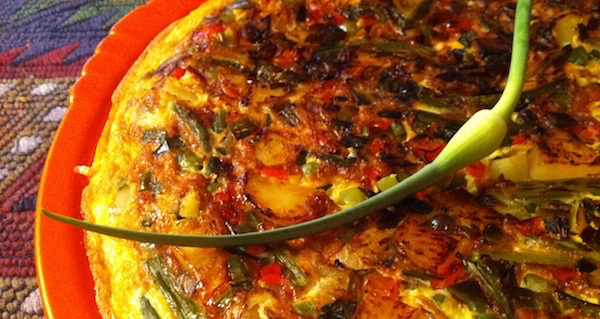
Garlic Scape Frittata
I love frittatas because they can be made from whatever vegetables or meats you happen to have on hand, sautéed and combined with eggs. Quick and easy, forgiving and always delicious, it's almost the perfect meal!
2 Tbsp. butter or olive oil 1/2 each green, red and ancho peppers, or about a heaping cup of any peppers, finely chopped 4 green onions, sliced into 1/8" slivers 4-6 mushrooms, halved and sliced thinly 5 garlic scapes, sliced in 1" pieces, leaving the bulbs intact 6 baby Yukon Gold potatoes (1 cup) chopped in 1/4" cubes 12 eggs 1/2 c. cheese, grated Salt and pepper to taste
Melt the butter over medium heat until it sizzles. Add potatoes and sauté briefly till slightly tender. Add rest of vegetables and sauté until very tender. While vegetables are cooking, break eggs into a mixing bowl and stir until well-mixed, adding salt to taste. When vegetables are done, pour the eggs over the top, sprinkle on the cheese and cover the pan, reducing the heat to low.
When the eggs are cooked on the bottom but still runny on top, put the pan under the broiler briefly (just don't walk away or get distracted like I sometimes do!). When lightly browned on top, remove the pan from the broiler.
To serve, run a spatula around the inside of the skillet to loosen the eggs. Then invert a serving platter over the skillet and, holding them firmly together, turn the platter and skillet upside down. The frittata should plop out of the skillet onto the platter.
I don't know about you, but this is the way it goes at our house: I'm browsing through recipes online or reading an article about our local fisheries—it is, after all, part of my job—and I think, "Gosh darn it, we need to have more fish in our diet."
Then I close the window or finish the article and forget about it.
But this summer we've invested in a CSA subscription from Stoneboat Farm, which means I will be picking up our share every Saturday morning for 23 weeks at its booth at the Hollywood Farmers Market. And that just happens to be across the aisle from the beautiful display at Linda Brand Crab which, in addition to the eponymous crab in its name, usually has a plethora of other local, fresh-out-of-the-water fish and shellfish on offer.
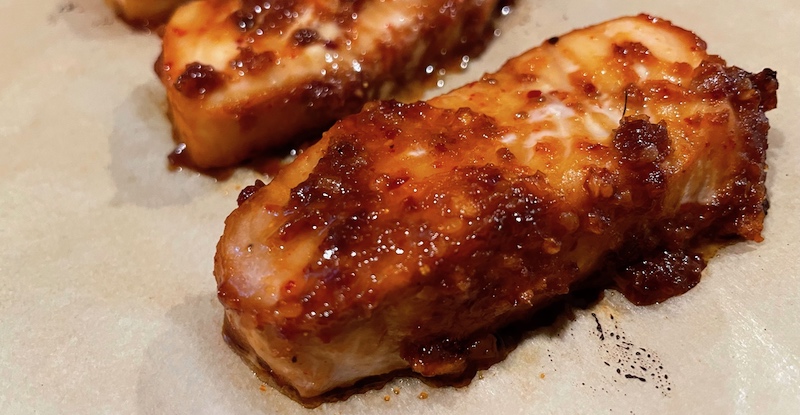
Quick and easy roasted fish presents multiple delicious possibilities!
After I picked up our share this past weekend, I glanced across the aisle and noticed some beautiful rosy albacore tuna loins for a very reasonable price. So I picked up a small-ish, three-quarter pound piece and stashed it in the shopping bag with my vegetables, figuring I'd come up with something for dinner that night.
As usual the afternoon got involved, this time with a trip to the garden store for compost, digging it in to amend the dead soil in our raised beds,planting the tomatoes, peppers and ground cherries from Alice at Log House Plants, and suddenly the clock somehow said it was time to make dinner.
Oops. The albacore!
A quick scan of the veg bin—this is where a CSA really comes in handy—made the decision a snap, and with my homemade gochujang and other staples at the ready, I came up with a simple and, it turned out, incredibly delicious solution. Not just a terrific way to supplement a vegetable stir fry, this roasted fish would be great to use with any firm-fleshed fish as a main course with rice and salad, or sliced into cubes it would make a terrific appetizer right out of the oven (or off the grill) this summer.
Plus it makes it easy to fulfill that pledge to include more fish on our table!
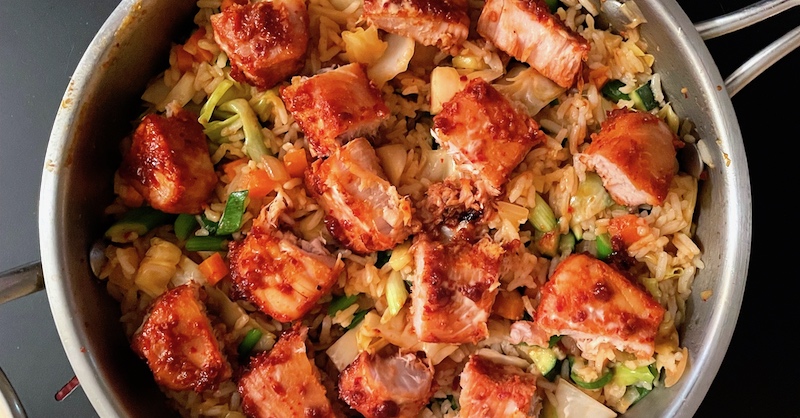
Gochujang Roasted Albacore with Vegetable Fried Rice
For the marinade: 3/4 lb. albacore loin, sliced in 1" thick sections 3 garlic cloves, finely minced or pressed in a garlic press 2 Tbsp. gochujang 1 Tbsp. miso (I'm addicted to locally made Jorinji miso) 1 1/2 tsp. brown sugar 1 Tbsp. water to thin
For the fried rice: 4 c. leftover cooked rice* 4 c. vegetables, chopped in bite-sized pieces (I used cabbage, carrots and zucchini) 2 Tbsp. vegetable oil 1 onion, chopped in 1/4-inch dice 3 garlic cloves, minced 1 Tbsp. ginger, peeled and grated 2 Tbsp. gochujang 2 Tbsp. miso 1 Tbsp. fish sauce 1Tbsp. toasted sesame oil 1 bunch green onions, sliced into 1" lengths 1/2 tsp. red pepper flakes (optional) 1 Tbsp. toasted sesame seeds (optional)
Preheat oven to 400°.
Place a sheet of parchment paper in a roasting pan.
Chop vegetables for stir fry.
In a small mixing bowl, stir together the marinade ingredients. Thickly coat each piece of fish in the marinade mixture and place them on the parchment paper in the roasting pan. Reserve any remaining marinade for the fried rice.
Place roasting pan in oven, roasting for 10 minutes. Remove from oven and set aside while you cook the fried rice.
In a deep sauté pan, heat the oil over medium-high heat until it shimmers. Add the chopped onions and sauté until it starts to become translucent. Add the ginger and garlic to the onions and sauté briefly, then add the gochujang, miso and any remaining gochujang marinade and cook for 1 minute, stirring to keep it from sticking.
Add vegetables starting with the ones that take the longest to cook (like carrots, then zucchini and cabbage) and sauté until crisp-tender. Add pepper flakes, fish sauce, sesame oil and green onions and heat briefly, then add cooked rice.* Cook for at least 5-10 minutes to heat the rice, then season to taste with more fish sauce, miso or sesame oil if it seems bland.
Cut the roasted fish into 1" pieces and place on top of the fried rice. Serve, sprinkling with toasted sesame seeds if desired.
* It's not necessary to have cooked rice on hand—I've made rice just beforehand with no problem. If you need to cook rice, bring 4 c. water to a boil and then add 2 cups long grain or jasmine rice. When it returns to a boil, turn down the heat to low and cook until all the liquid has been absorbed, about 20 minutes. You can cool the rice at this point, or use it hot.



 Whether you can stroll out to your garden bed and pluck your cherry tomatoes right off the vine or pull out a pint of little red orbs from your farmers' market stash, all you'll need is garlic, a tin of anchovies and olive oil to complete the dish. It's so simple you could whip it up while your guests sip gazpacho from tiny glass cups, but whether you choose to do that or just toss it in a bowl and put it in front of your family with a salad, I guarantee it'll be a dish you'll be pulling out again and again in tomato season.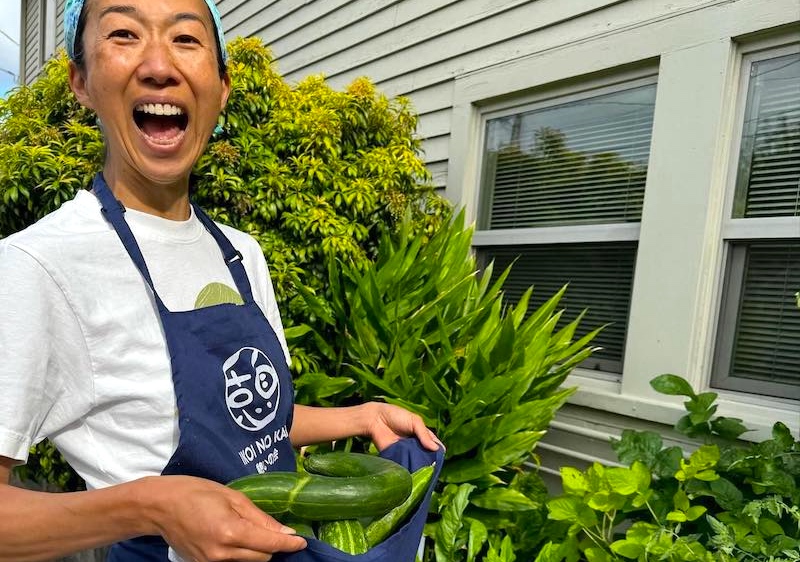

 Across the street in front of our house was another row of houses identical to ours, beyond which stretched another field, this one planted with row upon row of corn. All the kids on our street would play hide-and-seek in that field, losing each other in the sameness of the shadowy stalks that stretched into the sky, their tassels glowing in the evening light. During the late summer I'd often wander off into the field on my own and pick an ear or two, peeling back the green husk and nibbling the sweet raw corn that always tasted better than anything boiled and buttered, and only emerge when I heard my mother calling from the front porch to come in for dinner.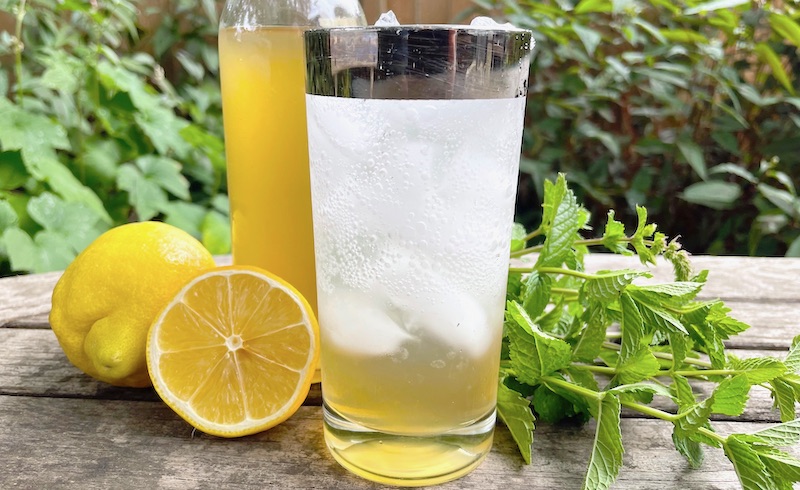
 This year, just as the early July heat wave was hitting the Northwest with a vengeance, our