First thing every morning I grab a cup of coffee that Dave brews early each morning and I take out our Corgi, Kitty, to, as my mother would have said, "stretch her legs." While she busies herself sniffing out the latest news from every tree and shrub, I look up at our ash trees to see if they're starting to build their furry leaf casings—a sure harbinger on our little lot—and I take a moment to note which canes of forsythia need clipping and whether the bleeding heart has emerged from under the leaf litter.
From this…
Early spring around here means yard work, with its requisite raking, trimming and moving of plants to new spots before they're smothered in shade by larger neighbors or spread beyond their assigned places in what we loosely call our "landscape." Attempting to tame their natural inclinations is better achieved in the cooler temperatures we're having now, before it warms up and they explode with growth and we'd rather laze about and sip cool drinks than labor in the yard.
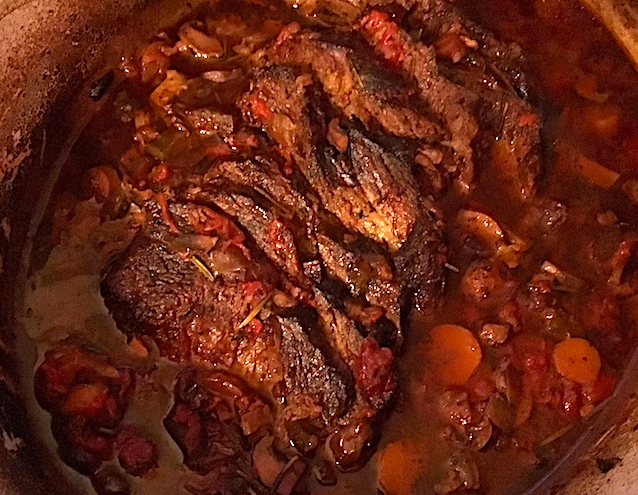
…to this in four hours. So worth it!
Cool days and still-chilly nights not only hamper this spring explosion, but also provide a last opportunity to get out the braising pot before warmer days beg for grilling outside. The heavenly pot roast recipe below is super simple and can be assembled and put in the oven to simmer for a few hours while you're outside doing yardwork. Plus it provides an excuse to schedule breaks every hour or so to check and make sure the liquid hasn't all cooked away (add water if it seems low).
The smell when you come in the house for those "breaks" will give you motivation to get the outside work done quicker, too, the better to come inside and enjoy a cocktail while you make a salad and boil potatoes to serve alongside. And sitting down to a hearty and flavor-filled dinner that basically cooks itself? I can't think of a better reward for all that hard work!
Pot Roast Bourguignon
This is extremely easy to make, but you'll need to get it in the oven four hours before dinner or make it the day before. Cutting back on the time in the oven makes for a less than stellar, though still delicious, result.
4 slices bacon, cut in 1/4" pieces 1 3-5 lb. chuck roast Salt and pepper 1 lg. onion, chopped in 1/2" dice 4 lg. cloves garlic, chopped roughly 4 med. carrots, sliced in 1/4" rounds 1 lb. mushrooms, sliced 1 tsp. thyme 3 large bay leaves 2 6" sprigs rosemary 1 qt. (32 oz.) roasted tomatoes 3-4 c. red wine
Preheat oven to 375 degrees.
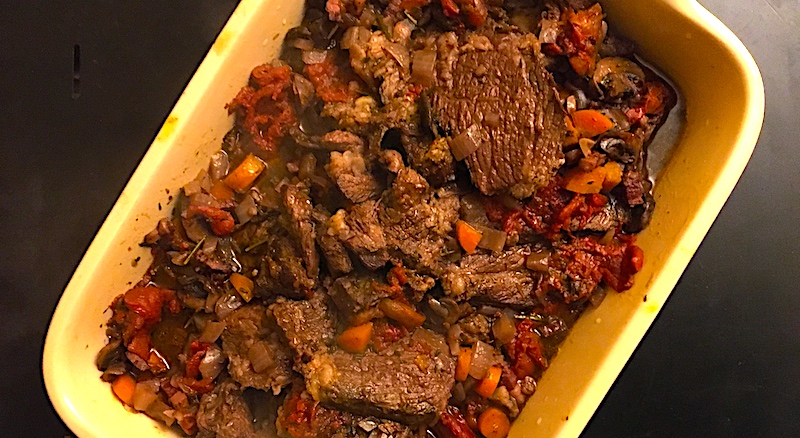
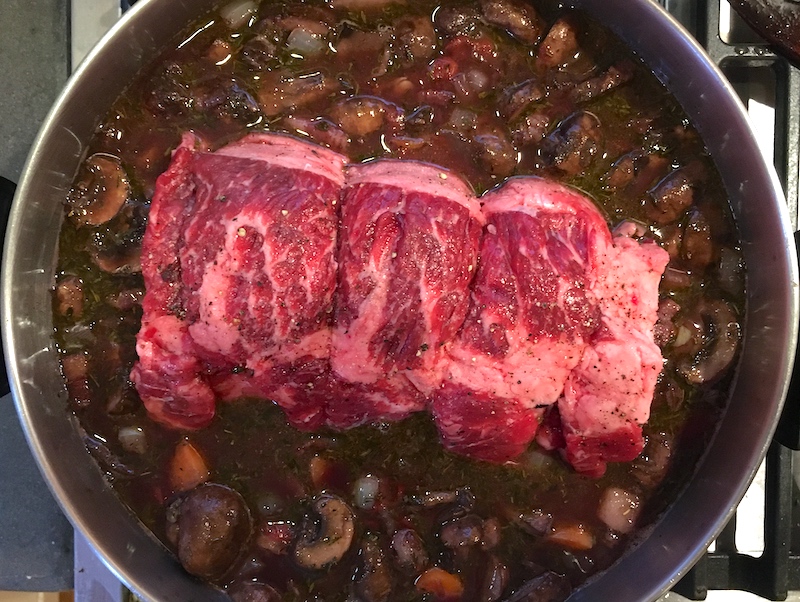
Put bacon in a large braising pot that can go in the oven and fry till fat is rendered and it starts to brown. Add onions and garlic and sauté 2-3 min., then add carrots and sauté 2-3 min. Add sliced mushrooms and sauté till tender. Stir in tomatoes, bay leaves and herbs, then add wine. Sprinkle roast generously with salt and pepper and add to pot. Bring to a boil, then cover tightly and place the pot in the oven. (If the lid doesn't fit tightly, put a sheet of parchment paper over the pot, then place the lid on.) Roast for 2 hrs. Remove meat from pot and slice in 1/4" slices, then return the sliced meat to the pot, submerging slices in the sauce and vegetables. Replace cover and bake for another 1 1/2 hrs.
Love West Coast albacore? Passionate about beer? Want to do something to change Oregon's food system for the better? If you care about where your food comes from and how it's produced, please consider joining one of Oregon's commodity commissions. Most include a member of the public, so check out the list of the positions available and make a difference in our food system!
This year the Oregon Department of Agriculture (ODA) is recruiting for 70 commodity commission seats, with a deadline to apply on March 15, 2021. Oregon’s 23 grower-funded commodity commissions support promotion, research and education to improve market conditions for their commodity.
A key point: they also give commissioners direct access to key Oregon agricultural opinion leaders and decision makers. Which means that new commissioners could help set the state's priorities going forward, encouraging the adoption of more regenerative, innovative practices rather than the business-as-usual, industry positions it has in the past.
Each commission has a board that includes producer and handler positions. Producers grow or harvest the commodity; handlers are the first to purchase the commodity from the producer and often are processors, distributors, or marketers. Most commissions also include a member of the public. Time commitment varies depending on the commission, and due to COVID-19 restrictions, remote attendance is an option.
Here are the commissions seeking public member applicants:
I suppose you could call us the casserole generation. We were one of the first cohorts of children whose mothers were entering the work force in the largest numbers since WWII, mostly because inflation had been whittling away at the salaries of "breadwinners" (mostly dads) for years. But women were still expected to do all their "mom" duties like laundry, housecleaning and, of course, shopping and cooking, in addition to putting in 40 hours on the job.
That meant my mom came home from her work as a social worker after an hour's commute and had to get dinner on the table fairly quickly while my dad, who (bless his heart), came home around the same time, turned on the nightly news, put his feet up and sipped a scotch and water until Mom called us in for dinner.
So with three hungry kids and a husband to feed, I can't blame my mother for welcoming convenience foods like Hamburger Helper with open arms, or making classics like Swiss steak and Spanish rice that could simmer away in the electric frying pan while she ran upstairs to change out of her work clothes.
(Did she have a glass of wine in her hand? Maybe…)
Noodle casseroles figured prominently in the pantheon of dinner menus—the "primavera" version hadn't yet appeared and fancified it into "pasta"—with goulash, macaroni and cheese and, on Fridays, the holy tuna version. (I was never sure why fish on Friday was a requirement since we weren't Catholics, though I suppose Episcopalians run a close second in the rules-ridden churchy hierarchy.)
As the female child, I was called on to put down whatever book I was currently immersed in to help my mother with prep chores and getting dinner on the table. It meant I learned to chop and mix and simmer early on, which I suppose cemented my inclination to appreciate the tastier parts of life. For that I'm thankful.
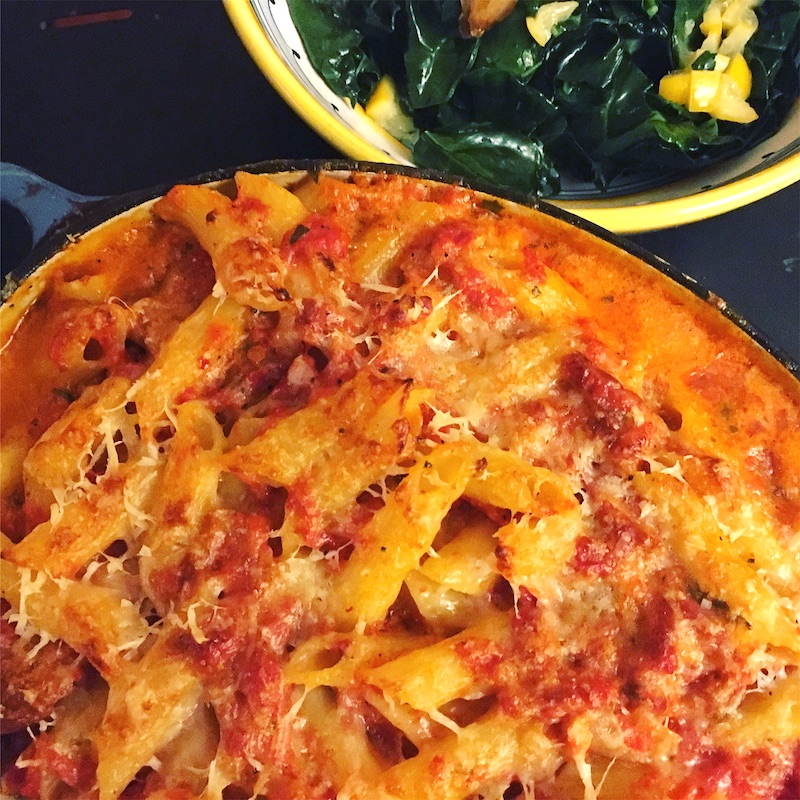
The recipe below—which involves little prep but calls for two-and-half-hours of simmering—would have been unthinkable for a weeknight dinner in my mom's day, but it's do-able in pandemic times since so many of us are spending scads more time at home. (And everyone needs an occasional break from Zoom meetings, right?) It's a variation on the perennial penne alla vodka served at 3 Doors Down café, which itself starts with a variation on the classic Marcella Hazan tomato sauce with onion and butter.
1 lb. penne 4 Tbsp. butter 1/2 med. onion, chopped in 1/4" dice 1 Tbsp. red pepper flakes 1 qt. roasted tomatoes (or 1 28-oz. can tomatoes) 3 mild Italian sausages (~1 lb.) sliced crosswise in 1/4" coins 1 c. vodka 1 tsp. dried oregano 1 c. sour cream or whipping cream 1 c. Parmigiano-reggiano cheese, grated Salt to taste
In a heavy-bottomed saute pan or skillet, melt the butter and add onion and red pepper flakes. Cook over medium-low heat until onion is translucent. Stir in the whole tomatoes with liquid and simmer for one hour. Add the sausage coins, vodka and oregano and continue to simmer for another hour. Turn the heat to medium high, add sour cream (or cream) and stir constantly for 10 minutes. Reduce to simmer and to cook for another 30 minutes.
Preheat oven to 450 degrees.
During the final half hour of simmering the sauce, bring 4 quarts of water to boil in a large pot. Drop the pasta in the boiling water and cook, stirring frequently until tender but still firm to the bite, a little less done than usual "al dente." Drain well, put back in pasta pot, add sauce, then toss pasta with sauce and 2/3 cup grated cheese. Adjust for salt. Pour into 2 3/4-qt. casserole dish and top with remaining cheese. Bake for 15 minutes. Remove from oven and serve.
In the growing scandal around the scheme that has been dubbed "Cattlegate," Easterday Farms is now tangled up in the bankruptcy of its sister company, Easterday Ranches, a giant ranching and feedlot operation in Washington state that filed for Chapter 11 bankruptcy protection earlier this month. The filing was made after a meatpacker sued Easterday Ranches for defrauding it of $225 million for 200,000 nonexistant cattle.
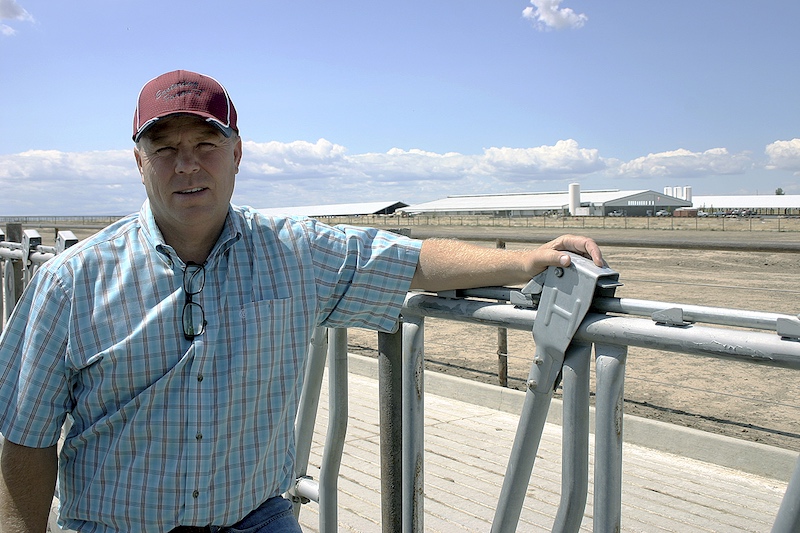
Cody Easterday.
Cody Easterday, president and CEO of Easterday Ranches, one of the largest agricultural operations in Washington State, is implicated in a complex modern-day cattle rustling operation involving 200,000 "ghost cattle" that apparently existed only on paper. Easterday was contracted to buy and feed the bovines for Tyson Fresh Meats, a division of Tyson Foods, then deliver them to slaughter at Tyson's processing facility, invoicing Tyson for their purchase and upkeep. The problem was that he never bought the cattle, but still invoiced Tyson for them, allegedly intending to use the money to cover losses he'd incurred in the commodities trading market.
An article in the Spokane (WA) Spokesman-Review said that on Monday (2/8), Easterday Farms filed for Chapter 11 bankruptcy seeking protection from its creditors. It said "according to court records made public Tuesday (2/9), Easterday Farms has and continues to sell feed to the ranch side of the business that has been caught up in an alleged scandal of missing cattle owned by Wallula-based Tyson Fresh Meats Inc., a subsidiary Tyson Foods Inc."
The Easterday family. Cody (far left) and his father, Gale (center), ran Easterday Ranches.
In addition to being the president and CEO of Easterday Ranches, Cody Easterday is also the head of Easterday Farms—one of the many sprawling and intertwined holdings of the Easterday family that includes private planes, hangars, giant storage and packing sheds, restaurants and million-dollar homes. On its 18,000 acres in the Columbia Basin, Easterday Farms grows onions, potatoes and other produce, plus feed and grain for the cattle in the family's feedlot operations.
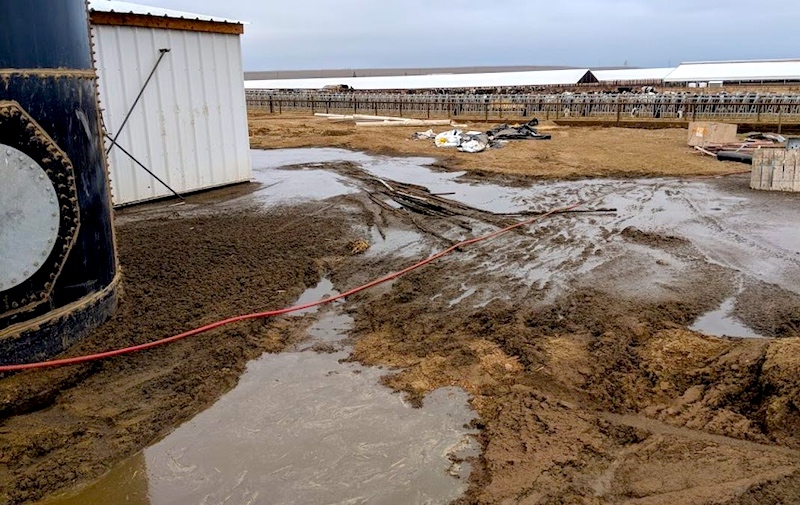
Easterday Farms is also the owner of the former Lost Valley Farm, the 30,000-cow mega-dairy that failed catastrophically in 2018 when the Oregon Department of Agriculture (ODA) shut it down after issuing more than 200 violations of its permit in two years of operation. It cost millions to clean up the "environmental mess"—including 30 million gallons of manure and wastewater—left by the previous owner.
At the time of the sale in 2019, Easterday was required to reapply to the state ODA for a Confined Animal Feeding Operation (CAFO) permit to operate a 28,300-cow mega-dairy on the site, which it did under the name "Easterday Farms Dairy." While the ODA issued a "letter of satisfaction" at the end of 2019 for the cleanup at Lost Valley Farm, according to sources the Easterdays will still need to invest $15 million to bring the facility into full environmental compliance.
Cleanup from the failed Lost Valley Farm ran into the tens of millions.
Cole Easterday, a co-owner of the new dairy business, said, "Though the situation with Easterday Ranches and Easterday Farms is unfortunate, Easterday Dairy LLC’s commitment to our current CAFO permit and our permit application is unchanged,” according to an article in the Capital Press.
The article quotes Stephanie Page, natural resources program director for the ODA, as saying that the lawsuit and bankruptcy potentially add another layer of complications. "I think we’ve all been on the same page in terms of not wanting to jump to conclusions," Page said. "We’re just continuing to evaluate the info we’ve gotten about the business structures, and how they’re separate but also making sure we understand how they’re interrelated."
In an e-mail, ODA communications director Andrea Cantu-Schomus said that the ODA and the state Environmental Protection Agency (EPA) are "required by Oregon law and EPA CAFO rules to consider all applications and issue permits for facilities that meet all legal requirements."
When asked whether the bankruptcy filings may impact the viability of Easterday's operations at the dairy, she said that the agencies are exploring Oregon Revised Statutes* and federal rules for CAFOs to determine whether they have the authority "to verify the ongoing financial status of an applicant and or operator" in the permit review. She termed the lawsuits and bankruptcy filings "a rapidly evolving situation" and that "the state will proceed with integrity and transparency."
Though this is hardly the ODA's first rodeo when it comes to issuing permits to large industrial facilities that go on to create problems.
“We know from experience that ODA and DEQ are likely to claim they don’t have the authority to deny Easterday’s permit,” said Tarah Heinzen, Food & Water Watch Legal Director. “Recent events underscore that this is just not true. They can deny a permit to any applicant who hasn’t disclosed all relevant facts or who has misrepresented any facts in their application. Easterday Ranches’ and Easterday Farms’ significant financial distress surely qualifies.”
Cantu-Schomus later clarified in an e-mail when asked about whether the agencies are able to put a permit application on hold while determining its status that "there is no time requirement for ODA or DEQ to complete CAFO Permit development and start the public notice period."
Adding pressure to the ODA's permit process, a coalition called Stand Up to Factory Farms is pushing a bill in the state legislature for a mega-dairy moratorium in order to institute regulations on industrial factory farm dairies to protect Oregon's environment, air and water and the health of its communities.
In light of the Easterday scandal, the coalition issued a press release saying that "denying the [Easterday Farms] permit is not enough. It’s been clear for years now that these facilities housing tens of thousands of cows and producing waste on par with many cities are mega-polluters regardless of the operators. It is time for Oregon legislators to enact a mega-dairy moratorium to protect our state from irresponsible mega-dairy operators and prevent harms from massive industrial dairies until regulations are in place to protect Oregonians."
Amy van Saun, a senior attorney for the Center for Food Safety, responded in an e-mail to a question about the Easterdays' various businesses, "While the intricacies of the various Easterday entities may not yet be clear, including to state regulators, one thing is clear: Cody Easterday and the Easterday family are the principals and the ones accused of massive fraud in Washington.
"It is beyond the pale that ODA and DEQ would still consider permitting the Easterdays to operate such a massive new source of nitrates and methane in Oregon," van Saun wrote.
As I write this, I'm looking out my kitchen windows at snow-covered yards and roofs, listening to the crackle and crash of ice falling from our trees and the tapping sound of icicles dripping from our gutters. We've had one of our February dumps of snow followed by an ice storm that has left a quarter of the city without power, some of whom won't be reconnected for at least a week.
Fortunately, so far we have only experienced about an hour without power, though I've been forcing Dave to grind coffee in the electric grinder before we go to bed at night, just in case. Yesterday was Valentine's day, and Dave spent it smoking one of his signature briskets, as well as making a Japanese-style milk bread, which he's been obsessing over since reading about it on the King Arthur website.
It's a sweetened, fluffy white bread that was perfect with the deep, moist, peppery smoked brisket and it soaked up the dark, salty juices like a champ. But you might well ask why I'm writing about brisket and milk bread in a post that's supposed to be about lemon curd. It's because for breakfast this morning we had thick slices of that slightly sweet, spongy bread toasted and spread with the Meyer lemon curd I've been making by the quart lately.
You know my "thing" about Meyer lemons, right? I've currently got two big Mason jars of preserved Meyer lemons curing in their salty brine in the fridge, and the puckery tang of my Meyer lemon tart reminded me I wanted to learn to make lemon curd. After all, the lemon filling is basically lemon curd, right?
I set about searching for an easy, simple recipe for curd and ran across one by Dorie Greenspan, who begins her biography with the words "I burned my parents’ kitchen down when I was 12 and didn’t cook again until I got married." Since then, luckily for us, she's written 13 cookbooks and is the "On Dessert" columnist for the venerable New York Times.
Funny and smart, her writing is always delightful and, at the same time, down to earth, and her recipes—certainly the ones I've tried—are bullet-proof. The same proved true when I made her lemon curd, which she describes as having a "texture [that] is smooth and comforting and its flavor is zesty, a delicious contradiction."
It takes less than half an hour to make, assuming you've got lemons on hand—either regular or Meyer lemons will work—and the result, while fabulous on scones, biscuits or that toasted milk bread, is something you'll be tempted to sneak spoonfuls of when no one's looking.
And yes, I actually have her personal blessing to share it with you. Thanks, Dorie!
Dorie Greenspan's Lemon Curd
1 1/4 c. (250 grams) sugar 4 large eggs 1 Tbsp. light corn syrup (I made up a substitute using 1/2 c. sugar dissolved in 2 Tbsp. hot water) 3/4 cup (180 milliliters) freshly squeezed lemon juice (4 to 6 lemons) 1 stick (8 tablespoons; 4 ounces; 113 grams) unsalted butter, cut into chunks
Whisk the sugar, eggs, corn syrup and lemon juice together in a medium heavy-bottomed saucepan. Drop in the pieces of butter.
Put the saucepan over medium heat and start whisking. You want to get into the corners of the pan, so if your whisk is too big for the job, switch to a wooden or silicone spatula. Cook, continuing to whisk—don’t stop—for 6 to 8 minutes, until the curd starts to thicken. When it is noticeably thickened and, most important, you see a bubble or two come to the surface, stop; the curd is ready.
Immediately scrape the curd into a heatproof bowl or canning jar or two. Press a piece of plastic wrap against the surface to create an airtight seal and let the curd cool to room temperature, then refrigerate.
We've been blowing through series television lately—rewatching the entire umpteen seasons of Deep Space Nine, being charmed by the more recent Ted Lasso and drawn in by the Canadian show Kim's Convenience—and, when we need a break, watching a documentary here and there. Recently we took in a biography of Diana Kennedy, the famed English-born authority on Mexican cooking, filmed in her home in the hills of the state of Michoacán and who, in her 96th year, is still as feisty and fiery as ever.
It was twenty years ago that our son took a three-week foreign studies tour to the town of Morelia in Michoacán, a city of almost a million not far from Ms. Kennedy's home. He and five of his fellow high school students from his Spanish class stayed with Mexican host families in the city, taking language classes and touring the area with their teacher.
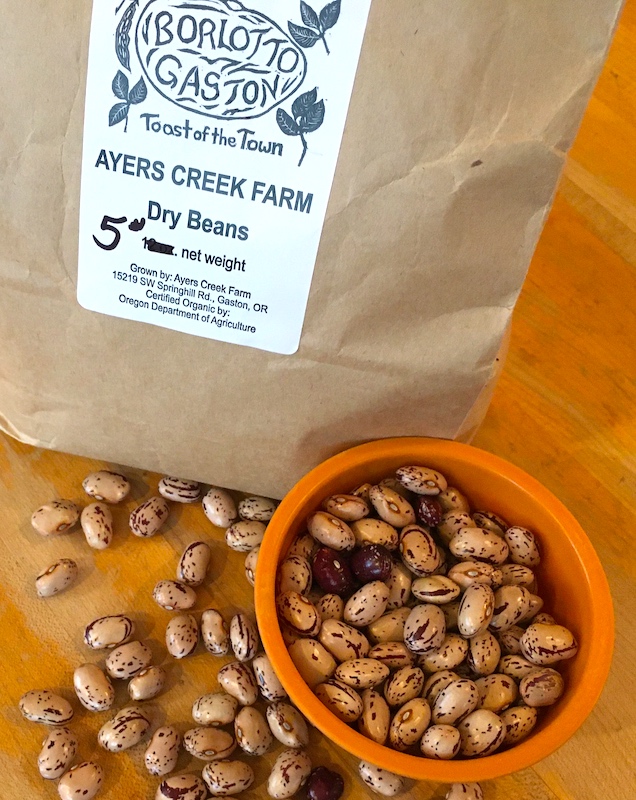
Organic beans for Diana Kennedy's soup? Perfect!
The other students were mostly consumed with going to bars (though the official drinking age was 21), eschewing Mexican food in favor of hamburgers and pizza. Our son was more intrigued with exploring Mexican regional specialties like the varieties of moles—he still waxes poetic about one exceptionally bitter version—as well as a garlic bread soup called Sopa de Ajo and another, a puréed bean soup called Sopa Tarasca. (His teacher was quite impressed.)
After watching the documentary about Kennedy, I was browsing through my not-insubstantial collection of her cookbooks and came across a recipe for that very bean soup. I happened to have a quart of cooked borlotto beans from Ayers Creek Farm left over from a dinner earlier in the week, so it presented an opportunity I couldn't well refuse.
Sopa Tarasca is named after the Tarascan Indians of Michoacán—the popular, if somewhat derogatory, name for theindigenous Purépecha culture which continues to maintain a significant population of nearly 200,000 in the state. It is a deeply flavorful bowl of puréed beans, tomatoes and chiles topped with fried chiles, tortilla strips and other condiments.
The soup itself is a fairly simple affair and comes together quickly, and the idea of the fried chiles crumbled on top will come in handy in the future as a crunchy topping for salads, tacos, nachos, dips or other dishes needing a crispy, smoky saltiness. See what you think!
For the toppings: Vegetable oil (canola or grapeseed) 3 dried chiles pasilla (dried ancho chiles work here, too), cut with scissors into small pieces 4 corn tortillas cut into strips Queso fresco, crumbled Sour cream
For the soup: 2 dried ancho chiles 2 medium tomatoes or 1 1/4 c. roasted tomatoes 3 cloves garlic 1/4 onion 3 Tbsp. lard or filtered bacon drippings 4 c. cooked pinto or borlotto beans with their liquid 2 1/2 c. pork or chicken stock 1 tsp. oregano (preferably Mexican oregano) Salt to taste
For the condiments, place large frying pan over high heat and pour in 1/2" or so of vegetable oil. When a small piece of tortilla strip is dropped in and sizzles with lively bubbles, it's hot enough. Put half of the tortilla strips into the oil and brown slightly, remove them from the oil with a wire scoop (spider) onto paper towels. Salt as soon as they come out of the oil. Repeat with remaining half of tortilla strips. While tortilla strips cool, put the pasilla chile pieces into your wire scoop and submerge in hot oil for three seconds. Remove to paper towels and salt.
In a heat-proof bowl, tear the ancho chiles into pieces, removing the seeds and veins. Add one cup boiling water and soak for 20 to 30 minutes.
In a food processor, blend the tomatoes, garlic and onion into a smooth purée. Melt the fat in a large Dutch oven or soup pot over high heat. Pour in the tomato purée, being careful since it may splatter when the mixture hits the hot fat. Cook for 5 minutes, stirring to make sure it doesn't stick. While the tomato mixture cooks, purée the beans, bean liquid, softened ancho chiles and their liquid in the food processor. Turn down the heat under the tomato mixture to medium-low and stir in the the bean purée and oregano. Cook for another 8 minutes, stirring frequently to keep it from sticking.
Add stock and stir to combine. Add salt to taste. Simmer on very low heat, stirring frequently, until ready to serve. This is supposed to be a thick soup, and it will thicken as it simmers, but you can add more stock as needed to get it the consistency you prefer. Serve with crumbled cheese, sour cream, tortilla strips and fried chiles.
You can also make the soup ahead of time, then fry the tortillas and chiles while you reheat the soup.
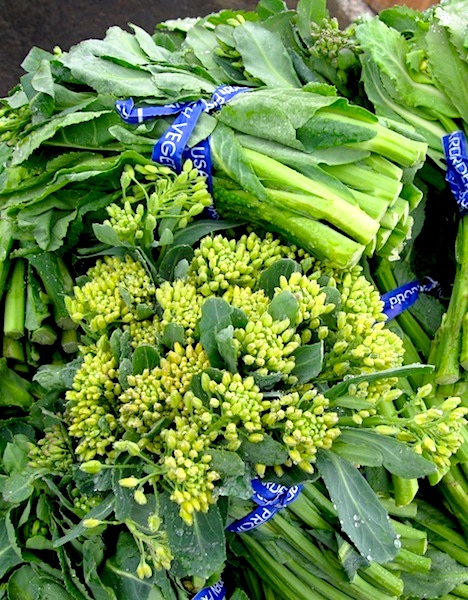
Since I'm jonesing for some lively greens and saw kale starting to flower in my neighbor Bill's garden, I thought this post from market master Ginger Rapport of the Beaverton Farmers Market would be great to keep on hand for market shoppers who might be asking, "What are those bundles of greens and why are they all called something different?"
Do you get confused when you hear the words “rabe,””raab,” “rapini” or “broccolini” used in recipes? Let us help you sort this out because you will find tons of these green vegetables in the market very soon.
First, a little taxonomy: Cruciferous vegetables are vegetables of the family Brassicacae, known as Brassicas or Crucifers. They include: cauliflower, broccoli, mustard greens, arugula, bok choy, kales and cabbages to name a few. Now, a little clarification:
Broccolini is not baby broccoli. It is a cross between regular broccoli and Chinese broccoli with long stems, larger florets, and less leaves. It is less bitter than some of its relatives which is why it is often thought of as baby broccoli.
Rapini and broccoli rabe are close cousins and are often used interchangeably. They are in the same subspecies as the turnip, hence they have the characteristically slightly bitter taste of this group. They do not form the large heads that we see in broccoli.
The flower buds of brassicas from the turnip family are often referred to as rabe, or raab, derived from raps, which means turnip in Italian. This time of the year, you will find the rabes of many types of brassicas in the market—kale, mustard greens, Brussels sprouts, turnips, bok choy and Chinese cabbage.
Whatever you call it, it's delicious!
While each of these are from a common family there are slight differences in taste between them. With each, you are meant to eat the stems, buds and leaves, making them very easy to prep for cooking. Don’t be alarmed if the buds have begun to show their yellow flowers. Some feel that the flowers are a sweeter version of the parent plant.
All of the aforementioned brassicas are excellent roasted, sautéed or lightly steamed. We don’t recommend boiling because it is easy to overcook the leaves in boiling water. The usual additions of garlic and a pinch of red pepper flakes makes for an easy and delicious preparation. Finish your dish with salt and pepper to taste and a squeeze of fresh lemon juice.
We also suggest that you try tossing your raabs with a balsamic vinegar reduction. The reduction’s sweet finish balances the bitter quality of the greens. We like to keep a balsamic reduction in the refrigerator to have on hand as needed. It is delicious drizzled on salads, fresh vegetables, fish and meats.
Basic Balsamic Vinegar Reduction
2 c. balsamic vinegar*
Boil in a small saucepan until reduced by half (one cup). You can continue to boil for a thicker glaze type consistency. You may add a clove of garlic, minced, or fresh herbs such as thyme. Be sure to strain those out before storing.
* Note: Bottles of balsamic vinegar on store shelves labeled "Balsamic Vinegar of Modena" are a commercial grade product made of wine vinegar with the addition of coloring, caramel and sometimes thickeners like guar gum or cornflour. Authentic balsamic vinegar, labeled "Aceto Balsamico Tradizionale di Modena," is produced from the juice of just-harvested white grapes (typically, Trebbiano grapes) boiled down to approximately 30% of the original volume to create a concentrate or must, which is then fermented in a slow aging process which concentrates the flavors.
It has the drama and intrigue of a Hollywood blockbuster—part western, part heist movie—centered on a middle-aged businessman up to his eyeballs in debt desperately trying to dig his way out scheming to rip off a giant national meat conglomerate, contracting to deliver thousands of cattle that only exist on paper.
Thing is? This is no movie, it's real.
Cody Easterday
Even weirder, it involves the catastrophic Boardman-area mega-dairy known as Lost Valley Farm—infamous for its drug-addled, prostitute-frequenting former owner, Greg te Velde, who racked up more than 200 violations of its operating permit in two years—and the scion of a multi-generational Northwest ranching family who swooped in and bought the failed dairy, proposing to infuse millions of dollars to bring it back to profitability.
The panicky businessman is Cody Easterday, president and CEO of Easterday Ranches, one of the largest agricultural operations in Washington State, who is also the main player in the Lost Valley Farm purchase. A tragic side note: His father, wealthy cattleman Gale Easterday, died in Decemberwhen the car he was driving ran head-on into an 18-wheeler hauling Easterday potatoes.
Reporter Anna King of the NW News Network broke the story that Cody had lost more than $200 million in the commodities market and had concocted the scheme in a bid to cover his losses. “As his commodities trading losses escalated, Mr. [Cody] Easterday explained that he began submitting fake feeding invoices as well as the fake cattle invoices,” Jason Wenglarski, vice president of internal governance for Tyson Foods, is quoted as saying.
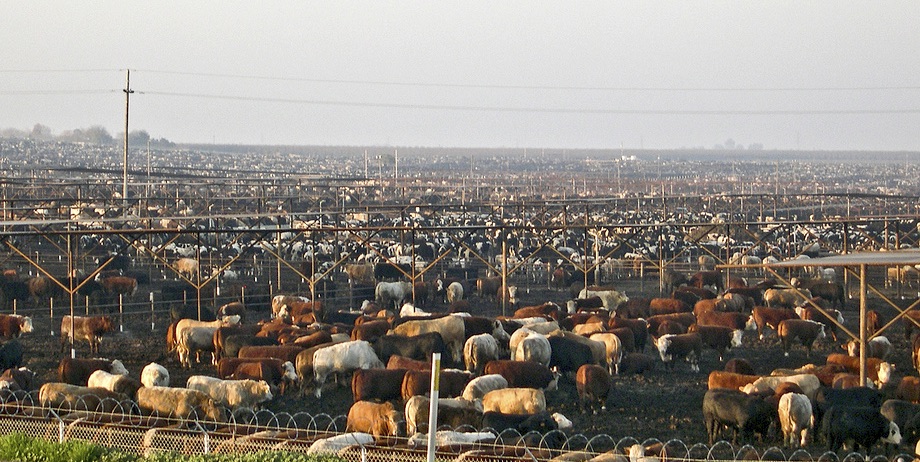
Easterday feedlot in Eastern Washington.
The story describes Easterday's scheme to contract with Tyson "to buy fake young cattle, then charge Tyson for them. Then Easterday Ranches would fictitiously feed the cattle and bill Tyson for that feed. Next, the cattle operator would deliver some actual cattle—but not all—to Tyson when the on-paper cattle would be market ready."
Interestingly, Tyson didn't discover the discrepancy for several years, according to the Tri-City Herald, which said Easterday had previously worked with Tyson for many years when, in 2017, Easterday signed an agreement to buy young cattle and feed them until they were ready for market, submitting invoices and being reimbursed for his costs.
According to Tyson's lawsuit against Easterday, the scheme came to Tyson's attention in late November of 2020 when it discovered "errors" in its inventory records and met with Easterday. “Its investigation, including the admissions of Defendant’s President Cody Easterday, showed there were over 200,000 head of cattle that Defendant reported to be in inventory, but which did not exist.”
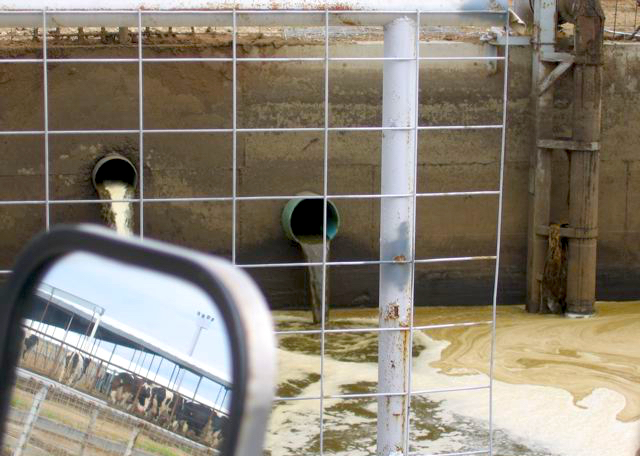
Cows were left standing in excrement at Lost Valley Farm.
As for Easterday's pending permit application with the Oregon Department of Agriculture (ODA) to operate a 30,000-cow mega-dairy on the former site of Lost Valley Farm? At this point it's unaffected by the recent revelations.
According to ODA communications director Andrea Cantu-Schomus, "the State is continuing the process of reviewing the Easterday Farms Dairy LLC application and drafting a permit." She added that when the draft permit is ready, the ODA and Department of Environmental Quality will release it and any supporting materials to the public prior to holding public hearings. Based on that, the agencies "will review and make possible changes" before making a final decision on the permit.
Stand Up To Factory Farms, the coalition of community, farm, environmental and social justice organizations behind the mega-dairy moratorium before this year's legislature, issued a press release on the Easterday scandal, saying "these serious allegations underscore that Lost Valley Farm’s owner, Greg te Velde, is not the only 'bad actor' among mega-dairies, as the Oregon Department of Agriculture and the dairy lobby would have us believe. It is vital that the Oregon Department of Agriculture immediately deny the Easterday permit application for a new mega-dairy in Eastern Oregon."
Until then—or until the movie comes out—I'll keep you posted on developments and/or shenanigans.
The Oregon Legislature convened its 81st session on January 11 of this year. Due to the coronavirus pandemic, the session will be held remotely with public hearings in both chambers done over videoconference. Governor Brown and the leadership of the House and Senate are planning to focus on the state's response to the COVID pandemic, addressing the damage from the climate change-related wildfires last year and the danger they present in the future, as well as dealing with the usual budget issues.
With all that, there are still bills dealing with Oregon's food system that are on tap for consideration. Here's an abbreviated list of what's coming up:
A moratorium on mega-dairies will be a hot topic this session.
A moratorium on permits for industrial mega-dairies (HB 2924, SB 583): Put forward by Rep. Rob Nosse (D-42) and Senator Michael Dembrow (D-23), these bills temporarily prohibit the state's Department of Environmental Quality (DEQ) and the Oregon Department of Agriculture (ODA) from issuing a permit to construct or operate any new industrial dairy, or to expand on an existing industrial dairy. "The moratorium would allow a pause in the permitting of new and expanding mega-dairies until meaningful protections can be enacted to protect Oregon’s air, water, climate, rural communities, small farmers and animal welfare," according to a statement from a coalition of community, farm, environmental and social justice organizations. One of those, Food and Water Watch, is encouraging citizens to sign a letter asking their legislators to co-sponsor the bills. For more information, watch a panel discussion on the topic.
Oregon Organic Action Plan (HB 2269, SB 404):Increases funding to the Oregon State University Extension Service for new positions related to organic production as well as funding for expanding the market for organic crops and products.
Meat processing facilities are critical for a robust food system.
Grant program to increase meat processing capacity (HB 2785): Establishes a grant program to fund upgrades to establishments under a program of state meat inspection. "So many of our [local] meat producers have been negatively impacted by Oregon’s lack of processing capacity," according to Amy Wong, Policy Director of Friends of Family Farmers. Oregon has lost several small processing facilities in the two years, crippling local farms and ranches who need to bring their animals to market. She said this program would build "infrastructure and hopefully technical assistance for bringing existing, and potentially new, processing facilities up to standards compliance." Read about the importance of access to local meat processing to Oregon growers.
Funding for Double Up Food Bucks program (HB 2292, SB 440, SB 555): Continuation of funding to assist recipients of supplemental nutrition assistance programs (SNAP), formerly known as food stamps, to purchase locally grown fruits and vegetables from farmers' markets, farm share sites and retail outlets that participate in program.
Manure digesters aren't the panacea they're cracked up to be.
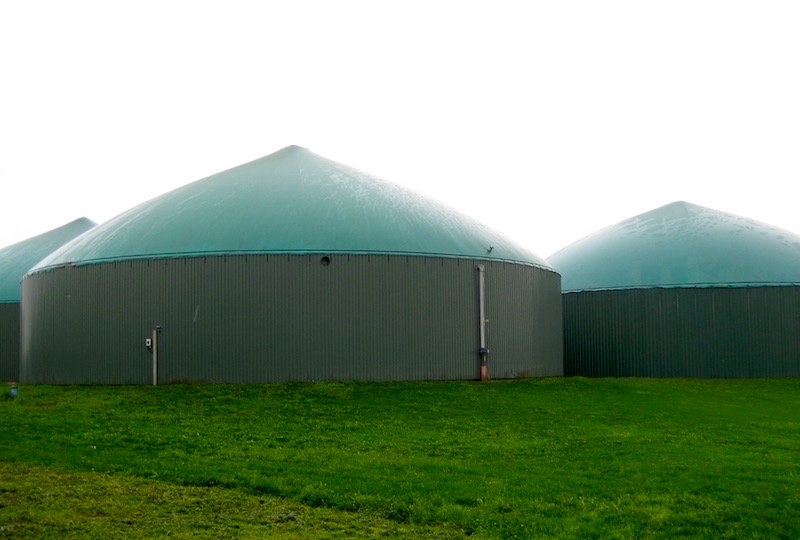
Renewal of the Bovine Tax Credit (HB 2451, SB 151): A bovine manure tax credit gives taxpayer money via tax credits to industrial facilities like feedlots and mega-dairies that have methane digesters for the production of biofuels. The problem is, as outlined in an issue brief from Food and Water Watch, "despite claims that digesters reduce greenhouse gas emissions, burning biogas actually releases carbon dioxide and other pollutants including smog-forming nitrogen oxides, ammonia and hydrogen sulfide, potentially offsetting other greenhouse gas reductions." Additionally, less than half of methane emissions from an industrial agricultural facility are actually captured by digesters. In addition, digesters, because they are heavily incentivized and subsidized, actually spur the expansion of these kinds of industrial facilities, according to Tarah Heinzen, an attorney for Food and Water Watch. She said they presents a false solution that doesn't address the underlying problem of methane emissions. Needless to say, consumer and watchdog organizations will be active in making sure this bill does not make it onto the floor for a vote.
Stay tuned for future installments in the 2021 Your Food, Your Legislature series as the legislative sausage gets made this session!
There's something about the color yellow tinged with a hint of orange that I find intoxicating. It's that golden-hour hue that comes just before sunset as the sun is sinking toward the horizon, slanting at just the right angle—some sources say between four and five degrees—to brush everything it touches with a yellow-orange glow. If you've seen the work of Van Gogh, you've certainly seen it. Or the movie Days of Heaven, shot by the legendary cinematographers Néstor Almendros and Haskell Wexler during the hours just after dawn and before sunset, suffusing the film with a dreamy, fairy tale-like atmosphere.
That Van Gogh yellow…
Meyer lemons, a hybrid of lemons and tangerines, are the fruit of the golden hour, carrying a warmer hue and a milder flavor than regular lemons. When they're in season—hint: now—I can't get enough of them. So as I've done in previous years, I decided to stretch out the pleasure of these golden jewels by preserving them in salt and lemon juice, perhaps one of the simplest methods ever devised and one that is virtually impossible to get wrong.
And the possibilities for using Meyer lemons, preserved or fresh, is endless. I've written about incorporating them into risotto, lemoncello, a crab risotto, pasta, a salad, evenacocktail…the list goes on and on. So run, don't walk, to your favorite produce department, get some of these gorgeous orbs and start squeezing them—need I say—now.
Preserved Meyer Lemons
12-14 Meyer lemons Kosher salt Wide-mouth quart jar with screw-on lid (either a metal ring and lid or a plastic lid)
Lightly rinse the lemons to remove any surface dust or dirt and dry them with a towel. Cover the bottom of the jar with a 1/8" layer of salt. Take six of the lemons and slice them vertically in quarters to within 1/2" of the base. Holding one upright in your palm over a small bowl, fill it with salt and place it in the jar. Do the same with the other five lemons and pack them tightly into the jar. Use more lemons if required to fill the jar within 3/4" of the top (you can slice the lemons into quarters to fit in the nooks and crannies). Pour the salt from the bowl into the jar. Squeeze the juice from the remaining lemons to fill the jar within 1/2" of the top (you can also use regular lemons if you need to). Screw on the lid and place in the refrigerator. Every day or so, shake the jar to distribute the salt and juice, and after three or four weeks you're good to go.
This recipe will work with regular lemons as well. You can also add herbs like bay leaves, peppercorns, cinnamon and cardamom.

 This year the Oregon Department of Agriculture (ODA) is recruiting for 70 commodity commission seats, with a deadline to apply on March 15, 2021. Oregon’s 23 grower-funded commodity commissions support promotion, research and education to improve market conditions for their commodity.
 Each commission has a board that includes producer and handler positions. Producers grow or harvest the commodity; handlers are the first to purchase the commodity from the producer and often are processors, distributors, or marketers. Most commissions also include a member of the public. Time commitment varies depending on the commission, and due to COVID-19 restrictions, remote attendance is an option.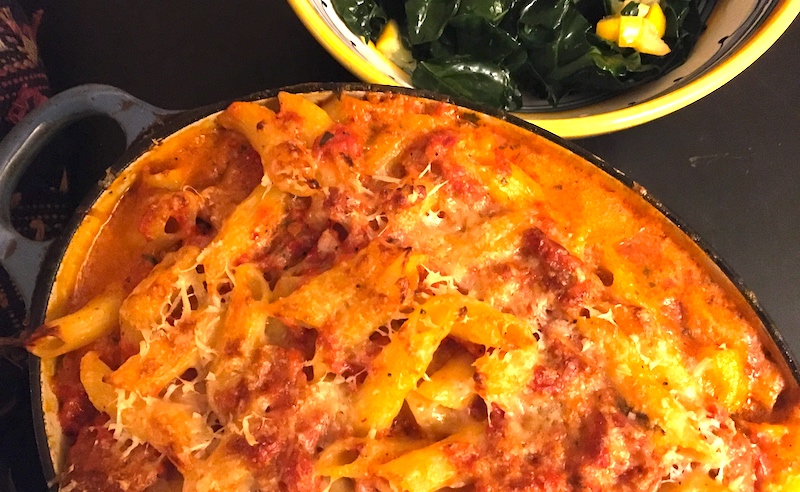
 Noodle casseroles figured prominently in the pantheon of dinner menus—the "primavera" version hadn't yet appeared and fancified it into "pasta"—with goulash,


 Fortunately, so far we have only experienced about an hour without power, though I've been forcing Dave to grind coffee in the electric grinder before we go to bed at night, just in case. Yesterday was Valentine's day, and Dave spent it smoking one of his signature briskets, as well as making a
  I set about searching for an easy, simple recipe for curd and ran across one by