Road Tripping: What's Cooking in Baker City

We needed to get outta town. And it had been a very long time since we'd been on a real road trip—anything longer than a couple of hours qualifies these days—and stuck a pin in our Oregon map in Baker City.

Granted, it's not new territory, especially for me, since most of the family on my mother's side still lives on the eastern side of the mountains and I grew up accompanying my grandfather to work at his cattle ranch in North Powder. The most indelible memories for me were riding the ranch's quarter horses—Rowdy, Riley, Sunny Boy, and my favorite, Big Red—and going on cattle drives to bring the cattle down from the mountains in spring, plus endless games of Kick the Can with my cousins.
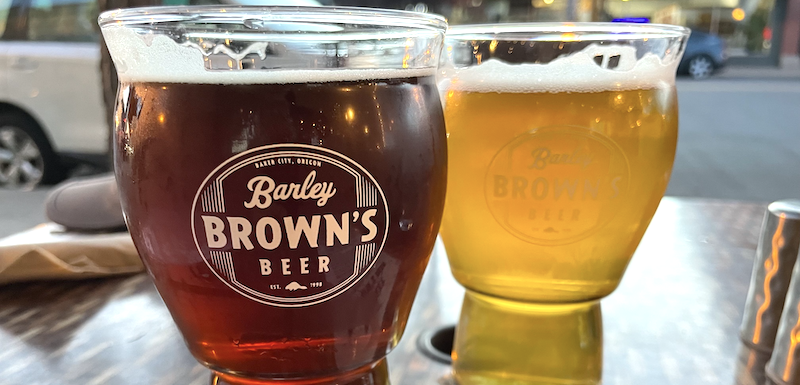
A must-stop in Baker City is Barley Brown's for beers and more-than-pub grub.

We'd rented a small, dog-friendly home in South Baker for the trip, and after the four-and-a-half-hour drive we were ready for dinner and a well-deserved beer. And where else to go when in Baker City but Barley Brown's for their extensive selection of house-brewed beers and not-just-pub grub—like my flat iron steak seared to medium-rare perfection just the way I like it.

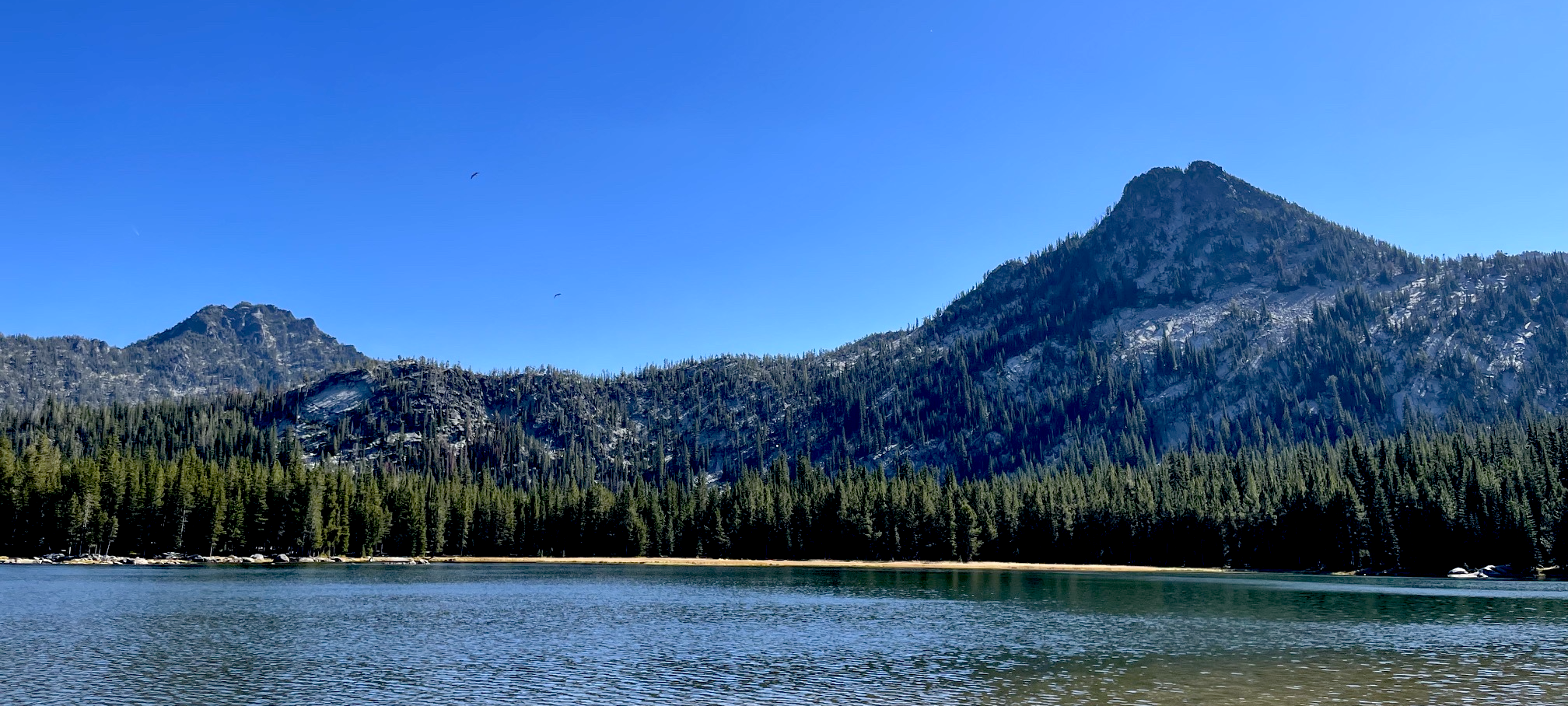
Our second day started with a drive up to Anthony Lakes which, at 7,100 feet in elevation, sits right in the middle of the Elkhorn Mountains outside of Baker City (top photo). Part of the Blue Mountain range, it's well known as an excellent off-the-beaten-track ski area in the winter months with downhill and nordic skiing that attracts skiers from all over the region, and a low-key vacation destination in the summer months for camping, paddling, fishing and hiking.
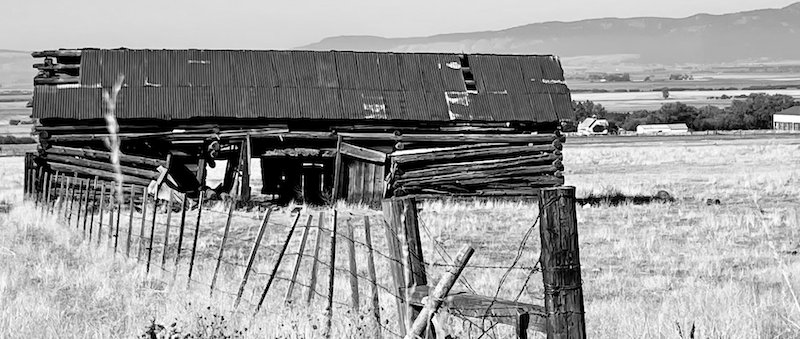
Historic farm structures can still be seen dotting the landscape in the area.

Interestingly, the current Anthony Lakes Outdoor Recreation Association (ALORA) is a 501(c)(3) nonprofit that was formed to purchase and preserve local control of the formerly privately owned facilities, which include the campground, ski lodge and golf course. It's committed to local purchasing and employment, and currently partners with local schools, offering ski and golf programs to local kids, as well as college scholarships for high school students planning to study outdoor recreation.

Our trip on a spectacular early fall day was simply an amble on the  main trail that rims the lake, which gave us an opportunity to check out the historic Anthony Lakes Guard Station, a Civilian Conservation Corps log cabin built in the 1930s (available to rent), as well as the campsites and campground. It also included a brief chat with one of the resident river otters who was joyfully making a feast of the plentiful fish in the lake's clear waters.
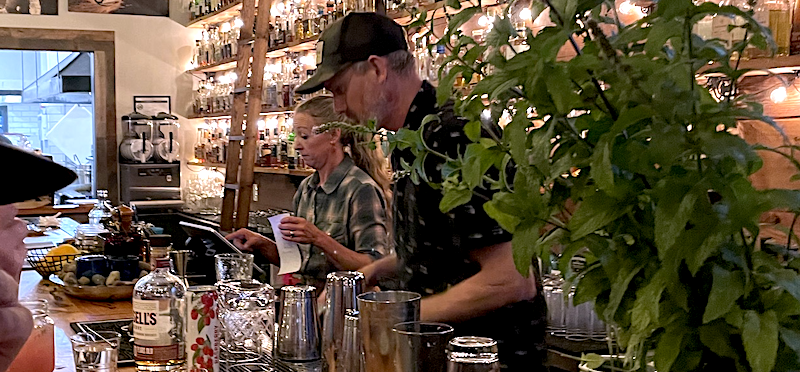
Cabyn owners Jenn Rominger and Ryan Duley's eclectic menu is astonishing for a small town.

On returning to town, we dropped in to The Cabyn, a pocket-sized bistro created by Jenn Rominger and Ryan Duley smack in the middle of the main drag in downtown Baker City. With an eclectic menu ranging from Asian-inspired pork belly buns, kimchi and chashu ramen to Western classics like elk lasagne and pot roast, this tiny beloved-by-locals spot hits each dish out of the park. And don’t get me started on the local brews, wines, spirits, house-crafted cocktails and shrubs. This is the kind of place you’d be excited to find in the big city, but to see it packed out in a tiny Eastern Oregon cow town? Truly remarkable.

The next morning I needed to find raw pet food for Silas since I'd forgotten to bring enough from home, a tough call when you're in a small town without bougie pet stores serving Poopsie's every need. Luckily, someone mentioned Old Souls Farm and Market, a farmstore that not only carries meat and proteins from its own animals and those from surrounding farms, but also an incredible array of specialty and gourmet items including olive oils, salts, wine, tinned fish and so much more. Once again, Baker City astonished me!
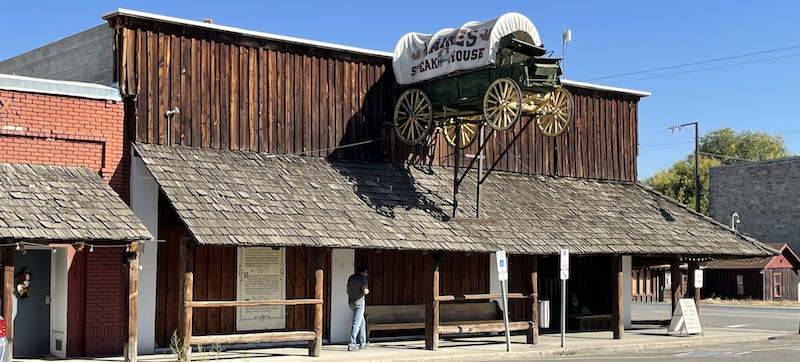
Classic steakhouse fare (and distinctive signage) at the Haines Steakhouse.

That evening we attended the annual event called Taste of Baker that shuts down Main Street for several hours and this year featured 40 local food vendors handing out samples of food and beverages to record-breaking crowds of several thousand happy attendees who spend the gorgeous fall evening eating, drinking and catching up with neighbors and friends.

Our last full day was spent with family where we gathered for lunch at local landmark Haines Steakhouse, which served up a truly spectacular prime rib and included its signature mini-Conestoga wagon holding a classic salad bar with all the fixings, one of my favorite old-time steakhouse features.

A return trip may include camping at Anthony Lakes with kayaking and fly fishing thrown in. Can't wait!
Camp Stories: Revisiting Old Haunts, Rereading Old Books

We go camping over the Fourth of July, ostensibly for our dogs who have been prone to become drooling, shivering messes if we stay in town and attempt to survive the "celebrations" of our fellow citizens that turn our normally quiet, tree-lined neighborhood into a booming, smoke-filled, fiery war zone.

No fireworks here.

Our favorite getaway spot is a small, primitive campground midway up Mt. Adams in the Gifford Pinchot National Forest. Called Paradise Creek, it's nestled in the deep old growth forest north of Carson, Washington, at the intersection of its namesake Paradise Creek and the Wind River. With no electrical hookups and rusty-but-potable water pumped from a creaky old-fashioned cast iron hand well pitcher pump, it (mostly) discourages the big rigs and generator-dependant types from rumbling through the tents and small trailers dotting the two loops. 

We realized on this trip that we've been camping there almost every year for the past 20 years with our tent and queen-sized air mattress—a step up from the backpacking tent with two zip-together down bags on insulated pads employed by our younger selves. We've gone through only two Coleman camp stoves if you don't count the white gas Coleman borrowed from my parents that had already survived 30 years of Bauer family campouts, and tents ranging from that first two-person LL Bean backpacking tent Dave had bought used from a college friend, to a Columbia Sportswear Bugaboo that Dave (at 6'4") could stand up in to our current "two-room" giant from REI that we've dubbed the Circus Tent.

Our version of "roughing it."

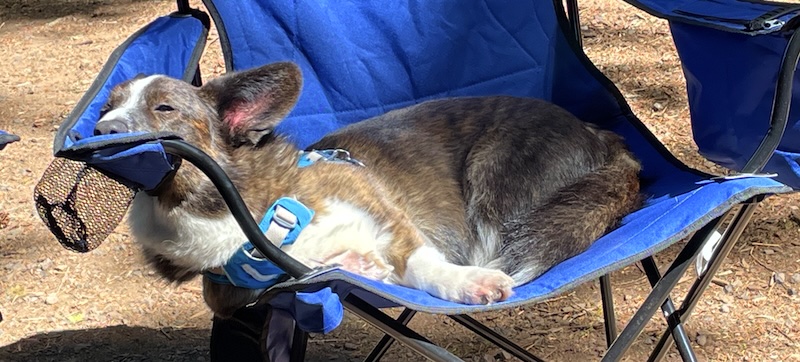
We try to snag a non-reservable, first-come, first-serve site a couple of days before the holiday, preferably along the creek, and this year we lucked into a double site* set back from the road, enabling us to listen to the creek burbling along about 50 feet down a thin thread of trail opening onto a shady private "beach," perfectly suited to a couple of camp chairs and an afternoon spent reading.

Dave wanted to finish a couple of books he'd been trying to get through for awhile, and I'd brought along the relatively recent and well-reviewed "James," a retelling of Twain's Huck Finn from the perspective of the slave Jim, by Percival Everett, which Dave had read and gave the thumbs-up to. My first choice, however, was "Angle of Repose" by Wallace Stegner, a book I'd read ages ago and remembered liking despite its intimidating 600 pages. It got me on a Stegner kick back then, so I thought I'd give it a reread.

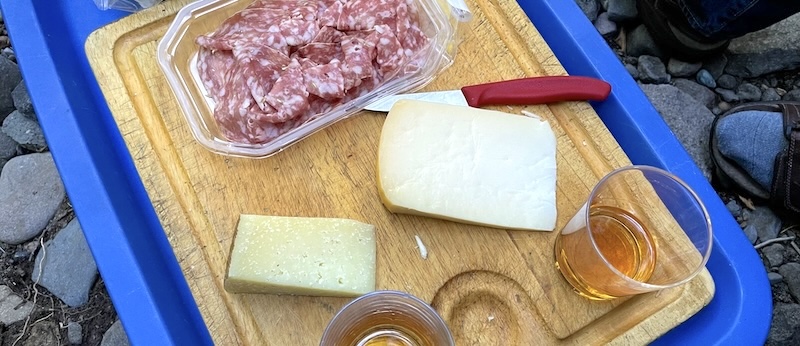
Something to warm our cockles in the evening.

It turned out to be a perfect vacation book, at least for me, a story (and a writer's voice) you get immersed in without much effort, though it's not what I'd call a light summer read. Told from the perspective of a 1970s-era retired history professor, Lyman Ward, Stegner's incredible prose and well-crafted story follows Ward's attempt to understand and document his grandmother's story of moving from a privileged East Coast society to move out West to follow her husband's itinerant career as a mining engineer.

Like many writers whose work I admire, I found myself stunned by Stegner's ability to bring people alive on the page and gobsmacked at his descriptions of places and atmosphere. For example, his description of the relationship between a writer and his characters, real or imagined, as expressed through Lyman's struggle to see and experience Susan Ward's life from her perspective:

“There is another physical law that teases me, too: the Doppler Effect. The sound of anything coming at you- a train, say, or the future- has a higher pitch than the sound of the same thing going away. If you have perfect pitch and a head for mathematics you can compute the speed of the object by the interval between its arriving and departing sounds. I have neither perfect pitch nor a head for mathematics, and anyway who wants to compute the speed of history? Like all falling bodies, it constantly accelerates. But I would like to hear your life as you heard it, coming at you, instead of hearing it as I do, a somber sound of expectations reduced, desires blunted, hopes deferred or abandoned, chances lost, defeats accepted, griefs borne.”

It's no wonder it won the Pulitzer, and got me started on a Stegner jag.


Read other Camp Stories (with more here) from our years of tent camping in the Pacific Northwest, as well as our best hacks to make it easy and fun.

* Double sites, if you're not aware, are generally intended for two or more tents and, at $45 per night, cost more than single sites. (We also can't use our National Parks Senior Pass for double sites, which halves the cost per night of a regular site.) But honestly, considering what a room rate or rental house would run, it's more than worth it.